

A European Central Bank (ECB) working paper has challenged one of DeFi’s core narratives concluding that decentralized autonomous organizations (DAOs) are far less decentralized than they claim.
The study examined governance structures across major DeFi protocols and found that token ownership and voting power are heavily concentrated among a small group of actors. In some cases, the top 100 holders controlled more than 80% of governance tokens, undermining the idea of broadly distributed control.
Less than 1% of Members on Most DAOs Have 90% Voting Power, Says Latest Chainalysis Report
DeFi-related DAOs have a giant lead accounting for 83% of all DAO treasury value and 33% of all of the DAOs by count.https://t.co/oSc9uUiCqG pic.twitter.com/5m6wUmMTZl
— BitKE (@BitcoinKE) October 2, 2022
Voting dynamics appear even more centralized.
The report notes that governance decisions are often dominated by a handful of delegates with top voters controlling large portions of decision-making power. In certain protocols, a small group accounts for the vast majority of votes while many participants remain inactive or unidentified.
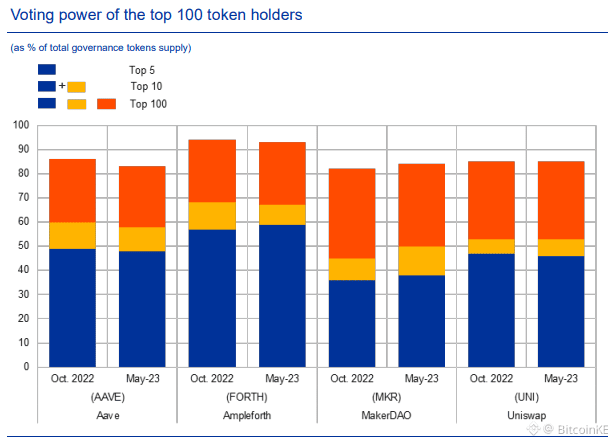
These findings raise questions about whether DAOs can truly operate without central authority. While DeFi promotes community-led governance, the reality, according to the ECB, is closer to power consolidation among insiders, large token holders, and intermediaries like exchanges.
The implications extend beyond theory. If DAOs are not ‘fully decentralized,’ they may fall within the scope of regulations such as the EU’s Markets in Crypto-Assets (MiCA) framework, which excludes only genuinely decentralized systems.
The report says:
As already highlighted, it seems that DAOs often only claim to be decentralised.
The paper goes on to highlight the Danish Financial Supervisory Authority on the suggested principles to better understand when a DAO could be considered decentralized.
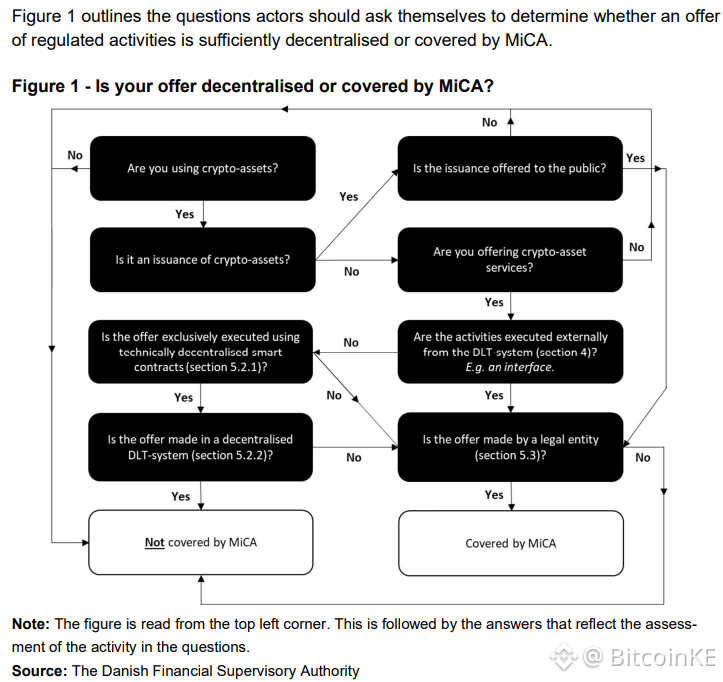
These principles are:
No identifiable controlling legal entity – A service is only “fully decentralised” if no legal person or entity controls the activity. If a company can be identified as having control, the activity is not decentralised and falls under regulation.
Control over the service is the decisive factor – The assessment focuses on who actually controls the regulated activity, not just who provides access. Simply offering an interface or gateway does not automatically mean control of the underlying service.
Decentralisation must exist across the full value chain – To qualify as decentralised, no single party should control key components, including smart contracts, protocol governance, execution of transactions, and access points (interfaces, APIs). If control exists at any critical layer, the system may be considered partially decentralised (CeDeFi) instead of fully DeFi.
Use of smart contracts is not enough – Just using blockchain or smart contracts does not make a system decentralised. If a legal entity deploys, controls, or can modify the smart contracts, then the activity is not fully decentralised.
Ongoing ability to influence or intervene matters – If any party can upgrade contracts, pause the system,and change parameters, then that indicates centralised control. True decentralisation requires no unilateral intervention power.
Governance must be genuinely distributed – Decision-making should not be concentrated in a founding team, a foundation, or a small group of token holders. Governance mechanisms must reflect real dispersion of power, not just formal structures.
Access should not depend on a central intermediary – Users should be able to interact with the system directly on-chain. If access depends on a company-run frontend, or controlled infrastructure, this weakens decentralisation.
Distinction between CeFi, CeDeFi, and DeFi – The document emphasizes a spectrum:
> CeFi → fully controlled by a legal entity
> CeDeFi → partially decentralised but still controlled
> DeFi → no controlling entity at all
Only the last category qualifies as outside MiCA scope
Ultimately, the paper suggests that DeFi governance may resemble traditional finance more than its branding implies raising fresh concerns about transparency, accountability, and how regulators should approach the sector.
Less than 1% of Members on Most DAOs Have 90% Voting Power, Says Latest Chainalysis Report
Stay tuned to BitKE for deeper insights into the crypto regulatory space.
Join our WhatsApp channel here.
Follow us on X for the latest posts and updates
Join and interact with our Telegram community
_________________________________________