
I’ve clicked “trust this site” more times than I can remember. Sometimes it’s approving a wallet connection, sometimes it’s signing a message I barely read, sometimes it’s just assuming that because something looks familiar, it’s safe enough.
Nothing breaks most of the time. The action goes through, the interface responds, and I move on.
But every now and then, there’s a pause. A small moment where I wonder what exactly I just agreed to. Not in a dramatic way, just a quiet uncertainty that passes quickly because the system doesn’t really give me a better option.
At first, I thought that was just part of using digital systems. You can’t verify everything manually, so you rely on interfaces, reputation, and a bit of habit.
But after repeating this enough, it starts to feel less like trust and more like assumption.
At that moment, I realized digital trust isn’t really solved. It’s deferred. Systems don’t always prove they’re trustworthy, they just reduce the friction enough that you stop questioning them.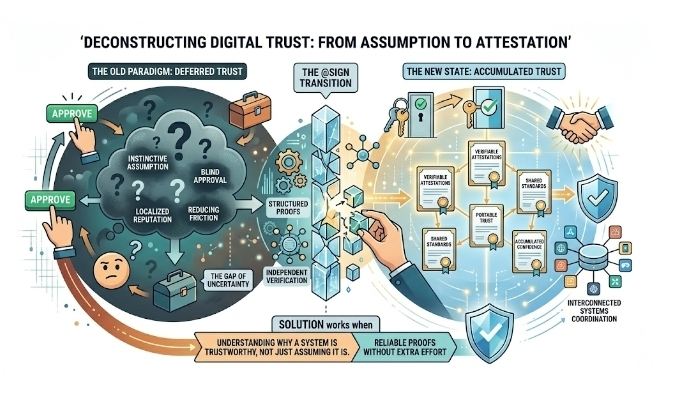
That gap is where I find myself thinking about @SIGN again. Not as a solution in the absolute sense, but as an attempt to structure trust into something more explicit.
If I try to put it simply, it’s about turning claims into verifiable attestations. Instead of relying on vague signals like “this looks legitimate” or “this platform is known,” you get structured proofs that something has been checked or confirmed.
You don’t just trust the interface, you rely on a statement that can be verified independently.
Initially, I thought this felt like over-engineering. Most users don’t ask for this level of clarity. They interact based on convenience, not verification layers. Adding more structure might actually make things feel heavier, not lighter.
But I don’t think the current model scales cleanly. At least not as systems become more interconnected.
What I find interesting is that trust today is often local. You trust a specific platform, a specific app, a specific interaction. But that trust doesn’t carry well across contexts. Every new environment resets the process.
Upon reflection, that’s where something like @SIGN starts to matter. Not because it replaces trust, but because it makes parts of it portable. A verified claim in one place can be reused somewhere else without needing to rebuild confidence from zero.
If it works, trust becomes less about constant re-evaluation and more about accumulated proof.
That changes how systems coordinate. Instead of relying on isolated reputations, they can reference shared attestations. Cross-chain interactions don’t feel like stepping into unknown territory every time. The user experience becomes less dependent on blind approval.
But I don’t think this is easy to implement. At least not yet.
Because trust isn’t just technical. It’s behavioral. People are used to moving quickly, skipping details, relying on patterns. Even if better verification exists, it doesn’t mean it will be used properly.
There’s also the issue of fragmentation. If different platforms issue different kinds of attestations without shared standards, the system risks becoming just another layer of complexity rather than a unifying one.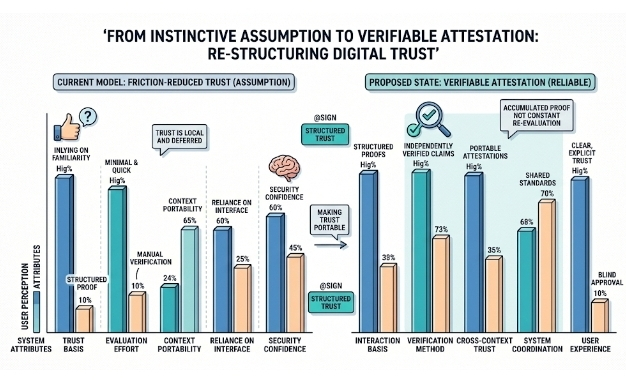
Right now, I’m still watching how this develops. I hold a small amount of $SIGN, mostly to stay close to the idea as it evolves. But I’m not fully convinced. I’ve seen too many attempts to “fix trust” that end up shifting the problem rather than resolving it.
But I keep coming back to a simple condition.
The solution works when I stop relying on instinct and interface cues, and start relying on clear, reusable proofs without extra effort. When I can interact with a system and understand why it’s trustworthy, not just assume that it is.
No second-guessing after the fact. No quiet uncertainty in the background.
If that becomes the default experience, then digital trust might actually move from assumption to something more concrete.
Until then, it still feels like we’re trusting systems in ways we don’t fully see.
@SignOfficial #SignDigitalSovereignInfra $SIGN
