
The more I think about trust systems in crypto, the more I feel they rarely collapse in the dramatic way people expect.
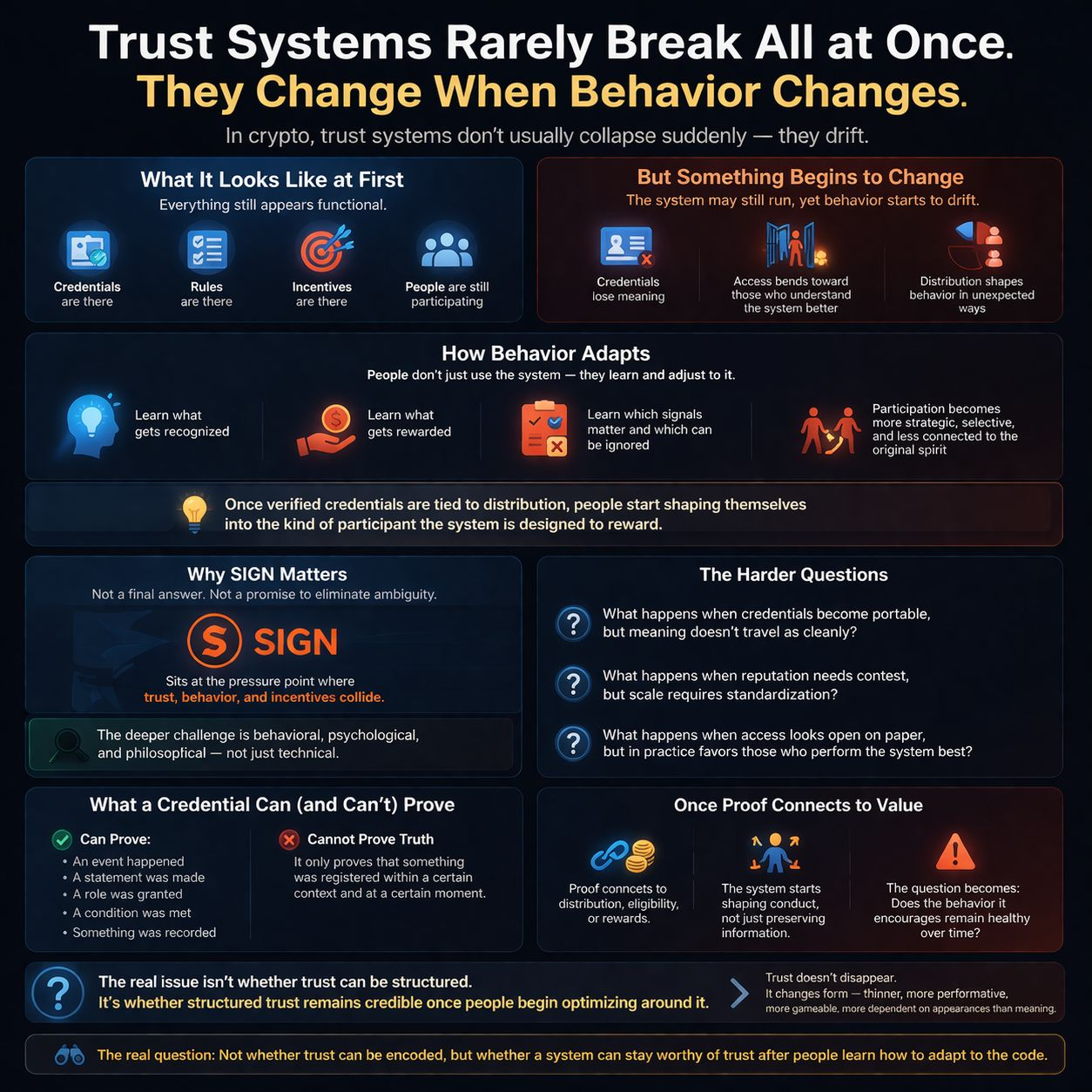
Most of the time, they do not fail all at once.
They drift.
At first, everything still looks functional.
The credentials are there.
The rules are there.
The incentives are there.
People are still participating.
But something begins to change underneath.
The system may still be running, yet the behavior inside it starts to feel different. The article that stayed with me captured this very well by arguing that many digital systems do not fall apart loudly. They begin to weaken when credentials lose meaning, access starts bending toward those who understand the system better than others, and distribution gradually shapes behavior in ways that were not obvious at the start.
That distinction matters.
Because in systems built around trust, the real danger is not only failure.
It is adaptation.
The moment incentives become strong enough, people do not simply use the system.
They begin to adjust themselves around it.
They learn what gets recognized.
They learn what gets rewarded.
They learn which signals matter and which ones can be ignored.
And over time, that changes the character of participation.
What looked like honest engagement at the beginning can slowly become strategic behavior. Not necessarily malicious. Not necessarily fraudulent. But more optimized, more selective, and less connected to the spirit of the system than it first appeared. The article makes a similar point when it says that once verified credentials are tied to distribution, people do not just try to earn value; they start shaping themselves into the kind of participant the system is designed to reward.
That is one reason I find SIGN interesting.
Not because it feels like a final answer to trust.
And not because it promises to eliminate ambiguity.
What makes it worth watching is that it sits very close to the point where trust, behavior, and incentives begin to collide. The article explicitly frames the deeper challenge here as behavioral, psychological, and even philosophical, rather than merely technical. (binance.com)
To me, that is a much more important place to look.
Because trust systems are rarely tested when everything is clean and calm.
They are tested when participants begin responding to incentives in ways the designers did not fully anticipate.
That is when the harder questions start appearing.
What happens when credentials become portable, but meaning does not travel as cleanly as the credential itself?
What happens when reputation needs context, but scale requires standardization?
What happens when access looks open on paper, but in practice favors those who understand how to perform the system best?
These are not small questions.
They go to the center of what trust actually means.
A credential can show that something was recorded.
It can show that an event happened, that a statement was made, that a role was granted, or that a condition was met. The article is very clear on this point: a credential does not automatically prove truth. It proves that something was registered within a certain context and at a certain moment. (binance.com)
And that is where the tension begins.
Because once recorded proof starts connecting to distribution, eligibility, or rewards, the system is no longer only preserving information. It starts shaping conduct. The article repeatedly returns to this idea, arguing that trust infrastructure becomes much more consequential once it begins influencing who receives value, who gets access, and how users adapt their behavior to fit recognized patterns. (binance.com)
That does not make the system bad.
But it does make it serious.
It means the question is no longer just whether the infrastructure works.
It becomes whether the behavior it encourages remains healthy over time.
And to me, that is the deeper reason these systems deserve more careful attention.
The real issue is not simply whether trust can be structured.
It is whether structured trust remains credible once people begin optimizing around it.
Because that is usually how systems mutate.
Not when users leave.
Not when features stop functioning.
But when honest participation no longer feels like the most rational strategy.
That is the point where trust does not disappear.
It changes form.
It becomes thinner.
More performative.
More gameable.
More dependent on appearances than on meaning.
And once that happens, a system can still look alive while quietly becoming weaker.
That is why I do not find SIGN interesting as a simple trust narrative.
I find it interesting as a pressure point.
A place where crypto is being forced to confront a harder truth: trust systems are not judged only by how well they record reality. They are judged by how human behavior changes once reality becomes something people can learn to perform. The article ends in a very similar spirit, suggesting that what makes SIGN worth watching is not that it solves trust, but that it exposes where trust systems start bending under incentive pressure.
And maybe that is the more important question going forward.
Not whether trust can be encoded.
But whether a system can stay worthy of trust
after people learn how to adapt to the code.
#SignDigitalSovereignInfra $SIGN
