
I used to think holding something was the same as having access to it. If a token sat in my wallet, that was the end of the story. Ownership felt complete, almost static. You have it, or you don’t.
But lately, that assumption doesn’t hold the same way.
I’ll open an app where I clearly hold the required asset, but still can’t do what I expected. There’s another layer. Maybe it’s staking, maybe it’s delegation, maybe it’s some prior interaction I didn’t complete. The asset is there, but the system is looking for something else.
At first, it feels confusing. Almost like the rules changed without notice. But after seeing it repeat, the pattern becomes clearer.
At that moment, I realized systems aren’t really centered around ownership anymore. They’re shifting toward state.
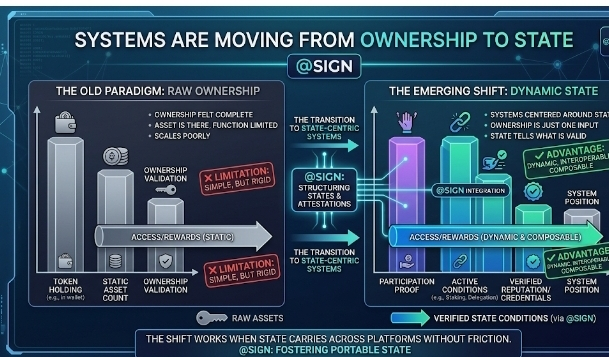
Ownership is just one input. What matters more is the condition attached to it. Not just what you hold, but what you’ve done, what you’ve proven, what position you’re currently in.
That shift is subtle, but it changes how everything behaves.
It’s also where something like @SIGN starts to make more sense to me. Not as a tool for tracking ownership, but as a way to structure these states in a form that can actually move between systems.
If I simplify it, instead of treating assets as the primary source of truth, the system allows claims or attestations to represent your current state. You didn’t just hold a token, you participated in something. You didn’t just exist in the system, you reached a condition that can be verified.
Initially, I thought this was just layering more abstraction on top of something that already works. Ownership is simple. You can check it instantly. Why complicate that with additional states?
But I don’t think ownership scales cleanly across more complex interactions. At least not in the way systems are evolving.
What I find interesting is that ownership is static, while state is dynamic. Ownership tells you what exists. State tells you what’s currently valid.
Upon reflection, most systems already rely on state more than they admit. Access, rewards, permissions… they’re rarely based on raw ownership alone. There’s always an additional condition, even if it’s hidden behind the interface.
If @SIGN works the way it’s aiming to, those conditions stop being isolated. A verified state in one place can become usable somewhere else. Instead of every application recalculating your position from scratch, they can rely on a shared representation of it.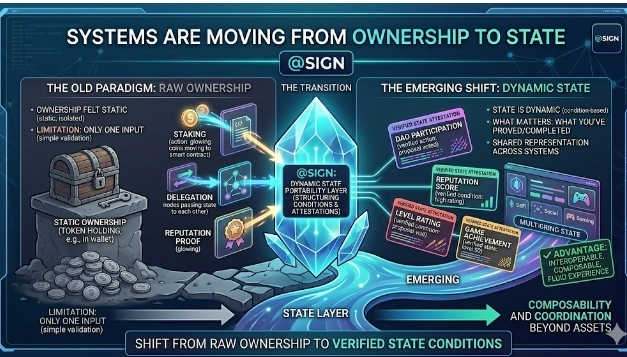
That’s where things start to shift.
Composability becomes less about assets moving between chains and more about states being recognized across them. Coordination becomes easier because systems are referencing the same signals instead of rebuilding them. The user experience becomes less repetitive, even if the underlying logic is more complex.
But I don’t think this transition is smooth. At least not yet.
Because state is harder to standardize than ownership. A token balance is clear. A condition or participation state can mean different things depending on who defines it. Without shared interpretation, portability breaks down.
There’s also the question of incentives. Some platforms benefit from keeping their own definition of state rather than relying on an external one. Fragmentation doesn’t disappear just because a better structure exists.
Right now, I’m still observing how this plays out. I hold a small amount of $SIGN, mostly to stay connected to the direction it’s taking. But I’m not fully convinced. Systems that try to sit between multiple layers often struggle to get consistent adoption.
But I keep coming back to one simple test.
The shift to state works when ownership stops being the main thing I check. When I move across platforms and what matters is not what I hold, but what I’ve already proven or completed, and that information carries without friction.
No repeated actions, no rebuilding context from zero.
If I can rely on my state the same way I used to rely on ownership, then something real has changed.
Until then, it still feels like we’re in between. Holding assets in one layer, while quietly rebuilding our state in another.
@SignOfficial #SignDigitalSovereignInfra $SIGN
