
i will be honest. For a long time, i thought this was a binary choice.
public blockchain or private CBDC. pick one. commit. move on.
But the more i looked at how governments are actually building this, the more i realized that framing was completely wrong. once i saw it clearly i could not unsee it.

Here’s what i think most people miss.
dfferent government services need different kinds of infrastructure. Take social benefit payments privacy matters. our transaction history should not be exposed to everyone. But for public procurement or government spending transparency is the whole point. anyone should be able to check where the money went and why.
one system can’t do both well. That’s not a design flaw. It is just how the problem works.
So what o see governments moving toward is running both systems side by side. Each one handles what it was built for.
The public blockchain handles the transparent side. Public services. open auditing. Verifiable records that anyone can inspect. i think of this as the accountability layer the part that makes governments answerable to citizens by default not by request.
Then there Hyperledger Fabric running a CBDC on the private side. That’s where banking operations live. Regulated financial flows. Controlled access. Programmable compliance built in from the start. Central banks can actually work with this because it gives them the tools they are required to have under existing financial law.
Both systems run at the same time. We use whichever fits our situation. Infrastructure risk gets spread across two separate setups. And when regulations shift because they always do neither system collapses under pressure, because neither one is trying to do everything alone.
What i find useful is the thinking about this a decision framework instead of a debate.
Match the use case to the right tool. Transparent public services go on public blockchain. Private banking operations go on the CBDC layer. International trade and cros-border payments can sit on either side
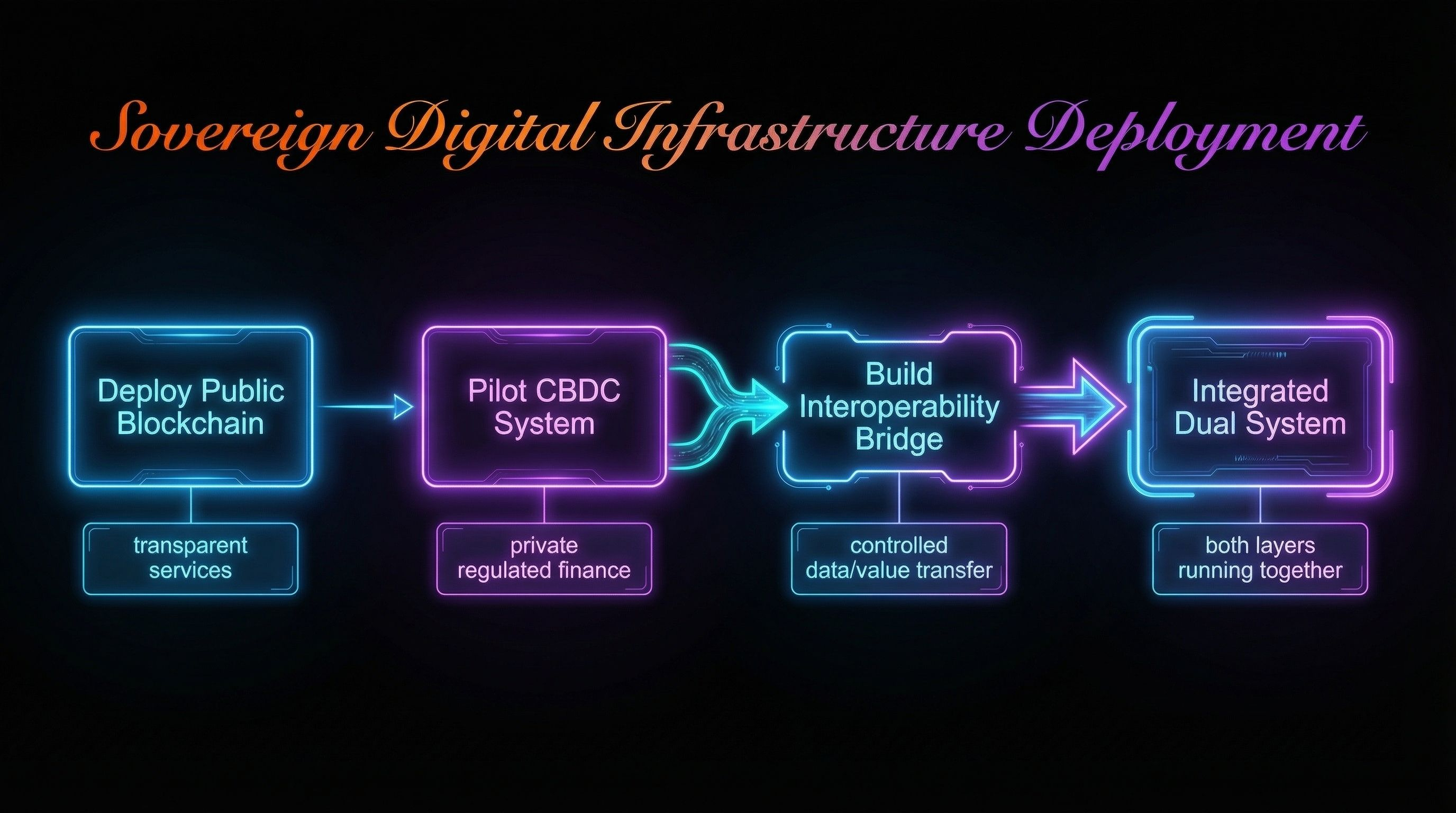
depending on what the transaction needs. Social benefits can go either way too. Sometimes privacy matters more. Sometimes auditability does. The framework lets governments decide case by case instead of forcing every service through the same pipeline.
The deployment itself follows a logical sequence that I think makes the whole thing less intimdating than it sounds.
First, put the public blockchain infrastructure in place. Get the transprent layer running. Let it handle real public service use cases from day one.
Second, pilot the CBDC for specific financial applications where privacy and regulation are non negotible.
Third, build a bridge between both systems so value and data can move in a controlled way across the two layers.
Fourth, run the full ecosystem as an integrated sovereign digital currency infrastructure.
Four stages. Each one building on the last. No single point of failure. No philosophical commitment to one blockchain approach over another.
What I take from studying this is simple.
The governments getting this right are not debating which blockchain is philosophically superior. They are identIfying what each service actually needs and matching it to the system built for that need. That is the whole strategy. and honestly that is just good infrastructure thinking dressed in new technology.
#signdigitalsovereigninfra $SIGN
@SignOfficial #SignDigitalSovereignInfra