
I keep and I’ve noticed how often I hit invisible walls now. You open a platform and everything looks accessible at first. Then you try to actually do something and it pauses you. Connect wallet. Hold a certain token. Be in a specific region. Complete some prior step you didn’t know existed.
It’s rarely a hard “no.” It’s more like a quiet condition you didn’t realize was there until you ran into it.
At first, I assumed this was temporary. Maybe early-stage friction, maybe just poor design. But it keeps showing up in different places, in slightly different forms. And after a while, it stops feeling accidental.
At that moment, I realized access isn’t really open anymore. It’s conditional. Not in an obvious way, but in layers that sit just beneath the surface.
The system isn’t asking “are you here?” It’s asking “do you qualify?”
That shift is subtle, but it changes how everything works. Because once access depends on conditions, those conditions need to be verified. And verification, in most cases, still means repeating the same steps across different platforms.
That’s usually where I find myself circling back to @SIGN. Not because it removes conditions, but because it tries to structure how those conditions are proven.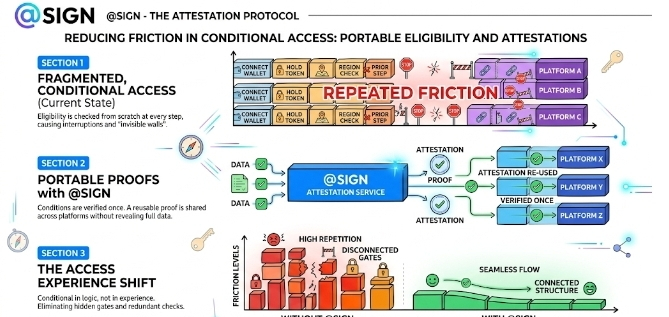
If I understand it in simple terms, it turns eligibility into attestations. Instead of each platform checking requirements from scratch, a condition can be verified once and expressed as a reusable proof. You don’t show all your data again, you show that you meet the requirement.
Initially, I thought this just adds another layer. Another system sitting between the user and access. And in a space already full of layers, that felt unnecessary.
But I don’t think it’s about adding complexity. At least not in the way it first appears.
What I find interesting is how it reframes access itself. If conditions are inevitable, then the real question becomes how those conditions are handled. Right now, they’re fragmented. Each platform defines and verifies them independently.
Upon reflection, that fragmentation is where most of the friction comes from. Not the condition itself, but the repetition behind it.
If something like @SIGN works as intended, conditions don’t disappear, but they become portable. You meet a requirement once, and that proof carries forward. Different applications can read it without forcing you to restart the process every time.
That changes the experience in a quiet way. Access still isn’t open, but it stops feeling constantly interrupted.
And it goes a bit further than that. If multiple systems rely on the same underlying proofs, coordination becomes easier. Cross-chain interactions don’t require rebuilding trust from zero. Applications don’t need to duplicate verification logic. The structure starts to feel more connected, even if the surface remains fragmented.
But I don’t think this resolves everything. At least not yet.
Because conditional access also depends on who defines the conditions. And those definitions can vary widely. One platform’s requirement might not align with another’s. Without shared standards, portability only goes so far.
There’s also the question of incentives. Platforms may prefer to control their own verification flows rather than rely on external proofs. Trust isn’t just technical, it’s strategic.
Right now, I’m somewhere in between observing and testing. I hold a small amount of $SIGN, mostly to stay close to how this idea evolves. But I’m not fully convinced. Systems that aim to sit in the middle of everything often struggle to get everyone on the same page.
Still, I keep coming back to a simple condition.
The system works when access feels conditional in logic, but not in experience. When I meet a requirement once, and that state follows me without needing to be re-proven in every new context.
No repeated checks, no hidden gates appearing late in the process. Just a clear signal that carries across systems.
If that becomes normal, then conditional access stops feeling like friction and starts feeling like structure.
Until then, it still feels like we’re dealing with conditions that exist everywhere, but don’t connect anywhere.
@SignOfficial #SignDigitalSovereignInfra $SIGN
