
There’s a pattern I’m starting to recognize in how I move.
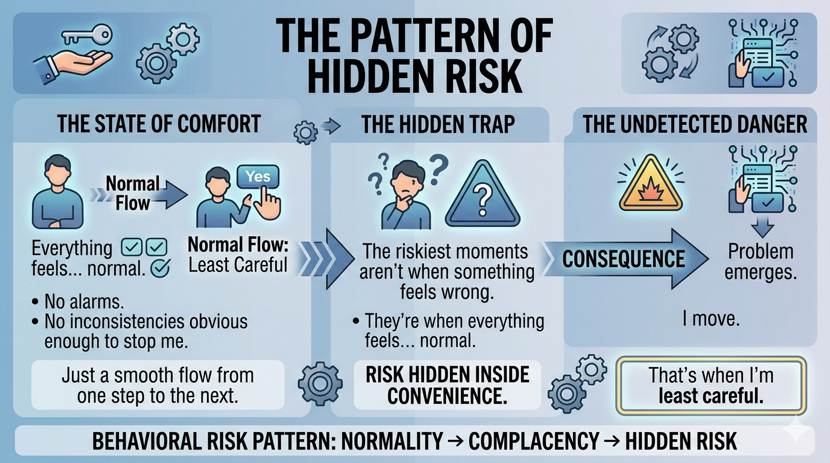
The riskiest moments aren’t when something feels wrong.
They’re when everything feels… normal.
No alarms.
No inconsistencies obvious enough to stop me.
Just a smooth flow from one step to the next.
That’s when I’m least careful.
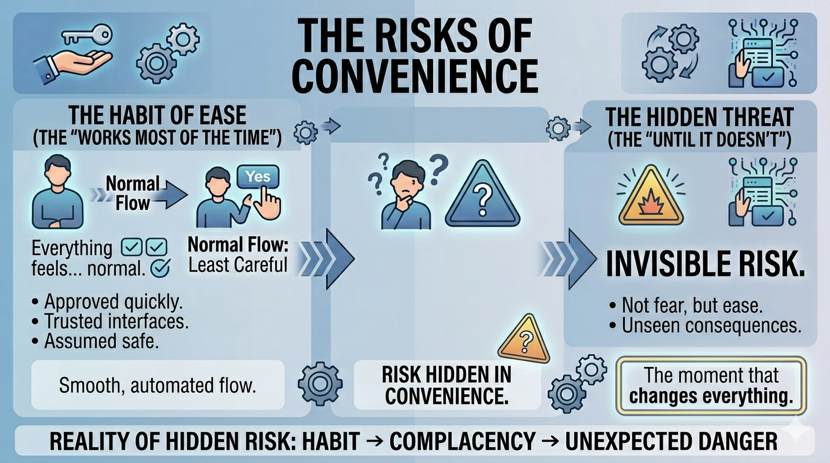
I’ve approved things quickly.
Trusted interfaces without thinking.
Assumed that if nothing looked broken, nothing was broken.
And most of the time, that works.
Until it doesn’t.
The strange part is how invisible that risk is.
It doesn’t show up as fear.
It shows up as convenience.
That’s what made me pause when thinking about Sign.
Not what it promises…
but what it quietly challenges.
Because if verification becomes stronger…
those “normal” moments start to look different.
Less automatic.
More deliberate.
And I’m not sure I like that.
There’s a certain comfort in speed.
In not questioning every step.
In moving forward based on familiarity instead of proof.
I’ve gotten used to that.
Probably more than I should.
But I’ve also seen how fragile that comfort is.
A small inconsistency.
A delayed update.
A mismatch that forces you to retrace everything.
And suddenly, that smooth experience feels misleading.
So now I’m caught between two states.
One where things are fast but slightly uncertain.
Another where things could be more certain… but heavier.
I don’t know which one people actually prefer when it matters.
Sign seems to lean toward the second.
Toward making things provable, consistent, harder to misinterpret.
But that comes with trade-offs.
Even if they’re subtle.
And I keep thinking about this:
Most people don’t notice risk when it’s hidden inside convenience.
They only notice it after something goes wrong.
So how do you build something for a problem people don’t actively feel?
That’s where my uncertainty sits.
Not in whether the idea makes sense.
But in whether the timing aligns with behavior.
I can see the need.
I’ve probably experienced it more than I realize.
But I’ve also ignored it just as often.
And that makes me question how this actually gets adopted.
Not theoretically.
But in real, everyday usage.
I don’t have a conclusion here.
Just a growing awareness that some of the “safe” moments I rely on…
might not be as safe as they feel.
If that awareness spreads, maybe things change.
If it doesn’t…
then this remains a solution waiting for a problem people haven’t fully acknowledged yet.
I’m paying attention to that gap.
It feels small.
But it might matter more than it looks.
#SignDigitalSovereignInfra @SignOfficial $SIGN
