I wasn’t even planning to read anything tonight. Just opened my phone to check if something nuked or pumped while I was offline. Same routine. Same empty scrolling. And somehow I ended up staring at another “infrastructure” project again. SIGN this time. Credential verification. Token distribution. Sounds like something that should’ve been solved three cycles ago, but here we are… still pretending it’s new.
That’s kind of the pattern now. Every cycle pretends to be revolutionary, but if you zoom out, it’s the same problems wearing new clothes. This time it’s AI narratives glued onto blockchains that still choke when too many people show up. Before that it was DeFi everything. Before that NFTs were going to redefine ownership. And yet, here we are, still struggling with something as basic as figuring out who deserves what on-chain.
Airdrops alone have turned into this weird meta-game. It’s not about participation anymore. It’s not even about being early. It’s about who can fake being early the best. Wallet farms, scripts, fake engagement loops. Entire ecosystems built around pretending to be a real user. And the worst part? It works. Projects end up rewarding ghosts while actual users either get diluted or ignored completely.
So when something like SIGN shows up, I don’t get excited. I just pause a little longer than usual.
Because it’s not flashy. It’s actually kind of boring. And boring in crypto is dangerous. Either it means it’s quietly important… or it means nobody will care enough to use it.
The idea itself is simple in theory. A global layer for verifying credentials and distributing tokens accordingly. Basically trying to answer a question that the space keeps dodging: how do you prove someone is eligible for something without exposing everything about them?
That sounds obvious until you realize how broken the current system is. Right now it’s either fully anonymous chaos or overly rigid systems that nobody wants to interact with. There’s no clean middle ground. Either you trust nothing or you reveal too much. And both options suck in their own way.
SIGN is trying to sit in that uncomfortable middle. Attestations, credentials, on-chain proofs… all the stuff that sounds clean on paper but gets messy the moment real users show up. Because users don’t behave like whitepapers assume. They’re lazy, opportunistic, and most of the time they just want free tokens without thinking too hard about how things work.
And honestly, I can’t even blame them. The space trained them this way.
What’s interesting is that SIGN isn’t really alone here. There are other players circling the same problem. Identity layers, reputation protocols, proof-of-humanity systems. Everyone’s trying to fix Sybil attacks in their own way. Some lean into biometrics, some into social graphs, some into zero-knowledge proofs. Different approaches, same headache.
But the thing is, most of these solutions quietly die not because the tech fails… but because nobody actually integrates them.
That’s the part people don’t like talking about. Infrastructure doesn’t matter unless someone builds on top of it. And building on top requires incentives, not just good intentions.
SIGN seems to understand that at least on some level. It’s not just about verifying identity for the sake of it. It’s tied directly to token distribution, which is where the real incentives are. Airdrops, rewards, access control… that’s where projects actually care. Because money forces behavior in a way ideology never will.
And if I’m being honest, that’s probably their strongest angle. Not “we’re solving identity,” but “we’re fixing who gets paid.”
Because right now, distribution is broken. Liquidity gets scattered across wallets that don’t care. Tokens end up in the hands of people who dump instantly. Communities get diluted before they even form. And then everyone acts surprised when the project dies two months later.
But even if SIGN gets this part right… there’s still the bigger problem. Scale.
Crypto doesn’t break because of bad ideas. It breaks because too many people show up at once. We’ve seen it over and over. Chains slow down, fees spike, UX collapses. It’s not the theory that fails, it’s the pressure.
So I keep wondering… what happens if something like SIGN actually works? Not in a testnet environment. Not in a controlled rollout. But in a real scenario where millions of users suddenly need credentials verified at the same time.
Does it hold? Or does it become another bottleneck?
Because adding another layer to the stack doesn’t remove complexity. It shifts it. Now instead of just interacting with a protocol, users have to deal with attestations, proofs, verification layers. Even if it’s abstracted, the complexity is still there underneath.
And abstraction only works until something goes wrong.
There’s also the question of trust. Not in the usual centralized vs decentralized sense, but in a more subtle way. Who issues these credentials? Who verifies them? What happens when different issuers have conflicting standards?
Because the moment you introduce credentials, you introduce authority. Even if it’s decentralized authority, it’s still a form of gatekeeping. And crypto historically doesn’t handle gatekeeping very well.
People say they want fairness, but what they really want is advantage. The second a system becomes harder to game, a portion of users just moves somewhere else where it’s easier.
So adoption becomes this weird balancing act. Too strict, and users leave. Too loose, and the system gets abused. There’s no perfect setting.
And then there’s the investor side of things, which is its own mess. Infrastructure projects don’t get the same attention as narrative-driven ones. You can’t meme “credential verification” the same way you can meme AI or gaming or whatever the trend of the month is.
So even if SIGN builds something genuinely useful, it still has to survive in a market that rewards noise over substance. Liquidity flows to stories, not systems. And right now, the loudest stories are still elsewhere.
But maybe that’s also why this feels a bit different.
It’s not trying to be loud. It’s just… there. Sitting in the background, trying to fix something that everyone knows is broken but nobody really wants to deal with.
And I kind of respect that, even if I’m not convinced.
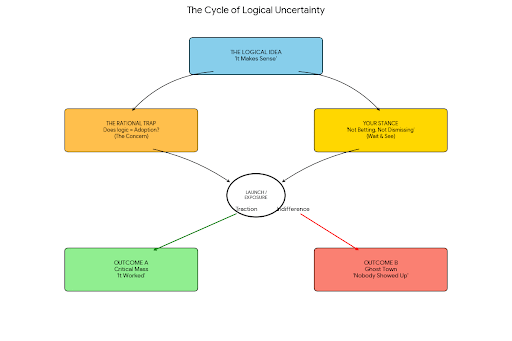
Because I’ve seen this before. Solid ideas that make perfect sense logically… and then just fade away because they never reach that critical mass of usage. Not because they failed, but because they never got the chance to matter.
Crypto has this brutal filter. It’s not enough to be right. You have to be adopted. And adoption doesn’t always go to the best solution. It goes to the one that aligns with incentives, timing, and sometimes just pure luck.
So where does that leave something like SIGN?
Somewhere in that gray zone between necessary and ignorable.
If enough projects start using it for distribution, it could quietly become a standard. Not something people talk about, but something they rely on. Like plumbing. Invisible, but essential.
Or it could just remain another well-designed layer that nobody integrates because it’s easier to keep doing things the broken way.
And honestly, both outcomes feel equally possible right now.
I keep coming back to the same thought… crypto doesn’t have a technology problem anymore. It has a behavior problem.
We know how to build. We just don’t know how to make people use things the way they’re supposed to be used.
SIGN is trying to nudge behavior in a better direction. Reward the right users. Filter out the noise. Make distribution fairer.
That’s a good goal.
But good goals don’t guarantee anything here.
Maybe it becomes part of the backbone of the next cycle. Maybe it quietly powers systems that people don’t even realize they’re using.
Or maybe it just sits there, technically correct, waiting for a world that never fully shows up.
I don’t know.
It makes sense. That’s what bothers me the most.
And in this space, things that make too much sense usually have the hardest time surviving.
Still… I’m not dismissing it.
I’m just not betting on it either.
It might work.
Or nobody shows up.