
@MidnightNetwork #NIGHT $NIGHT
My portfolio is in a weirdly perfect balance right now—mostly because both my $XAU (physical gold) and $BTC (digital gold) are getting liquidated at the same time. 😂
But jokes aside, I’ve seen enough network launches to know that "decentralization" is often just a fancy marketing label rather than a Day One reality. To be fair, Midnight is refreshingly honest about this. They aren’t hiding the fact that the Midnight Foundation and Shielded Technologies are the ones holding the steering wheel for now.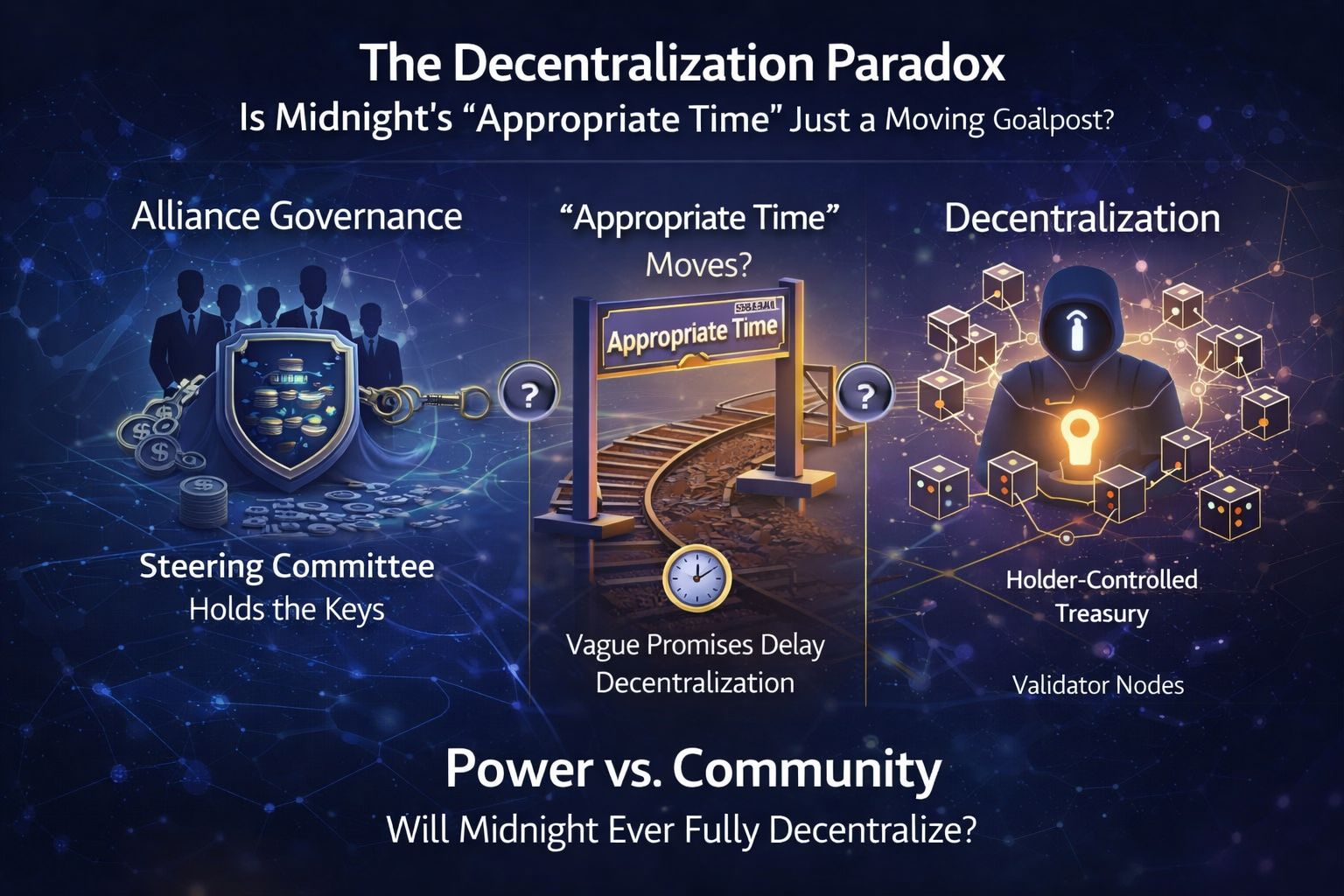
Honestly? It’s a smart move. A privacy-focused network needs a steady hand during its infancy to avoid the chaotic governance mess that has killed even bigger projects. The "promised land" is moving from this "Alliance Governance" to a fully decentralized on-chain system. But this is where the air gets thin and the real questions start piling up.
The core tension here isn't the code—it’s human nature and the thirst for power.
The whitepaper talks about a phased approach where the Alliance Committee eventually hands the keys over to $NIGHT holders. They call it the "appropriate time." In the crypto world, "appropriate time" is a dangerous phrase. It’s a vague horizon that can keep moving further away as long as the status quo feels comfortable for those in charge.
Look at the Treasury, for example. It’s a massive pool of $NIGHT tokens meant to fund the future of the ecosystem. Right now, the community doesn't have a vote on how that money is spent. The Foundation decides. While I trust their expertise for now, there’s a massive transparency gap. Who exactly is on this committee? What are their terms? How do they handle conflicts of interest? If a member wants to fund a project they’re personally invested in, where’s the check and balance?
It’s a huge paradox for a project built on "Rational Privacy." The protocol is designed to give users control over what they reveal, yet the governance itself stays mostly in the dark. We’re basically being asked to trust a centralized group to eventually build a system that makes them obsolete. It’s a "just trust me" bridge in an industry that’s supposed to be "trustless."
The stakes are high because Midnight isn't just another random token. It’s trying to be the compliance-friendly privacy layer for the whole digital economy. If governance stays centralized for too long, those "selective disclosure" features could easily become a tool for the stewards instead of the users. A committee that can tweak things behind closed doors is a committee that can be bullied by outside forces.
I really want to believe in the Mohalu and Hua phases. I want to see the validator set grow and the on-chain Treasury go live. But history tells us that once people get a taste of power, they rarely give it up willingly.
The jump from "Alliance" to "Decentralized" is Midnight’s toughest engineering challenge, and it has nothing to do with programming. It’s a test of whether the founders' commitment to freedom is stronger than their urge to stay in control.
If that "appropriate time" isn't defined by clear, measurable milestones, does the Alliance Committee eventually become the very thing Midnight was supposed to protect us from?