
@SignOfficial #SignDigitalSovereignInfra
Digital systems are rapidly becoming the foundation of how countries manage identity, distribute resources, and build trust between institutions and citizens. Yet one major challenge remains unresolved across much of the world: how can governments and organizations verify people fairly, protect privacy, and distribute benefits without creating inefficiency or abuse? This is where $SIGN introduces a new kind of infrastructure—one designed not simply for blockchain users, but for entire national systems that need reliable digital trust.
At its core, this infrastructure is built around verifiable credentials. A credential can represent identity, eligibility, education, business registration, social support status, or any officially recognized qualification. Instead of storing this information in isolated databases controlled by separate institutions, the system allows credentials to be issued in a standardized format that can be verified across departments, agencies, and even borders. This creates a common digital language where trust does not need to be rebuilt every time data moves from one institution to another.
One of the strongest aspects of this model is digital sovereignty. Many countries today rely heavily on foreign platforms or fragmented internal systems to manage sensitive citizen information. A national credential framework built on $SIGN allows governments to keep authority over their own data standards while still benefiting from open verification methods. Each ministry, public agency, or partner organization can issue credentials under one unified framework while preserving legal control at the national level. This means a country can modernize public infrastructure without surrendering ownership of its digital identity systems.
Blockchain plays a critical role here, but not in the way many people imagine. Sensitive personal data is not simply placed openly on-chain. Instead, blockchain acts as a verification layer—a place where proofs, timestamps, and issuance records can be anchored so that authenticity becomes tamper-resistant. This creates transparency because any authorized verifier can confirm whether a credential is genuine, while the underlying personal details remain protected through controlled access methods.
That privacy protection becomes even stronger through zero-knowledge proof design. In practical terms, this means a person can prove they qualify for something without exposing unnecessary information. Someone could demonstrate eligibility for a subsidy, a grant, or a restricted program without revealing their full identity file. This changes how trust works: verification becomes precise, while unnecessary exposure is reduced. In large public systems, this matters because privacy failures often create distrust even when technology itself is strong.
Hybrid storage also becomes essential in this model. Full national-scale data cannot realistically live only on-chain because of cost, speed, and legal sensitivity. Instead, critical proof references are stored on-chain, while larger credential records remain in secure off-chain environments managed under national or institutional control. This balance allows scalability without sacrificing accountability. Governments can maintain compliance requirements while still benefiting from cryptographic verification.
The economic impact of such infrastructure could be significant. In many countries, benefit distribution suffers from duplicate records, delayed verification, and exclusion errors. If eligibility credentials are issued accurately and updated transparently, token-based or digital asset distribution becomes more precise. Aid programs, youth grants, educational incentives, agricultural support, and emergency funding can all move through systems where qualification is verified automatically before distribution happens. This reduces administrative friction and can increase public confidence.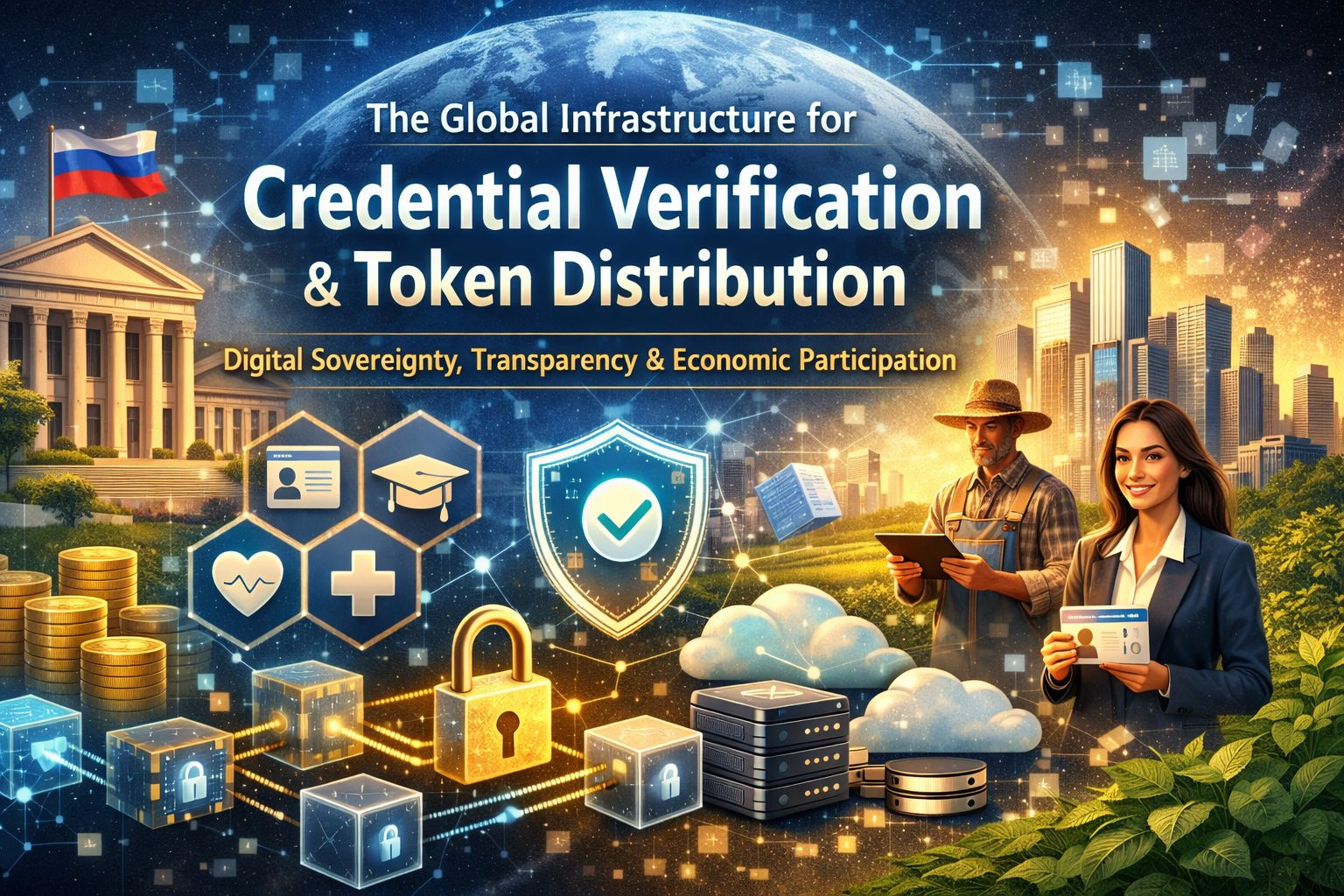
A second national-level effect is broader economic participation. Millions of people remain partially excluded from digital finance because they cannot easily prove status, ownership, or eligibility across systems. Verifiable credentials connected to trusted issuance can allow individuals and businesses to participate more directly in modern digital economies. A small business, for example, could prove licensing, tax standing, and regional eligibility without repeating documentation at every stage.
Still, infrastructure of this scale also introduces real risks. If poorly designed, central control can become too strong, allowing institutions to over-concentrate authority over who receives access or recognition. Privacy protections must therefore remain enforceable, not optional. Governance around issuance, revocation, and auditability must be transparent enough that public trust is maintained over time. Technology alone cannot solve institutional imbalance; it only provides stronger tools.
A realistic example helps explain this better. Imagine a government launching agricultural assistance for farmers after severe flooding. Instead of collecting paper claims repeatedly through local offices, farmers already hold verified land and eligibility credentials issued earlier through official systems. Relief funds can then be distributed quickly because eligibility is proven immediately, while fraud becomes harder because credentials are verifiable and tamper-resistant. At the same time, personal records remain protected because only necessary proof is shared.
What makes imporSIGNtant is that it does not present blockchain merely as speculation or token mechanics. It positions digital verification as national infrastructure something closer to roads, payment rails, or identity systems than a short-term trend. If implemented carefully, this kind of framework could reshape how trust operates between governments, institutions, and citizens.
The long-term success of such a system will depend less on technology alone and more on governance, legal design, and public accountability. Strong infrastructure is not just about efficiency; it is about whether people believe the system protects them while serving them fairly. That is where credential verification becomes more than a technical concept—it becomes part of how modern digital societies define trust itself.