
I didn’t plan on getting pulled into SIGN this deeply.
It began the usual way—late-night scrolling, half-focused, skimming past the same recycled takes and overconfident threads that tend to dominate crypto discussions. You know the kind: polished, certain, and instantly forgettable. Most of it fades the moment you move on.
SIGN didn’t.
Not because it immediately felt groundbreaking. Not because it screamed “next big thing.” If anything, my first instinct was doubt.
That’s become almost automatic whenever I see terms like identity, credentials, or attestations in crypto. These ideas usually drift into one of two dead ends: either they become so abstract they lose practical meaning, or they slide too close to centralization to feel aligned with the ethos of the space.
They sound compelling. They look important. But the moment you imagine real users interacting with them, cracks start to show.
Still, something about SIGN kept resurfacing.
The more I looked, the less it resembled a typical token narrative and the more it felt like it was pressing on a problem crypto still hasn’t solved—despite everything it claims to have built.
Because for all its innovation, crypto still doesn’t truly understand its users.
Not in the traditional sense—this isn’t about names, IDs, or bureaucratic identity systems. It’s something more fundamental.
Crypto struggles to determine who actually contributed, who qualifies, who is acting honestly, who is extracting value, who belongs in governance, who deserves allocation, and who is simply good at appearing legitimate long enough to slip through.
That’s the strange contradiction at the heart of the space.
On one hand, it has built incredibly sophisticated systems for moving value—faster, more flexible, and often more powerful than traditional finance. It can create markets out of almost anything. It can tokenize behavior, attention, access, and belief with remarkable speed.
But when it comes to understanding the humans behind those systems, it still feels underdeveloped.
Everything is inferred.
Everything is guessed.
Everything is stitched together from behavioral signals that are treated as more reliable than they actually are.
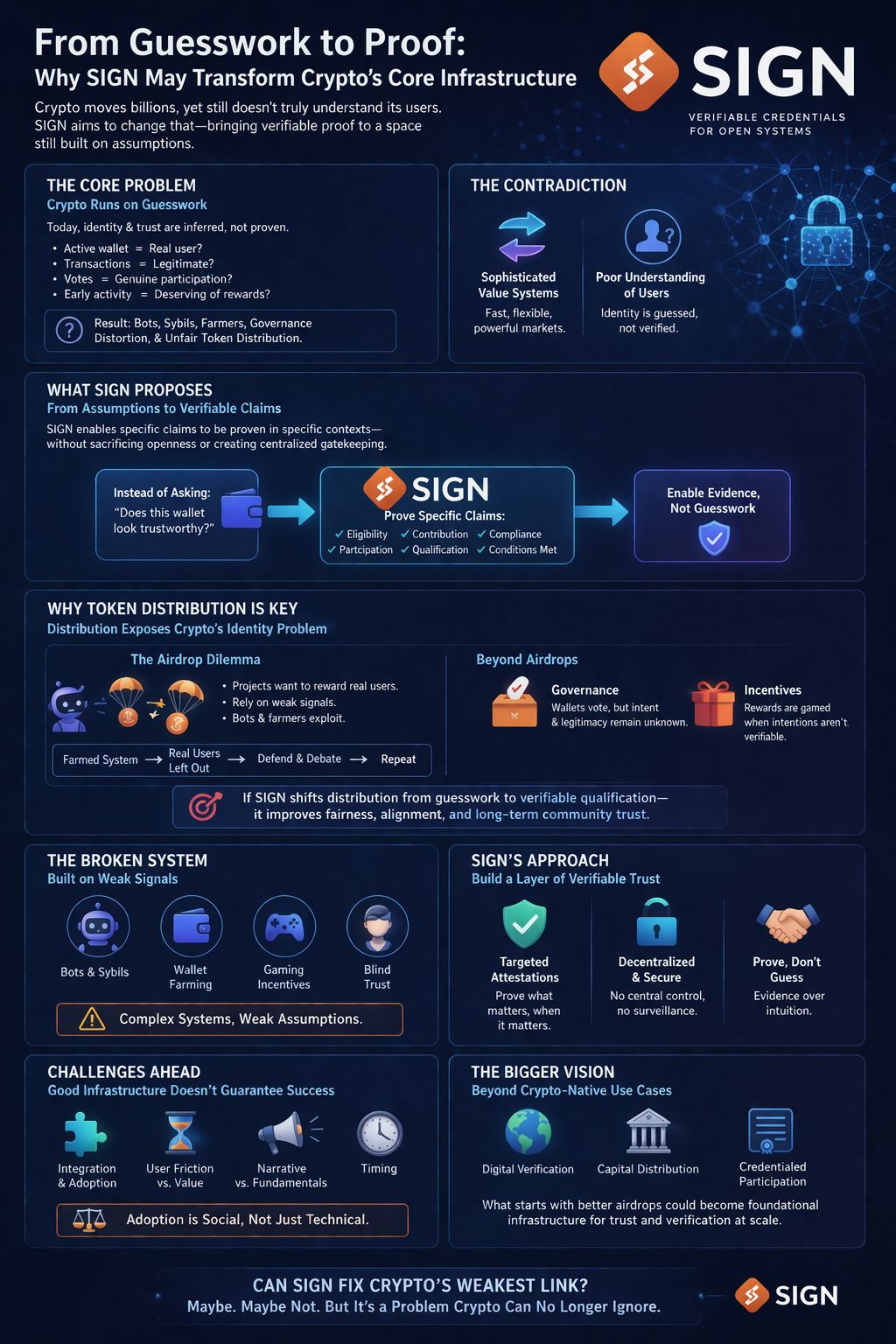
An active wallet is assumed to be a real user.
A natural-looking transaction pattern is taken as proof of legitimacy.
A few governance votes suggest genuine participation.
Early activity implies future entitlement.
This is how major decisions around trust, eligibility, and identity are still made.
That’s not a solid foundation.
It’s improvisation—just better packaged.
And that’s where SIGN starts to matter.
At its core, it seems to confront a question crypto has been avoiding:
How do you verify something meaningful about a participant in an open system—without turning the entire experience into centralized gatekeeping?
That question cuts across everything.
Take airdrops. They’re one of the clearest examples of how flawed current assumptions are. Projects say they want to reward real users, but rely on weak signals—wallet activity, transaction history, protocol usage, even social cues. Then they act surprised when bots, sybils, and professional farmers slip through.
The cycle repeats endlessly:
The system gets farmed.
Real users get left out.
The team defends its approach.
Debate follows.
Then it happens again somewhere else.
Governance faces a similar issue. In theory, it’s about collective decision-making. In reality, it’s often shaped by capital concentration, wallet fragmentation, and shallow assumptions about intent.
A wallet can vote.
That doesn’t mean the system understands anything about the entity behind it.
Incentives only complicate things further. The moment rewards become visible, behavior shifts. People optimize for outcomes, not intentions. That’s not a flaw—it’s predictable.
So systems that aim to reward contribution often end up rewarding those who learn to game them fastest.
SIGN appears to take a different stance.
Not by enforcing rigid identity across everything.
Not by making users fully legible.
Not by replacing openness with bureaucracy.
But by enabling specific claims to be proven in specific contexts.
That distinction matters.
Instead of asking whether a wallet “looks” trustworthy, the focus shifts to whether it can actually prove something:
Eligibility.
Participation.
Contribution.
Qualification.
Compliance.
A condition fulfilled.
A role earned.
A claim that can be verified—not just assumed.
That reframing moves the conversation away from intuition and toward evidence.
And crypto could use more of that.
The more I thought about it, the more it became clear why token distribution sits at the center of SIGN’s approach.
Distribution is where crypto’s identity problem becomes unavoidable.
There’s still no clean way to decide who should receive value. Distribute too widely, and it gets exploited. Be too selective, and you exclude the very users you intended to reward. Projects aim for fairness but operate with incomplete information. They want to reward contribution but struggle to define it clearly.
If SIGN can help shift even part of this process from guesswork to verifiable qualification, that’s significant.
Because distribution isn’t just about tokens landing in wallets.
It determines who feels included.
Who stays engaged.
Who aligns with an ecosystem.
Who feels overlooked.
Who sees value—and who sees extraction.
It’s not a side mechanism.
It’s structural.
That’s where SIGN feels grounded in a way many infrastructure projects don’t. It isn’t selling abstraction for its own sake. It’s identifying a real weakness and suggesting it can be addressed with better structure, clearer evidence, and stronger logic.
That makes sense.
But it doesn’t make success inevitable.
One of crypto’s recurring misconceptions is that good infrastructure wins simply because it’s well-designed.
It doesn’t.
Even strong systems fail—often.
They fail when no one integrates them deeply enough.
They fail when users resist added friction.
They fail when narratives overshadow fundamentals.
They fail because timing is off.
A project can be directionally correct and still go nowhere.
That risk applies to SIGN as much as anything else.
You can build better credential systems.
You can improve attestations.
You can refine eligibility logic.
You can reduce blind spots.
And still fail—because adoption isn’t purely technical. It’s social.
People don’t wake up wanting to verify credentials.
They want access, speed, rewards, simplicity.
So any added structure has to justify itself. Too much friction, and users bypass it. Too little, and it loses meaning.
That balance is difficult.
Which is why SIGN doesn’t feel inevitable. It feels… fragile.
Promising, potentially important—but fragile.
There’s also a deeper tension here.
Crypto celebrates openness, yet constantly builds systems that rely on identity-like judgments.
It wants permissionless access—but also fairness.
It resists centralization—but needs protection against abuse.
It values openness—but struggles when openness creates distortion.
That tension isn’t going away. If anything, it intensifies as more capital and real-world activity moves on-chain.
And that’s where SIGN becomes even more interesting.
Because its implications extend beyond crypto-native use cases. What starts as “better airdrops” begins to look like something broader: infrastructure for digital verification, capital distribution, and credentialed participation at scale.
Not just within ecosystems.
Not just for token claims.
But for any system that requires verifiable records to function effectively.
That’s a larger ambition.
Of course, ambition is easy to declare. Execution is harder. But the shift in framing still matters—it shows how the problem is being understood.
This isn’t just about optimizing token launches.
It’s about building a layer that allows systems to know not everything about a participant—but enough to make better decisions than blind wallet analysis allows.
That’s a meaningful direction.
Because as crypto grows, it becomes harder to pretend that transaction history alone can carry trust.
Eventually, systems need better ways to recognize:
Who qualifies.
Who contributed.
What was earned.
What was proven.
What can actually be trusted.
Not full surveillance.
Not total transparency.
Just enough structure to prevent open systems from being endlessly exploited.
That’s the problem SIGN is circling.
Not perfectly.
Not definitively.
But seriously enough that it’s hard to ignore.
That’s why it sticks.
Plenty of projects feel impressive for a moment, then fade. SIGN doesn’t quite do that. It lingers—because the issue it addresses isn’t going anywhere.
If anything, it becomes more visible with each cycle.
More users.
More capital.
More incentives.
More pseudo-community behavior.
More sybil pressure.
More governance theater.
More distribution failures.
All reinforcing the same point:
Crypto is still building complex systems on top of weak assumptions about who is actually participating.
That won’t hold forever.
At some point:
Participation has to mean more than wallet activity.
Eligibility has to go beyond rough filters.
Trust has to be more than social consensus layered over transaction data.
Something has to improve.
Maybe SIGN becomes part of that solution—a quiet but essential layer that supports better systems without dominating attention.
Or maybe it struggles, like many infrastructure projects do, because usefulness doesn’t guarantee adoption.
That’s the realistic range.
But even that says something.
This isn’t about hype anymore.
It’s about whether crypto is finally starting to take one of its oldest blind spots seriously.
And that, more than anything, is what makes SIGN worth watching.
#SignDigitalSovereignInfra @SignOfficial $SIGN
