
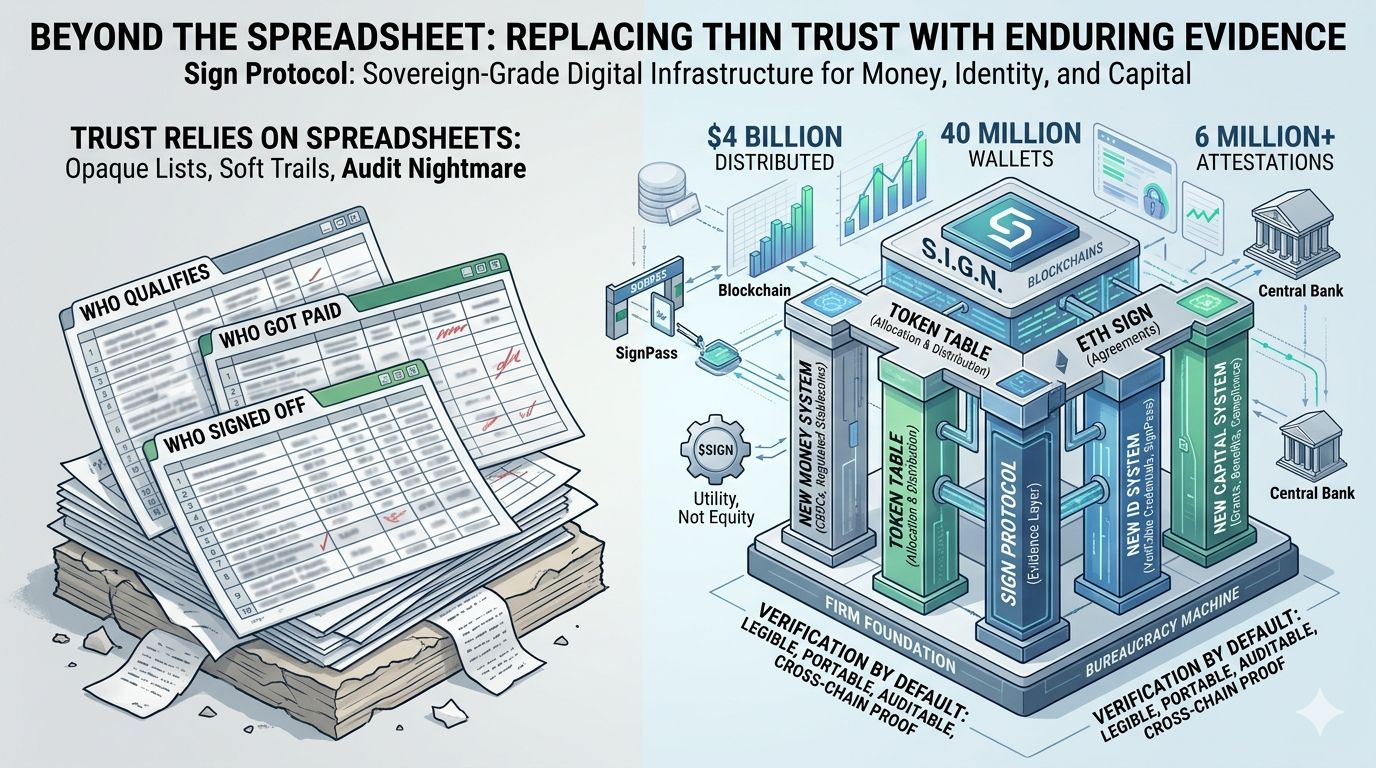
@SignOfficial The ugliest thing in public infrastructure is not the database. It is the spreadsheet that is pretending to be a system. One tab says who qualifies. Another says who got paid. A third says who signed off. By the time anyone asks what really happened, the trail is already soft at the edges. Sign’s core idea is brutally simple: replace that paper-thin trust with evidence that can survive the next audit, the next chain, the next ministry, the next dispute. Its own documentation says TokenTable exists because traditional distribution relies on spreadsheets, opaque beneficiary lists, one-off scripts, and slow post-hoc audits; Sign Protocol exists as the evidence layer that makes claims verifiable, attributable, and auditable across systems.
That is why the project makes more sense when you stop reading it like a crypto launch and start reading it like a bureaucracy machine. S.I.G.N., in the company’s current framing, is sovereign-grade digital infrastructure for money, identity, and capital. The three pillars are bluntly named: a new money system for CBDCs and regulated stablecoins, a new ID system for verifiable credentials, and a new capital system for grants, benefits, incentives, and compliant distribution. Sign Protocol is the shared evidence layer underneath those deployments; TokenTable handles allocation and distribution; EthSign handles agreements and signatures. This is not a cute product bundle. It is an attempt to make verification the default substrate of state and enterprise workflows.
The interesting part is how unromantic the architecture is. Sign Protocol organizes data into two basic units: schemas and attestations. Schemas define the shape of the claim; attestations are the signed instances of that claim. Data can live fully on-chain, fully on Arweave, or in a hybrid model with on-chain references and off-chain payloads. Builders can read it through direct contract reads or through SignScan’s REST and GraphQL APIs, which aggregate data across supported chains. In other words, Sign is not trying to make every record flashy. It is trying to make every record legible, portable, and hard to fake.
Then there is the cross-chain problem, where most tidy narratives usually fall apart. Sign’s docs describe a decentralized TEE-based flow with Lit Protocol for cross-chain attestations, where an attestation on an official cross-chain schema can be verified against target-chain data and returned as a signed delegated attestation. The point is not just interoperability as a slogan; the point is proving that a claim made in one place still means the same thing somewhere else. That matters whenever evidence has to travel across networks, institutions, or jurisdictions without becoming a mess of manual rechecks and political exceptions.
TokenTable is where Sign gets practical and slightly ruthless. Its documentation says it is responsible for allocation logic, vesting, unlock schedules, eligibility constraints, and deterministic outputs. It supports direct distribution, beneficiary-initiated claims, delegated claiming, and batched settlement. It can operate across private CBDC rails, regulated stablecoins, and public blockchain tokens. The allocation tables themselves can include beneficiary identifiers, amounts, vesting terms, claim conditions, and clawback rules, and once finalized they are versioned and immutable. That is the part that makes it feel less like a crypto toy and more like a machine built for programs that cannot afford improvisation.
The scale is not theoretical anymore. Sign’s own TokenTable page says it has unlocked $2 billion to 40 million unique addresses across 200+ projects. Its whitepaper goes further, saying that in 2024 Sign processed more than 6 million attestations and distributed more than $4 billion in tokens to upwards of 40 million wallets. Those are not decorative numbers. They tell you the project has already crossed from concept into infrastructure, at least in the narrow sense that infrastructure is judged by volume, repetition, and whether people keep using it after the first announcement wears off.
The token itself is framed with a very different mood from the usual speculation theater. Sign’s official token page says the total supply is 10 billion $SIGN, deployed on Ethereum, Base, and BNB Chain. Its MiCA whitepaper describes SIGN as a fungible, non-redeemable, non-interest-bearing utility token, and says purchasers do not obtain equity interests or claims against the issuer. That matters because it clarifies the role of the token in the system: not ownership, not dividends, not fantasy scarcity, but utility inside the machinery. The token is there to support the protocol, not to cosplay as the protocol’s entire meaning.
There is also some proof that the team has built before the token spotlight. Sign’s EthSign page says the product has more than 2 million users and 800,000 contracts signed. Blockworks reported in October 2025 that YZi Labs led a $25.5 million strategic round, following a January $16 million investment, bringing Sign’s total raised to over $55 million across seed, Series A, and strategic rounds. The same report says the team is hiring around Hyperledger Fabric, zero-knowledge proofs, interoperability, and local country teams. That tells you where the project thinks the hard part is: not on-chain theater, but operational reach.
The most revealing part of the story may be the identity angle. Sign’s docs treat identity as foundational infrastructure, not an app layer. They talk about W3C Verifiable Credentials, DIDs, OpenID-based issuance and presentation, revocation lists, and offline patterns like QR and NFC. The whitepaper leans hard into that logic too, arguing that digital identity is the prerequisite for financial inclusion and service delivery, and using Sierra Leone as an example of how identity gaps block access even when payment rails already exist. That is the real tell: Sign is not merely distributing tokens. It is trying to make eligibility itself machine-checkable.
That is also why the SignPass story matters. A June 2024 report from The Block said Sign Foundation was working with Sierra Leone’s Immigration Department so SignPass holders could obtain permanent residency. Separate official and semi-official materials describe SignPass as a blockchain-based ID verification system with credentials registered on-chain through Sign Protocol. Strip away the buzz and the message is plain: the company is trying to make credentials travel from the browser to the border, from the wallet to the state, without turning every verification into a new manual ritual.
That is why Sign feels different from the usual “Web3 infrastructure” pitch. Most projects start with belief and spend years trying to find utility. Sign starts with utility and lets belief arrive later, if it must. It is building for the moment when a government wants to pay people, a protocol wants to distribute value, an institution wants to verify a claim, and nobody in the room wants to trust a spreadsheet, a screenshot, or a memory. The quiet revolution here is not token distribution. It is that trust becomes less of a feeling and more of a file that can be checked, again and again, without wearing out. That is where power lives now: in the system that can produce the receipt while everyone else is still arguing about the story.
#SignDigitalSovereignInfra @SignOfficial $SIGN
