

Last year I watched a small business owner in my city try to move funds between his local bank account and an international payment platform. The process took days. He had to fill separate forms, wait for approvals, and hope nothing got frozen in between. At one point he told me he felt stuck money in limbo, rules changing mid-way, no clear guarantee anything would land safely. That moment stayed with me.
I saw something similar when I read deeper into Sign’s whitepaper, especially the bridge between its private CBDC infrastructure and the public stablecoin system. Nations building digital money face the exact same friction, only at country scale. They need strict privacy and control for some operations, yet real openness for trade and innovation. Standing between those two worlds creates real stress. Sign tries to engineer a cleaner way across.
The stack deliberately runs two parallel rails. One is the Hyperledger Fabric X CBDC side permissioned, privacy-focused, and kept under direct central bank authority. It suits confidential transactions where full transparency could create risks. The other is the public sovereign EVM L2 running regulated stablecoins. Open, transparent, and able to connect with global digital ecosystems. Citizens and institutions often need to shift value between them. Maybe move CBDC holdings into stablecoin to access broader services, or pull stablecoin back into CBDC when privacy matters more.
Sign connects these rails through a controlled bridge that uses atomic swaps. The entire conversion happens as one single operation. Both sides either complete together or the transaction fails cleanly with nothing lost. That removes the dangerous middle ground where funds could vanish or get stuck. I appreciate how the design puts a strong cryptographic guarantee on the execution itself.
Every bridge move still passes through proper compliance. AML and CFT checks apply just like on the rest of the network. Sign Protocol’s attestations help prove eligibility or identity without exposing unnecessary details. The evidence layer keeps records verifiable and tied to real authority. TokenTable can sit on top to handle larger distributions while respecting the bridge limits.
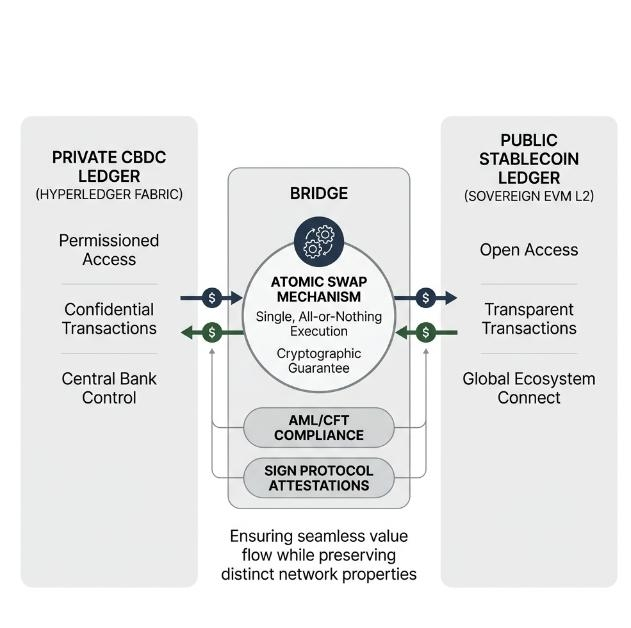
The atomic swap secures the “how” of each transfer very well. But the economic terms stay firmly with the central bank. It sets the exchange rate. It decides individual and aggregate conversion limits. It holds the power to pause the bridge entirely during emergencies. The swap ensures that whatever parameters are active at the moment will execute fairly and completely. This keeps sovereign control intact, which matches the core S.I.G.N. idea of national oversight.
I see the practical value. The private CBDC rail protects confidentiality where it is needed. The public stablecoin rail brings liquidity and composability. The bridge lets value flow between them without breaking the properties of either side. Identity flows through layered attestations. Sybil resistance strengthens because access ties back to proven claims rather than easy fakes. Everything stays auditable under national rules.
At the same time I wonder about the policy layer. Rate setting and limit decisions become highly programmable here. The whitepaper does not detail public processes or appeal mechanisms for how those parameters get adjusted. Central banks already manage such tools in traditional finance, but the direct nature of this bridge makes accountability especially important. Nations will need to handle that side thoughtfully as usage grows.
The full stack ties together neatly. A customizable sovereign chain for the foundation, Sign Protocol for the evidence and trust layer, TokenTable for fair capital distribution. Money, ID, and capital systems work together instead of against each other. It follows the whitepaper’s simple tenets keep designs clear, embrace open standards, and let evidence support governance.
After spending time with the docs, I believe this bridge offers a pragmatic solution. It reduces the limbo many people feel when moving between private and public money systems. Nations gain both control and flexibility. Citizens get safer transitions under clear rules.
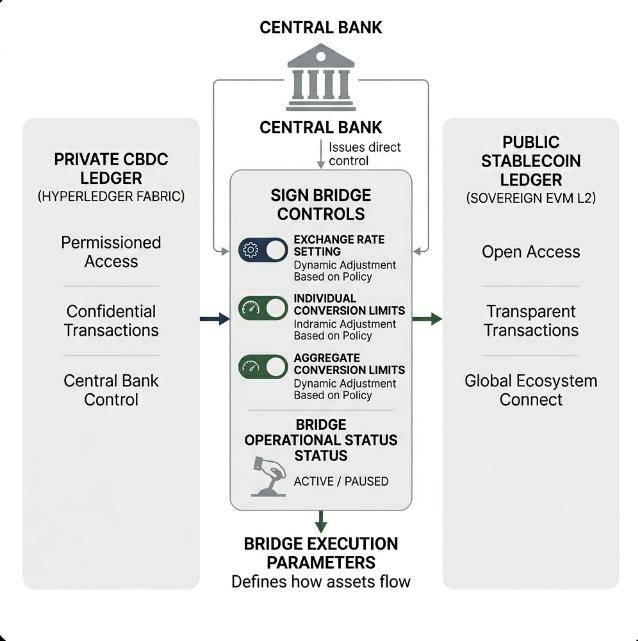
How will central banks communicate and adjust exchange rates and limits in live deployments? And could stronger use of Sign Protocol attestations bring more transparency to those policy decisions over time?
Sovereign infrastructure should let countries stand confidently in both worlds when needed. Sign builds the bridge so the transition feels less like risky limbo and more like a governed pathway. That feels like real progress for national digital systems. I will keep watching how it develops.