

Sign is focused on solving a problem most people ignore until they actually face it.
The way governments distribute money sounds straightforward on the surface grants, subsidies, and support programs. But in reality, it’s often disorganized. The rules aren’t always clear, decisions can feel inconsistent, and once funds are released, it becomes difficult to see where they actually go.
For many, the entire system feels like something you can’t look inside—a complete black box.
What Sign does is take that unclear process and reshape it into something organized, transparent, and far more resistant to manipulation.
Think about being a small business owner applying for financial support. Normally, you submit forms and documents that disappear into a system with little feedback. With Sign, the process begins differently. Your identity, eligibility, and submitted documents aren’t just stored—they are turned into verifiable digital proofs.
These proofs can be checked anytime, not just during the initial review.
The decision stage, which is usually the most unclear part, becomes much more defined. With Sign, the criteria are set in advance—clearly stating who qualifies, how much they can receive, and under which conditions. There’s no vague interpretation. Instead of manual reviews happening behind closed doors, the system applies these rules directly. If you meet the requirements, you proceed. If you don’t, the process stops there. It’s simple and consistent.
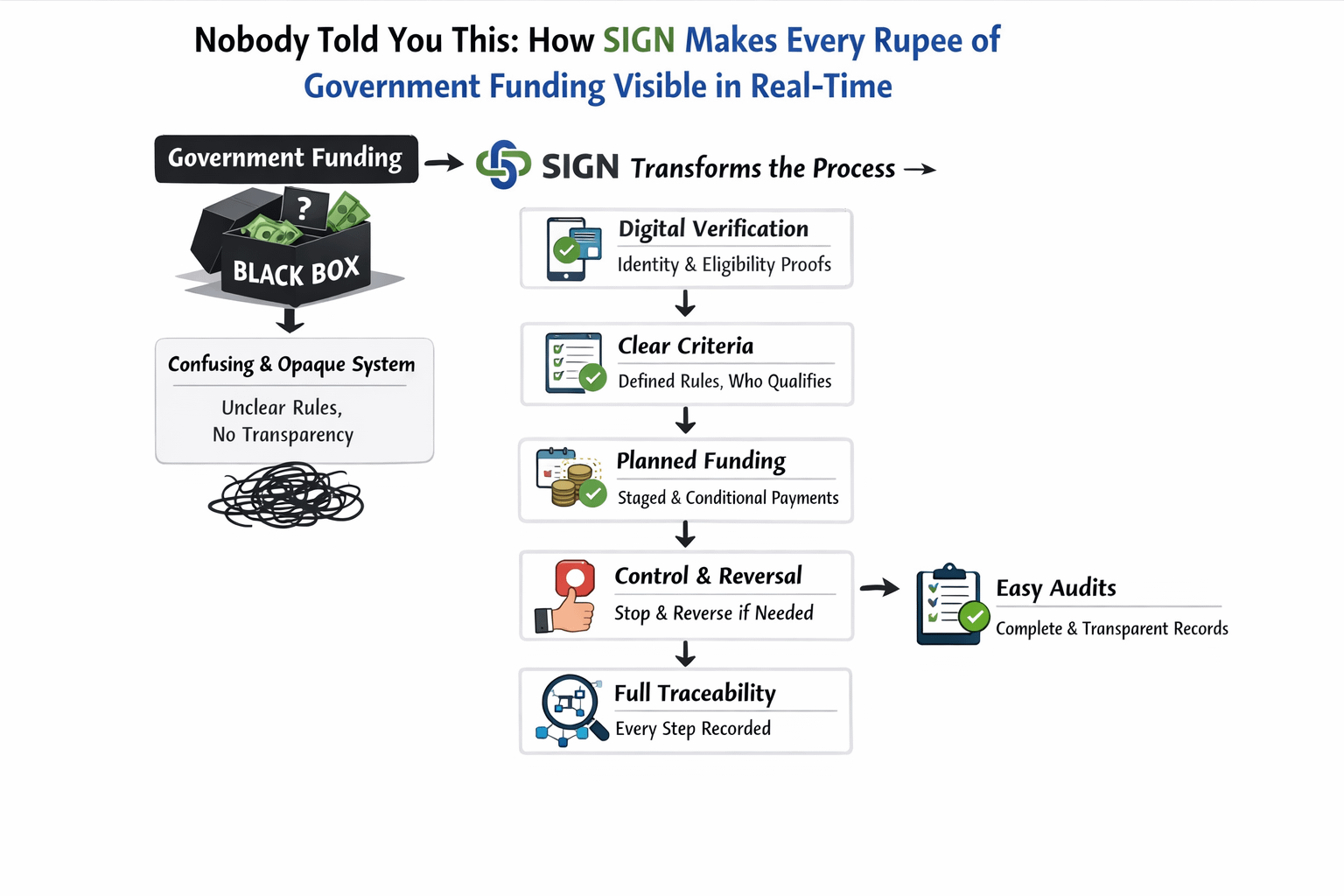
After approval, funds are not sent randomly in one go. They can be released gradually, scheduled over time, or linked to specific milestones. It works more like a structured plan rather than a one-time payment. And if an issue arises—such as incorrect eligibility or rule violations—the system has the ability to intervene, pause, or even reverse the distribution.
What truly sets Sign apart is what happens behind the scenes.
Each step in the process creates a clear and verifiable record. When funds are allocated, there is a documented reason. When money is transferred, there is proof of its destination. When someone qualifies, there is evidence showing how that decision was reached.
This makes auditing far more efficient. Instead of digging through spreadsheets or trying to reconstruct events, auditors can immediately access a complete and reliable history. They can see exactly who received funds, when they received them, and why they were eligible in the first place.
At this point, Sign starts to feel less like a typical crypto-based solution and more like a practical system addressing a real-world issue.
Because the challenge it tackles isn’t abstract—it’s the everyday complexity and lack of clarity in how public funds are distributed.
Rather than depending on trust and manual oversight, it introduces a system where rules are clearly defined from the beginning and tracking happens automatically throughout the process.