I think one of the easiest mistakes in digital systems is to assume the job is done the moment something gets signed.
On the surface, that sounds fine. Two sides agree. The document is executed. The flow is complete. But the part that matters to me starts after that. Can that agreement still be useful later, when another workflow, another counterparty, or another system needs to rely on it without dragging everyone back into the original process?
That is where SIGN started getting more interesting to me.
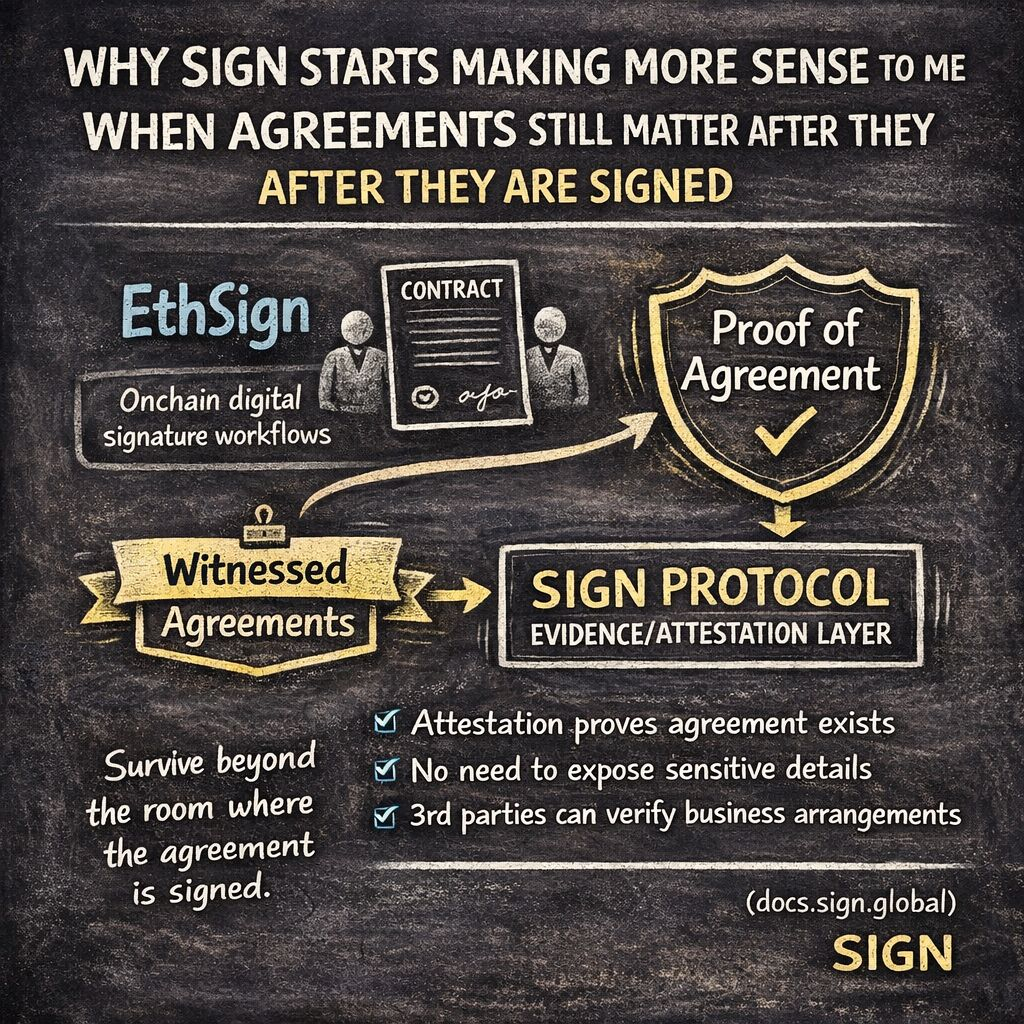
What changed my view was EthSign’s official case study. It does not just describe EthSign as a signing product. It says EthSign makes legal contracts and agreement signing easier while keeping cryptographic security, but it also admits a real limitation: contracts created through EthSign remain siloed, limited to the context and parties directly involved. The docs call that a missed opportunity because those agreements are not easily composable or reusable across other dapps and experiences.
That point matters more than it first sounds.
A lot of systems are good at creating a valid event once. Far fewer are good at letting the proof of that event stay useful later. An agreement can be real, secure, and properly executed, and still become awkward the moment someone else needs to verify its existence for a business reason. That is where the official “Proof of Agreement” idea becomes interesting to me. EthSign’s docs describe it as an attestation made using Sign Protocol that confirms an agreement exists between parties, so a third party can verify that existence for business purposes.
To me, that changes the whole meaning of a signature workflow.
Now it is not only about getting a document signed. It is about whether the result of that signing can travel forward in a useful form. The same EthSign docs describe “Witnessed Agreements,” where EthSign or another third party can witness the signing and issue an attestation that serves as proof of agreement. They also say this lets users indicate ongoing contractual arrangements onchain without revealing sensitive details.
That is the part I find strong.
Because the harder problem is rarely the click that finalizes the agreement. The harder problem is what comes next. Maybe a lender needs to know a contract exists. Maybe access depends on a verified commercial relationship. Maybe another application needs proof of authorization without exposing the full document. If agreements stay trapped inside the exact system where they were created, every later step has to rebuild trust in a clumsy way. If there is a structured attestation that the agreement exists, then another layer can rely on that fact without restarting from zero. That is a much more serious use of infrastructure.
This is also why Sign Protocol feels central here rather than decorative.
The official docs describe Sign Protocol as the cryptographic evidence layer of the S.I.G.N. stack. It is built to define structured schemas, issue verifiable attestations, anchor evidence across chains and systems, and support querying, verification, and audits. The FAQ says the core idea is to make verification reusable across applications by standardizing how claims are structured, signed, stored, queried, and referenced. Once I read that, EthSign stopped feeling like a standalone signing app and started feeling like one example of a bigger design philosophy.
And that bigger design is what holds my attention.
S.I.G.N. is officially framed as sovereign-grade infrastructure for money, identity, and capital, with Sign Protocol as the shared evidence layer across deployments. EthSign is listed alongside TokenTable as a deployable product that can support those broader systems when agreements, signatures, allocations, and evidence all need to remain inspectable later. To me, that means the project is not treating proof like a one-time event. It is treating proof like something that should remain usable after the first workflow ends.
And that's where SIGN stops sounding interesting and starts feeling important to me.
I do not think an agreement should stop mattering the moment it is signed. I think the real value begins when the system can preserve the meaning of that agreement in a form that another step can still trust later.
For me, that is where SIGN starts making more sense.
Not because it makes agreements look more modern.
Because it treats agreements like something that should still matter after they are signed.
@SignOfficial $SIGN #SignDigitalSovereignInfra