The current global financial system often feels like a relic of the past. Small business owners in hubs like Karachi or Dubai face a recurring nightmare: cross-border payments that stall for days, exorbitant fees, and a constant tug-of-war between the need for privacy and the demands of regulators. While the world has gone digital, the "plumbing" of money remains clogged by bureaucracy.
Sign Protocol’s New Money System offers a sophisticated departure from this friction, moving beyond simple cryptocurrency toward a robust infrastructure for Sovereign Digital Money Rails.
The Dual-Rail Strategy: Transparency Meets Confidentiality
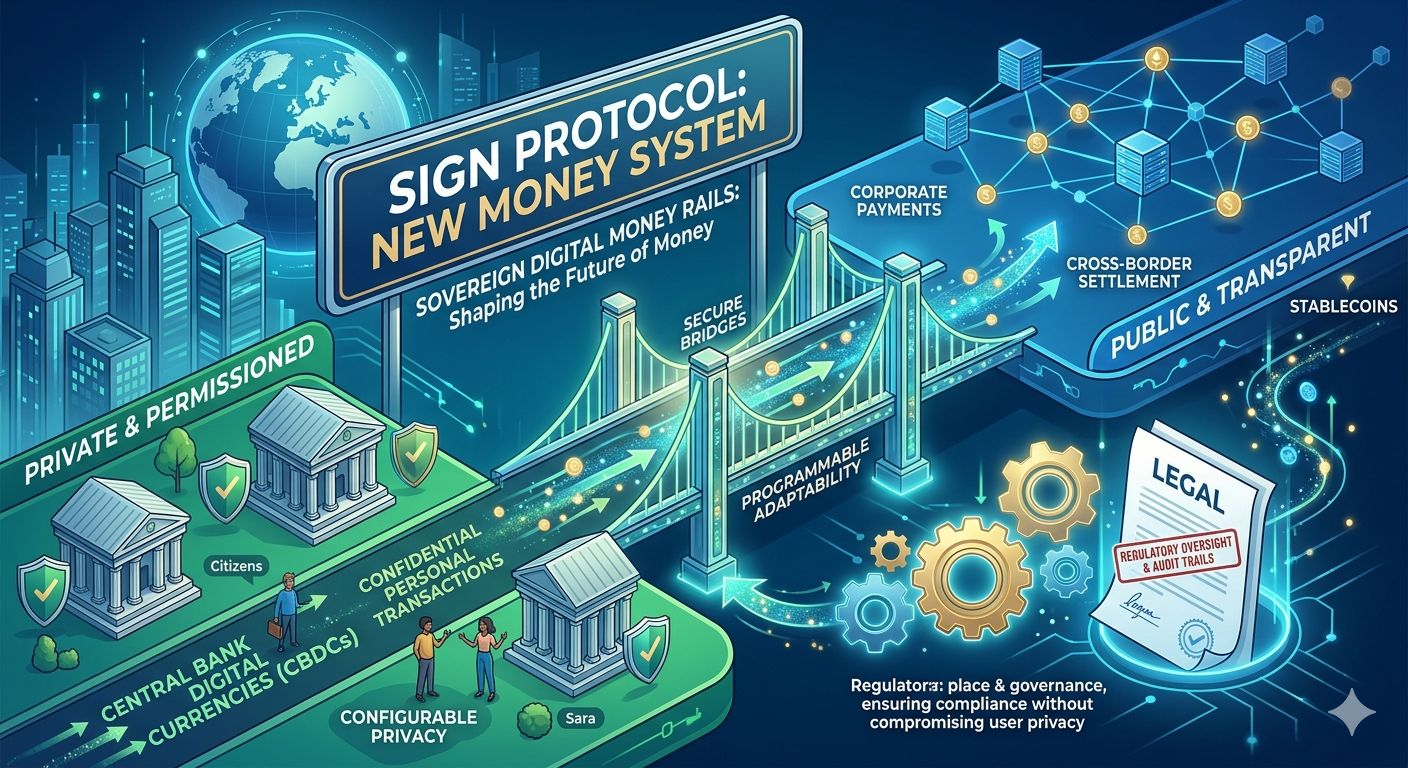
The genius of this system lies in its "Hybrid Architecture." Instead of forcing users to choose between a fully public ledger (where every transaction is visible) and a fully dark system (which alarms regulators), it operates on two interconnected tracks:
* The Public Rail: Utilizes a transparent blockchain ideal for corporate settlements, high-level cross-border transfers, and public stablecoins. This ensures that large-scale movements of value are verifiable and secure.
* The Private Rail: Built on Hyperledger Fabric-based technology, this permissioned layer is designed for Central Bank Digital Currencies (CBDCs). Here, everyday personal transactions—like a shopkeeper paying a supplier—remain confidential.
Solving the "Ali and Sara" Dilemma
For an importer like Ali, the "invisible plumbing" of Sign Protocol means a transaction that used to take five days can now settle in seconds. Because the system is programmable, the regulatory documentation is embedded into the transaction itself.
For an online retailer like Sara, the benefit is Configurable Privacy. Her financial footprint isn't exposed to the world, yet the system provides "Auditability on Demand." If a regulator needs to verify a transaction for anti-money laundering (AML) purposes, the keys exist to grant that specific insight without exposing her entire history.
The Technical Backbone: Scalability and Finality
Research into the protocol’s structure reveals that it isn't just about "sending coins." It is about Sovereign Infrastructure:
* Fast Finality: Unlike older blockchains that require multiple "confirmations," Sign’s private rails provide near-instant finality, essential for high-volume retail environments.
* Cross-Chain Bridges: These act as the translators between the private CBDC world and the public DeFi (Decentralized Finance) world. It allows a user to hold a private "digital Rupee" and seamlessly convert it to a "Global Stablecoin" for international trade.
* Governance-First Design: It respects the right of a nation to set its own monetary rules while remaining compatible with global standards.
Community-Led Adoption: The Binance Square Catalyst
Technology only succeeds if people use it. The recent engagement on Binance Square’s CreatorPad, featuring SIGN token rewards, is more than just a marketing campaign; it is an educational bridge. By incentivizing creators to break down complex topics like Digital Sovereignty, the protocol ensures that the transition from "bank queues" to "digital rails" is understood by the masses.
The Future Outlook
As nations look toward 2026 and beyond, the goal is a system where money works for the people. Sign Protocol represents a shift where:
* Friction is eliminated through smart programming.
* Privacy is protected by default, not as an afterthought.
* Trust is restored between citizens and financial institutions.
The frustrations of today’s banking delays are becoming obsolete. Through the lens of Sign Protocol, the future of money is fast, private, and—most importantly—sovereign.
@SignOfficial #SignDigitalSovereignInfra $SIGN ?