Cross-border payments remain one of the biggest friction points in global finance. For many small business owners, sending money internationally still involves delays, high fees, and extensive compliance procedures. A business owner importing goods may wait days for a payment to settle, while also submitting repeated documentation to satisfy regulatory checks. At the same time, individuals and businesses worry about financial privacy. Every transaction often leaves a visible trail that many users feel uncomfortable sharing with multiple institutions.
This tension between transparency and privacy has shaped the evolution of digital financial systems. Governments require oversight to prevent fraud, tax evasion, and financial crime. Citizens and businesses, however, expect speed, convenience, and control over their financial information. Traditional banking infrastructure struggles to balance these competing priorities. Blockchain technology introduced faster and more transparent transactions, yet public blockchains can expose financial activity in ways that are unsuitable for sensitive payments or national financial systems.
The Dual-Rail Architecture of Sign Protocol.
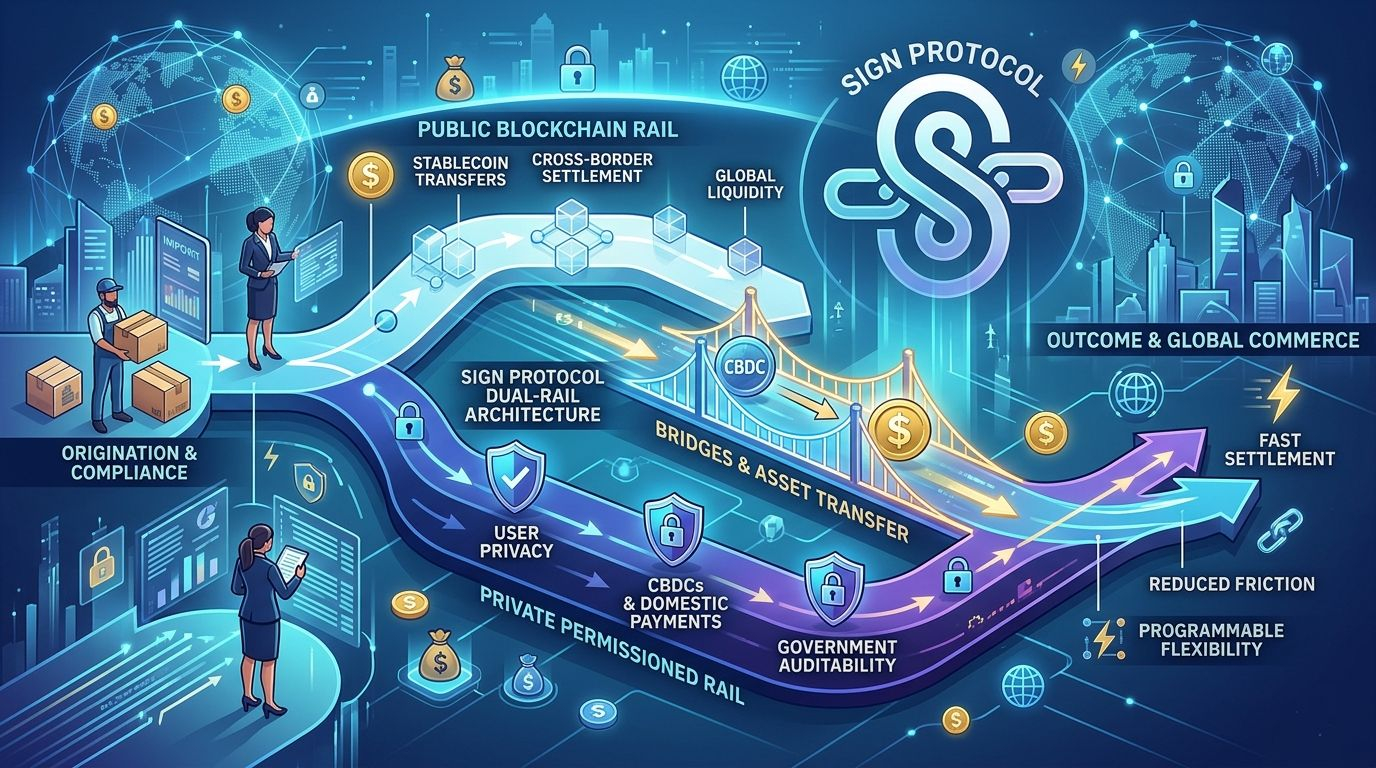
Sign Protocol introduces an interesting approach to this challenge through a dual-rail digital money architecture. Instead of forcing a single system to handle every requirement, it separates financial activity into two complementary environments: a public blockchain and a private permissioned blockchain.
The public blockchain rail supports transparent and efficient transactions. This environment works well for cross-border settlements, corporate payments, and stablecoin transfers where transparency and liquidity are beneficial. Public chains also allow global interoperability, making them suitable for international trade and decentralized finance applications.
The private rail, on the other hand, is designed for sensitive financial activity. Built using technology inspired by Hyperledger Fabric, the permissioned blockchain allows governments or institutions to control access while maintaining strong security and fast transaction finality. This environment is particularly suitable for central bank digital currencies (CBDCs) and domestic payment systems where user privacy must be protected.
Balancing Privacy, Compliance, and Efficiency.
One of the most notable aspects of this architecture is how the two rails interact. Bridges allow digital assets to move between the private and public environments seamlessly. For example, a domestic CBDC payment could begin within a private blockchain channel where user data remains confidential. The transaction could then convert into a stablecoin on a public chain for cross-border settlement before reaching the recipient quickly and efficiently.
This mechanism acts like invisible infrastructure behind the financial system. Users experience faster transfers and smoother payments, while regulators maintain the ability to audit activity when required. The permissioned network ensures that sensitive financial data remains protected, but authorized authorities can still verify transactions when necessary.
Programmability also plays a critical role. Because the system is adaptable, different countries can configure privacy levels, compliance frameworks, and governance rules according to their regulations. This flexibility makes the infrastructure attractive for global commerce, where regulatory environments vary widely across jurisdictions.
The Future of Sovereign Digital Money.
As digital finance evolves, infrastructure that balances efficiency, privacy, and regulatory compliance will likely become increasingly important. Systems like Sign Protocol demonstrate how blockchain technology can move beyond speculation and address practical financial challenges faced by businesses and governments.
For everyday users, the benefits could include faster payments, reduced friction in cross-border trade, and greater control over personal financial data. For regulators, the system provides transparency and auditability without sacrificing operational scalability.
The growing engagement around the Sign ecosystem also reflects a broader trend in the crypto industry. Educational initiatives and creator-driven campaigns are helping communities explore new financial technologies while rewarding early participation. As awareness expands, adoption of programmable digital money systems may accelerate across multiple regions.
If these infrastructures continue to mature, digital money could become more efficient, accessible, and trustworthy. Instead of forcing users to choose between privacy and compliance, the next generation of financial rails may deliver both simultaneously.