
i have been tracking the MENA digital payments market closely and the numbers tell the first part of the story well. the market stands at $248 billion in 2025 and is projected to reach $462 billion by 2031. Saudi Arabia hit 79% non-cash retail transactions by early 2025, surpassing Vision 2030's interim target ahead of schedule. Dubai recorded 88% cashless usage. governments across the Gulf are linking VAT rebates and procurement contracts to digital acceptance. statutory e-invoice mandates are rolling out across GCC markets by 2026. the direction is clear. the momentum is real.
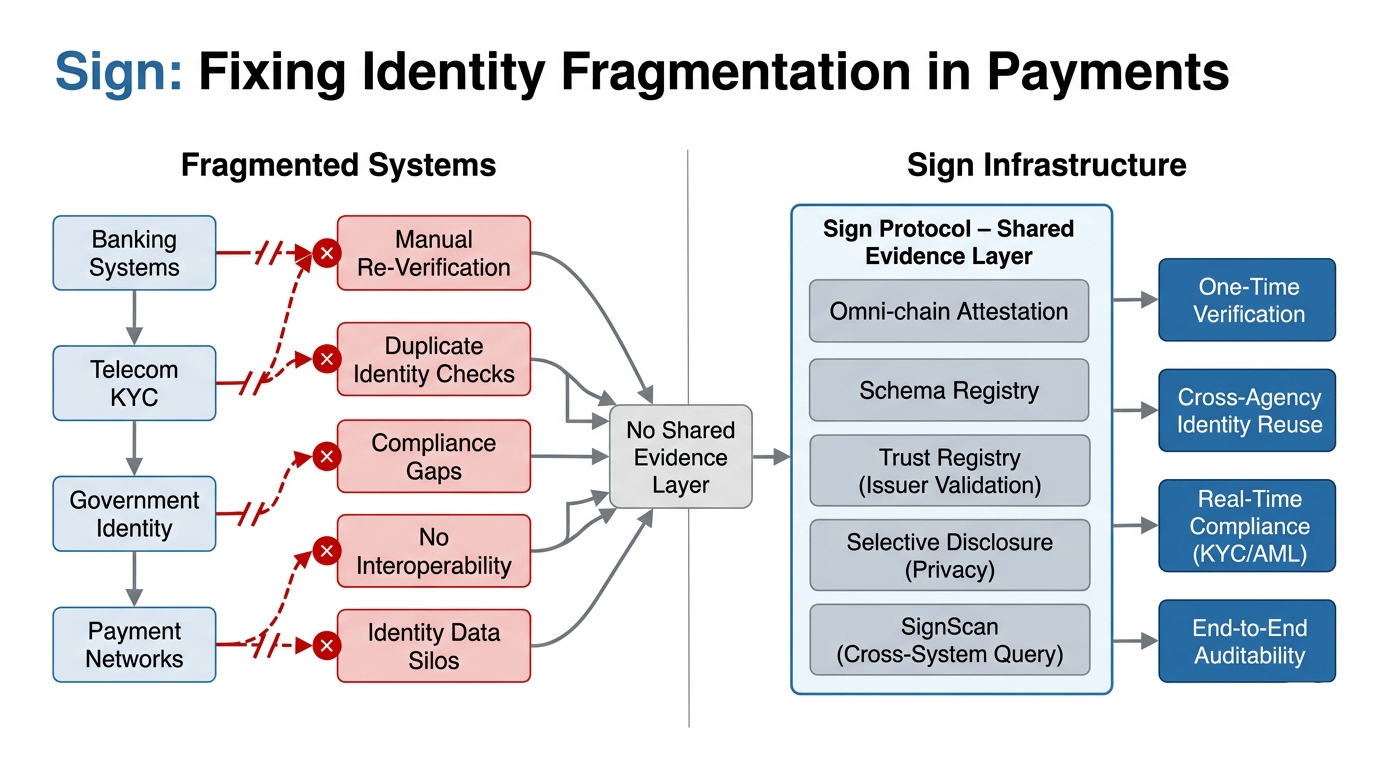
but underneath that momentum sits a structural problem that the payment rails alone cannot fix.
every transaction flowing across the Gulf's digital payment ecosystem — cross-border remittances, government disbursements, B2B settlements, real-time retail payments — needs verified identity information to travel with it. not just at onboarding. at every hop. across every agency. across every regulated operator. across every border. and right now, that identity verification is being rebuilt from scratch every time a payment crosses from one system into another. banks re-verify what telecom operators already verified. government agencies re-check what banks already confirmed. the same citizen credential gets duplicated, re-submitted, and re-checked across systems that have no shared layer connecting them.
i keep thinking about what that fragmentation actually costs. with statutory e-invoice mandates due across GCC markets by 2026, card-present and account-to-account rails will converge around national identity tokenisation, tightening KYC assurance requirements across every institution simultaneously. that convergence is coming whether the infrastructure is ready for it or not.
on the market side, SIGN is currently trading at $0.03190, up 0.19% over the last 24 hours, with a session high of $0.03404 and a low of $0.03131. volume came in at 151.17 million SIGN tokens, approximately $4.9 million USDT. the MA(7) at 0.03230 and MA(25) at 0.03223 are separated by just 0.00007 — a golden cross is forming. the EMA(7) at 0.03228 and EMA(25) at 0.03411 are closing simultaneously. price has held above the $0.03085 support level for five consecutive sessions on declining volume. that is a compression structure, not a breakdown. the market is not leaving. it is waiting.
but the price is not where Sign's most important work is happening.
the work is in exactly the infrastructure gap the Gulf's digital economy keeps exposing. and Sign's S.I.G.N. framework addresses it where the gap actually lives — not at the application layer where compliance patches get applied and fail, but at the foundational sovereign infrastructure level.
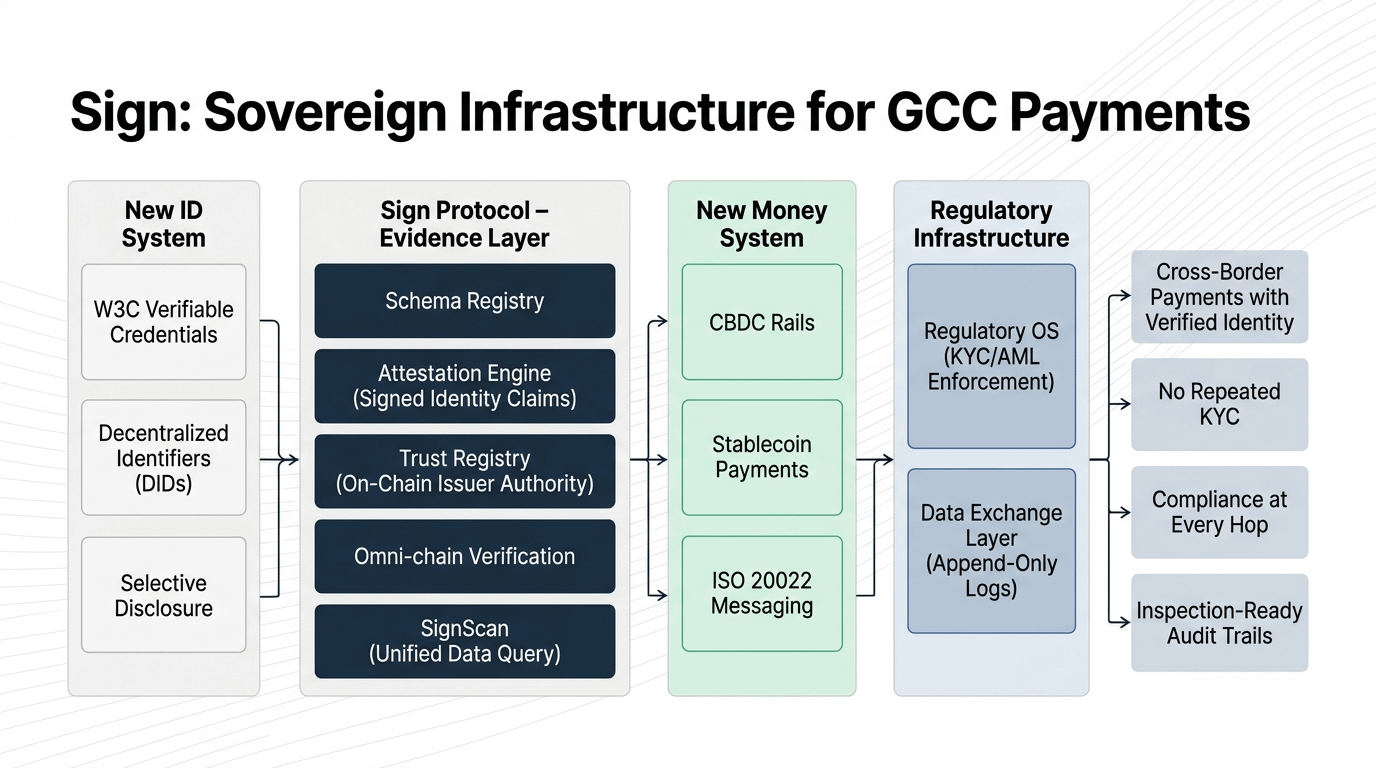
it needs a New ID System built on W3C Verifiable Credentials and W3C DIDs — where a cryptographically signed claim issued by one government authority travels across every bank, every agency, and every regulated operator without being re-verified from scratch at every hop. it needs a New Money System running CBDC and regulated stablecoin rails with ISO 20022 aligned payment messaging — where real-time settlement carries inspection-ready identity anchors through every transaction automatically. it needs a trust registry that records every authorised issuer on-chain — so the verification is not a phone call back to a ministry but a live, revocable, queryable record that any system in the chain can resolve against in milliseconds.
"the Gulf is not missing payment rails. it is missing the evidence layer that makes those rails governable at sovereign scale."
Sign Protocol sits as the omni-chain attestation protocol across all three systems. schemas define how structured data is represented consistently. attestations are the signed, inspection-ready records proving who was verified, under which authority, when, and according to which ruleset version. SignScan provides unified querying across chains and storage modes so regulators and auditors see the same evidence surface without rebuilding it. TokenTable handles programmatic capital distribution — the same engine that has already distributed over $4 billion across 40 million on-chain wallet addresses — now deployed inside sovereign government disbursement programmes with identity-linked targeting and duplicate prevention built in. the Regulatory OS maps real world identities to onchain activity and applies KYC and AML policy enforcement in real time. the Data Exchange Layer records every inter-agency interaction as append-only, verifiable logs — no raw data centralised, no broken handoffs.
"the Middle East is not building faster payments. it is building sovereign infrastructure. those are two different projects. only one of them needs Sign."
i find it hard to look at that gap and not see exactly what Sign's B2G model was designed for. long-term contracts. deep integration into live government workflows. proprietary technology compounding through every iteration cycle inside real sovereign deployments. each compliance edge case solved inside a live GCC payment corridor becomes knowledge no outside vendor can replicate. EthSign produces verifiable proof of execution for agreement workflows. and once the foundational systems stabilise, sovereign AI becomes the next layer — governance stops being a paperwork problem, real-time data flows through programmable interfaces, countries become companies, fiat becomes its stock, citizens becomes shareholders. 🤔
the $462 billion market is coming. the infrastructure underneath it needs to be ready before it arrives.
Sign is building that infrastructure. not as a feature. as the foundation. 😐
@SignOfficial #SignDigitalSovereignInfra $SIGN
