I remember a stretch of time not that long ago when every pitch in crypto somehow circled back to transparency. It was almost treated like the end state, like once everything was on-chain and visible, the problem was solved. I bought into that for a while. It felt clean. Elegant, even. You could point to a block explorer and say, look, nothing to hide here. But over time, sitting in the market, watching how things actually play out, I started noticing something uncomfortable. Transparency doesn’t really create trust. It just exposes behavior. And most people either don’t check, don’t understand what they’re looking at, or worse, check and still don’t trust what they see.
That’s been sitting in the back of my mind lately, especially as I’ve been looking at Sign Coin and the broader idea it’s trying to push. Because if I strip it down to the core, this isn’t really about transparency at all. It’s about something more aggressive. It’s about making trust itself verifiable, portable, almost like a primitive you can plug into systems instead of relying on assumptions or reputation.
Here is the thing. Crypto has always had this contradiction. We say “don’t trust, verify,” but in practice, we still rely on layers of soft trust everywhere. Oracles, bridges, governance, even social consensus around which chain is “legit.” It’s not pure verification, it’s more like selective belief wrapped in technical guarantees. And that gap is where most narratives quietly break down, even if the market doesn’t always price it in immediately.
So when I first came across Sign, my initial reaction wasn’t excitement. It was more like skepticism mixed with curiosity. Another infrastructure play, another attempt to define a new base layer narrative. We’ve seen this before. Identity layers, reputation protocols, attestation frameworks, they all kind of orbit the same idea. But most of them never really break out of niche use because they either overcomplicate the model or fail to create something that people actually need in practice.
But the more I think about it, the more I wonder if Sign is coming at this from a slightly different angle. Not trying to build identity in the traditional sense, but focusing on attestations as a core unit. Which, if I simplify it, is just a way of saying: instead of asking who you are, the system tracks what can be proven about you or about a piece of data. It’s less about identity as a static label and more about verifiable statements that can be checked, reused, and composed.
It reminds me a bit of how primitives evolved in DeFi. At some point, people stopped building full-stack products and started building Lego pieces. Liquidity pools, lending markets, derivatives. Each one simple on its own, but powerful when combined. I’m starting to see Sign in a similar light, except the primitive here isn’t capital, it’s trust.
My thesis is simple, at least on the surface. If trust becomes something that can be verified as easily as a transaction, a lot of the narratives we rely on today start to collapse. Not gradually, but almost abruptly. Because so much of crypto still runs on implied trust rather than explicit proof.
Think about airdrops, for example. Entire economies have formed around guessing who deserves what, filtering sybil attacks, trying to identify “real users.” It’s messy, inefficient, and honestly kind of gameable. Now imagine a system where participation, behavior, contribution, all of that can be attested to in a way that other protocols can actually rely on without rebuilding the logic from scratch every time. That starts to change things.
But this is where it gets tricky. Just because something can exist doesn’t mean the market will care. I’ve seen technically solid projects get completely ignored because they didn’t align with where capital and attention were flowing. And right now, attention is fragmented. AI narratives, modular chains, restaking, RWAs, everything is competing for mindshare. So where does something like Sign actually sit in that landscape?
From a token perspective, I find myself going back and forth. On one hand, if Sign becomes a base layer for attestations across multiple ecosystems, the token could end up being deeply embedded in how value flows through those systems. Fees, staking, validation, maybe even governance around what constitutes a valid attestation. That’s a strong positioning if it plays out.
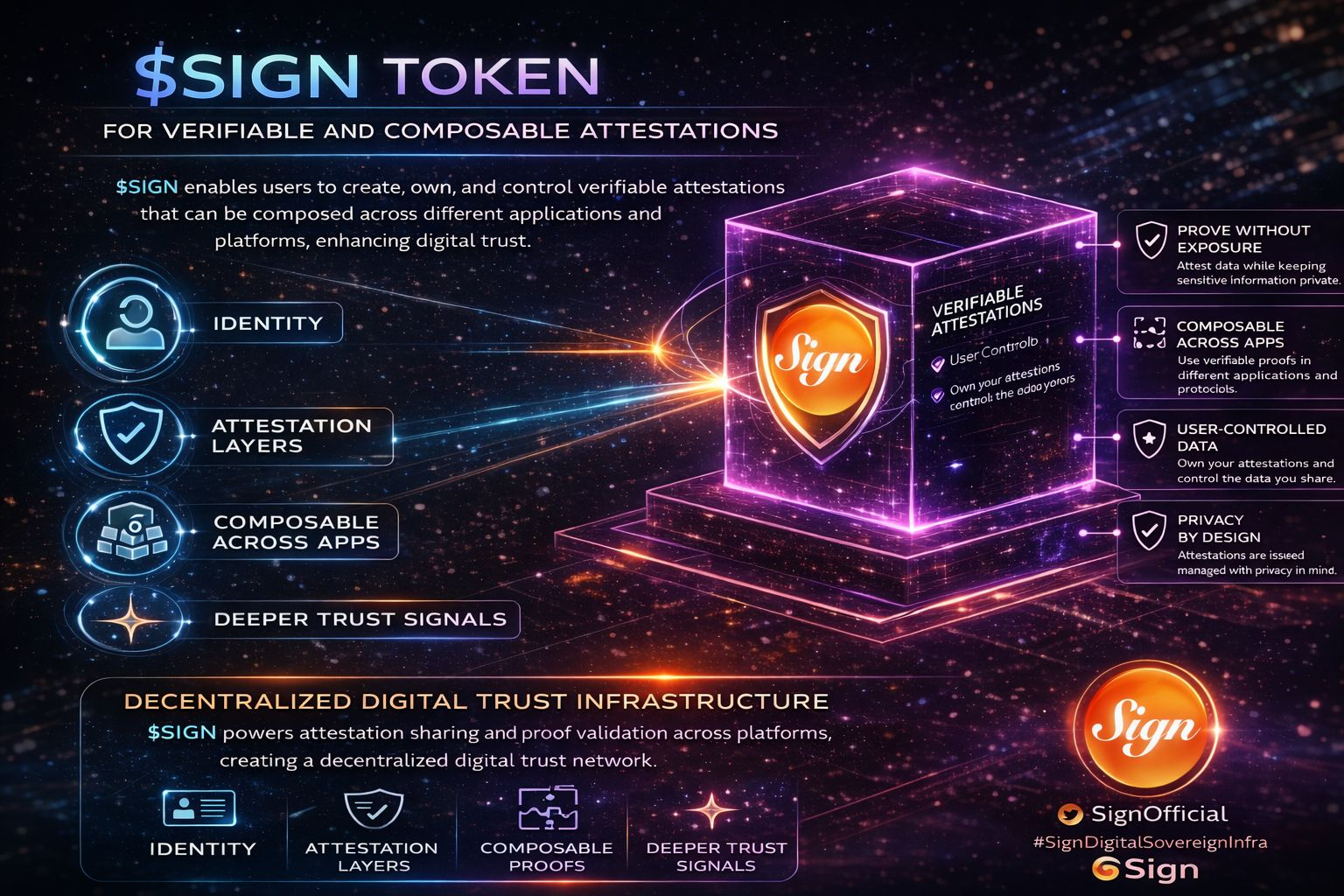
On the other hand, infrastructure tokens often struggle unless there’s clear, consistent demand that translates into economic activity. It’s not enough to be useful in theory. The system has to generate usage that people are willing to pay for, and that usage has to scale. Otherwise, you end up with a technically important protocol that the market underprices for years.
I might be wrong about this, but I think the real question isn’t whether Sign works. It’s whether other protocols start depending on it in a way that’s hard to unwind. That’s usually the signal I look for. When something stops being optional and starts becoming embedded.
The bull case, if I try to lean into it, is actually pretty interesting. If more applications start building on verifiable attestations instead of reinventing trust systems internally, you could see a kind of standardization emerge. And once standards lock in, they tend to be sticky. It’s the same pattern we’ve seen with ERC-20, with stablecoins, even with certain oracle providers. The market converges because it’s easier than fragmentation.
And if that happens, Sign isn’t just another project. It becomes part of the underlying fabric that other systems rely on. Not flashy, not necessarily the thing retail talks about every day, but quietly critical. Those are often the assets that reprice the hardest once the market realizes what’s actually happening.
But I can’t ignore the other side. There’s a real chance this never breaks out of the “interesting but not essential” category. Developers might prefer to build their own solutions. Competing standards could emerge. Or the need for verifiable trust might not be as urgent as it seems from a theoretical standpoint.
The market sometimes misses things like this, but it also sometimes correctly ignores them.
And there’s another angle that keeps bothering me a bit. If everything becomes verifiable, what happens to the parts of crypto that thrive on ambiguity? Because let’s be honest, a lot of activity in this space benefits from gray areas. From narratives that can’t be easily checked. From systems that rely on perception as much as reality.
If Sign or anything like it actually succeeds in making trust fully verifiable, it doesn’t just improve the system. It forces a kind of clarity that might break certain business models entirely. And I’m not sure the market is ready for that, or even wants it.
So I keep circling back to the same question. Is this a necessary evolution, or is it an overcorrection? Is the market moving toward a world where everything needs to be provable, or will it continue to tolerate a mix of verification and narrative because that’s where the opportunity lives?
I don’t have a clean answer yet. I find myself watching small signals instead. Are new protocols integrating attestations by default? Are users interacting with systems where trust assumptions are minimized without even realizing it? Does the token activity reflect real usage, or just speculative positioning?
Because if trust really does become verifiable in a way that’s seamless and widely adopted, then a lot of what we currently treat as core narratives in crypto start to look fragile. Not immediately, but over time.
And if that shift is happening, even slowly, I’d rather be early in understanding it than late in reacting to it.
@SignOfficial #SignDigitalSovereignInfra $SIGN