

For a long time, I believed that if digital systems were built on transparent and immutable foundations, trust would naturally follow. It seemed logical. If identity, capital, and execution were all anchored to verifiable systems, then over time everything would begin to align. Verification would become portable, reputation would persist, and users would not need to rebuild their identity every time they moved between platforms.
In theory, coherence should have led to adoption.
In reality, fragmentation persisted.
The same person exists as multiple identities across different systems. Credentials that matter in one platform are meaningless in another. Capital moves freely across networks, but identity, verification, and compliance context do not move with it. Every system works, but each system works alone.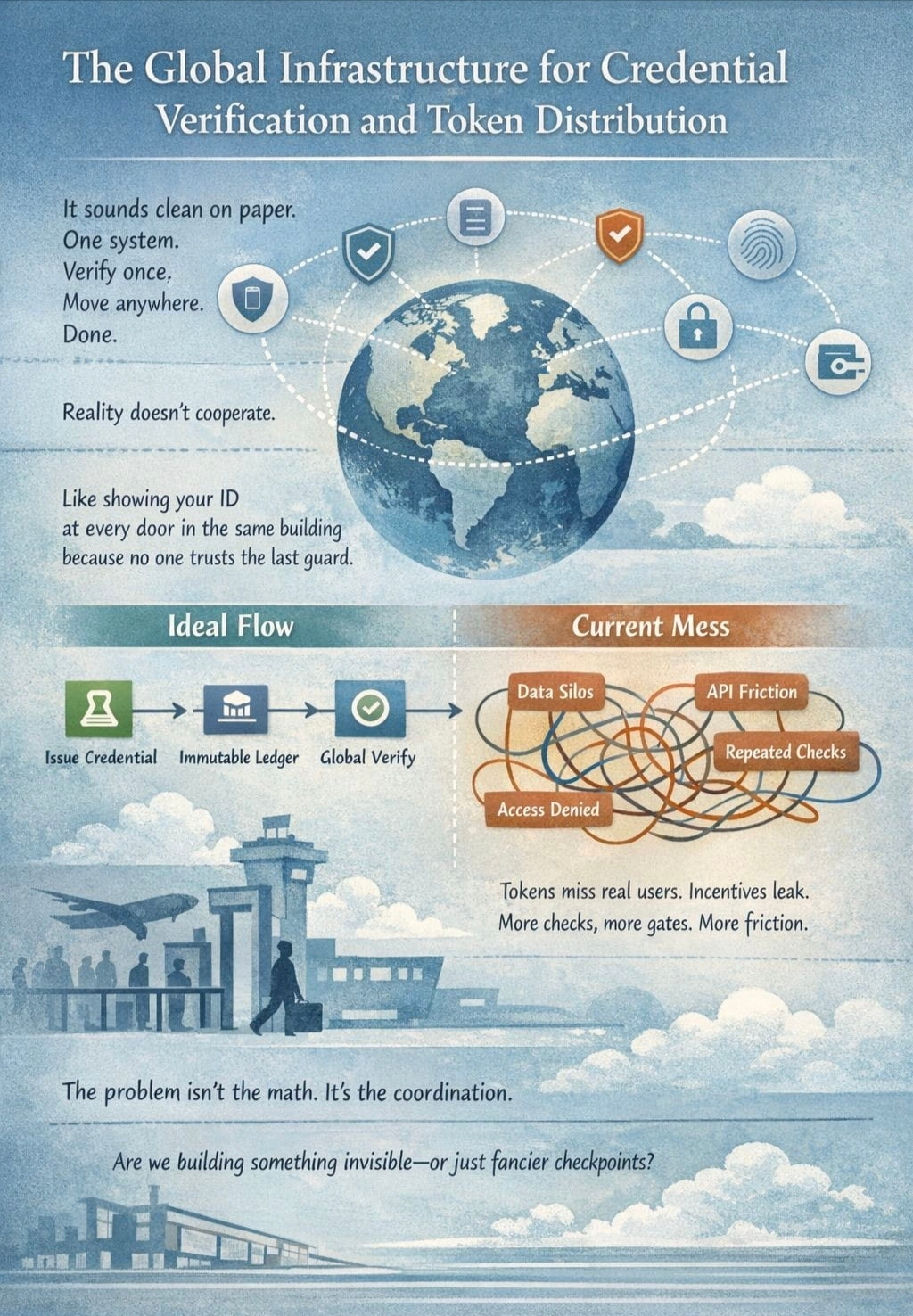
Nothing is broken.
But nothing connects.
This is when I started realizing that the real problem in digital systems is not functionality it is continuity.
Trust exists in many places, but it does not persist across environments. Every application rebuilds identity from the beginning. Every workflow repeats verification. Every distribution system defines eligibility as if no previous verification ever happened.
It is not a technology problem.
It is a memory problem.
Our digital systems do not remember enough about previous interactions in a way that other systems can reuse.
This creates a very subtle form of friction. Not the kind that immediately stops users, but the kind that slowly accumulates. Every time someone has to re-verify identity, re-submit documents, or re-establish eligibility, the system is quietly asking them to start over. Most users tolerate this a few times. Eventually, they stop returning.
What looks like a user experience issue is actually an architectural limitation.
We often talk about digital identity, on-chain execution, verifiable credentials, and proof systems as features. They are visible, easy to demonstrate, and easy to market. But features do not create lasting systems.
Infrastructure does.
Infrastructure behaves differently from products. Products try to attract attention. Infrastructure tries to disappear. The best infrastructure reduces steps, removes repetition, and allows processes to continue without restarting. When infrastructure works well, users barely notice it they only notice that things become easier over time.
This idea changed how I started evaluating new systems. I stopped asking what a protocol claims to enable, and started asking different questions:
Does this system reduce repeated effort?
Does it allow past actions to remain meaningful in the future?
Does it make future interactions easier without users needing to understand why?
Systems that succeed long-term usually do these things quietly.
This is where S.I.G.N. started to feel different to me.
At first glance, it looks like another trust or identity protocol. Crypto has explored that area many times identity frameworks, credential layers, attestation systems, proof networks. Many of them focus on decentralization, privacy, or removing intermediaries.
But the more I looked at the architecture, the more it seemed that the goal was not just digital identity or attestations.
The goal seemed to be continuity between systems.
S.I.G.N. does not try to replace existing systems or force everything into one network. Instead, it tries to create structure so that identity, verification, and execution can carry context across different environments.
That is a very different objective.
Instead of asking, “Can identity be decentralized?” the more important question becomes:
Can identity act as a stable anchor across multiple systems, while verifiable claims carry context forward wherever the user goes?
That question is less ideological and more architectural.
At the core of this structure are two simple ideas: schemas and attestations.
Schemas define how information is structured so different systems can understand the same claims in the same way. They create a shared language without forcing everyone to use the same platform.
Attestations are verifiable statements issued about an identity eligibility, reputation, compliance status, participation, approvals, or proof that something happened.
But the most important part is not that these attestations exist.
The important part is that they persist and can be reused.
Verification stops being something temporary and becomes something reusable. Systems no longer need to repeat the same verification process every time if they can reference existing attestations. Some information can be public, some private, some selectively disclosed depending on context.
This changes verification from a repeated process into a reusable layer of trust.
Of course, reuse only works if there are shared schemas and trusted issuers. Interoperability does not become automatic it becomes structured. But structured interoperability is often more realistic than universal interoperability.
Trust does not need to exist everywhere.
It just needs to be able to move.
Other components like token distribution systems and verifiable signing systems extend this structure into capital flows and agreements. Distribution can be tied to verified eligibility. Agreements can become verifiable records instead of one-time events. Identity, capital, and execution start to connect through shared verification rather than operating independently.
This is why the system feels less like a protocol and more like infrastructure.
Protocols usually try to introduce new features. Infrastructure reorganizes how existing systems interact.
The difference is subtle but important.
Features create activity.
Infrastructure creates continuity.
And continuity is what most digital systems are missing today.
Many regions are rapidly building digital identity systems, payment systems, fintech platforms, and distribution programs. But they are often built as separate silos. Identity exists in one system, payments in another, compliance in another, and distribution in another. Verification happens repeatedly in each system instead of once and then reused.
The future problem is not whether we can build digital systems.
The problem is whether those systems can remember and reuse trust.
But architecture alone does not determine success. Usage does.
Infrastructure does not become important because of design diagrams or whitepapers. It becomes important when people start using it repeatedly without thinking about it.
You know infrastructure is forming when:
Users stop repeating verification.
Systems start referencing previous credentials instead of recreating them.
Workflows continue instead of restarting.
Identity becomes persistent across applications.
Verification becomes background instead of a constant task.
Not hype.
Not announcements.
Repetition.
Infrastructure grows quietly.
It becomes visible only when things stop breaking, stop repeating, and start continuing.
I used to believe that if an idea made logical sense, it would eventually become necessary. But necessity rarely comes from logic alone.
It comes from repetition.
From systems that remember previous interactions.
From processes that continue instead of restarting.
From structures that allow trust to move forward instead of starting from zero every time.
The difference between an idea that sounds important and infrastructure that becomes indispensable is not design elegance, decentralization, or innovation.
It is whether people use it again.
And again.
And again.
Until eventually, they don’t even realize it’s there anymore.
