


I have been thinking about a specific failure mode that keeps appearing in national digital infrastructure deployments - and it is not the one most post-mortems focus on.
The failure mode is this: a government builds a technically functional on-chain system, then discovers that the off-chain institutions it needs to interact with - auditors, regulators, partner agencies, international oversight bodies - cannot reconcile the on-chain records with their own reporting requirements. The on-chain data exists. It is verifiable. It is accurate. And it is completely unusable for the compliance, audit, and reporting workflows that the off-chain institutional world actually runs on.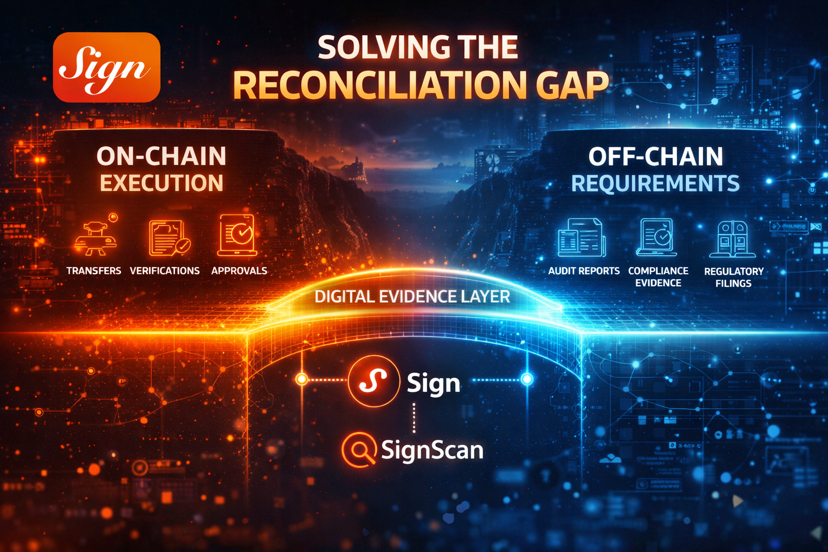
That seam between on-chain execution and off-chain institutional requirements is where billions in government digital program value disappears quietly. Not through fraud. Not through technical failure. Through reconciliation gaps that nobody budgeted for and nobody knows how to close after the fact.
I spent time tracing where this breakdown occurs specifically in the kinds of programs @Sign is targeting. Take a national benefit distribution program running on-chain infrastructure. The execution layer works - transfers happen, amounts are correct, timing is accurate. But the treasury audit team needs a report showing which version of the eligibility rules was in effect when each transfer executed. The external compliance reviewer needs evidence that AML checks ran before each disbursement. The international development organization monitoring the program needs reconciled data showing that recipient counts match the allocation manifest that was approved before the program launched. None of those requirements are satisfied by transaction records alone. They require a structured evidence chain that links each execution event back to the specific rules, approvals, and verifications that authorized it.
This is not an edge case. It is the standard operating requirement for any government program subject to audit. And most on-chain distribution infrastructure was not built with that requirement in mind.
@Sign’s architecture treats the reconciliation gap as a first-order design problem rather than a post-deployment integration challenge. Sign Protocol generates structured evidence artifacts at every significant event - not as a reporting layer added afterward, but as a structural output of the execution process itself. When a TokenTable distribution event executes, it produces a Sign Protocol attestation capturing the allocation manifest reference, the eligibility attestation that authorized the transfer, the ruleset version hash in effect at execution time, and the on-chain transaction reference. When a New ID System credential verification occurs, it produces an attestation capturing the issuer identity, the credential schema version, the verification timestamp, and the selective disclosure scope. All of it queryable through SignScan by any authorized institution - treasury auditors, external compliance reviewers, Binance’s institutional due diligence teams, international oversight bodies - independently of the program operator.
The practical implication is that the audit package is the execution record. Not a reconstruction of it. Not an approximation assembled from logs and administrative documentation weeks after the fact. The evidence that satisfies off-chain institutional requirements is produced at the moment of on-chain execution and made permanently available for query.
I find that architectural choice more significant than it sounds on a first read. The reason is that most reconciliation problems in government digital programs are not discovered during normal operations. They surface during audits, reviews, and disputes - often months or years after the underlying events occurred. By that point, reconstructing a credible evidence chain from scattered system logs, email records, and administrator accounts is expensive, time-consuming, and inherently contestable. @Sign’s approach makes that reconstruction unnecessary because the evidence chain was never broken in the first place.
The connection to Binance’s ecosystem is worth tracing specifically for this audience. Binance has invested heavily in institutional-grade compliance infrastructure - KYC processes, transaction monitoring, regulatory reporting across multiple jurisdictions. Projects building on Binance’s ecosystem increasingly face institutional due diligence requirements that demand the same kind of on-chain evidence that @Sign’s architecture produces structurally. A project that can demonstrate Sign Protocol-anchored attestations for its governance decisions, its distribution events, and its compliance approvals is a meaningfully different risk profile from a project where that evidence needs to be reconstructed from off-chain records. That distinction compounds as Binance’s institutional product suite expands.
The cross-agency dimension of the reconciliation problem is also worth examining. Government programs rarely involve a single agency. A national housing program might involve an identity agency for eligibility verification, a tax authority for income confirmation, a financial regulator for disbursement oversight, and an international development bank for program monitoring. Each of those institutions has different reporting requirements, different audit timelines, and different technical environments. The traditional approach is to build bilateral data exchange agreements between each pair of institutions - a combinatorially expensive integration problem that produces a fragile web of dependencies.
@Sign’s shared evidence layer collapses that problem. Each institution queries Sign Protocol attestations through SignScan using its own tools and in its own timing. The evidence layer does not require bilateral agreements between institutions. It requires each institution to have query access to the same attestation index. That is a fundamentally different integration model - and a considerably more scalable one as the number of participating institutions grows.
That said, I want to be honest about what @Sign’s architecture does not solve on its own.
The reconciliation gap has a technical dimension and an organizational dimension. @Sign addresses the technical dimension well - structured evidence artifacts, queryable attestation index, standardized schemas. The organizational dimension is harder. Getting multiple government agencies to agree on shared attestation schemas, common evidence formats, and unified query access requires the kind of cross-agency coordination that has defeated simpler GovTech initiatives for decades. The architecture being technically ready does not mean the institutional alignment follows automatically.
The evidence retention dimension also deserves attention. Sign Protocol attestations are anchored on-chain and designed to be permanently queryable. But permanently queryable evidence is only valuable if the chain and indexing infrastructure remain operational and accessible over the relevant audit horizon - which for government programs can be ten to twenty years. How @Sign’s infrastructure handles long-term evidence retention and chain migration risk is something I have not seen addressed comprehensively in current documentation.
Still. Starting from the reconciliation gap as the core design problem is the right framing. Most on-chain government infrastructure treats audit and compliance as features to be added later. @Sign treats them as the structural output that the system is designed to produce. That inversion is quiet, unglamorous, and considerably more important than most of the things that get highlighted in project announcements. Worth following closely as institutional deployments develop.