
Most people fall in love with blockchain because of permanence. The idea that once something is signed, it lives forever, untouched and undeniable. It sounds powerful, almost poetic. But the longer you stay in this space, the more you realize that permanence alone is not what creates trust. In many cases, it quietly introduces risk.
Because reality is messy.
Keys get exposed. Interfaces mislead. Terms shift after you sign. Sometimes you simply don’t understand what you agreed to until it’s too late. And in a system that prides itself on immutability, that moment of realization can feel heavy. You’re left wondering if there’s any way to step back, or if you’re permanently tied to a decision you didn’t fully grasp.
This is where revocation stops being a “feature” and starts revealing itself as something much deeper. It’s not about undoing the past. It’s about protecting your future.
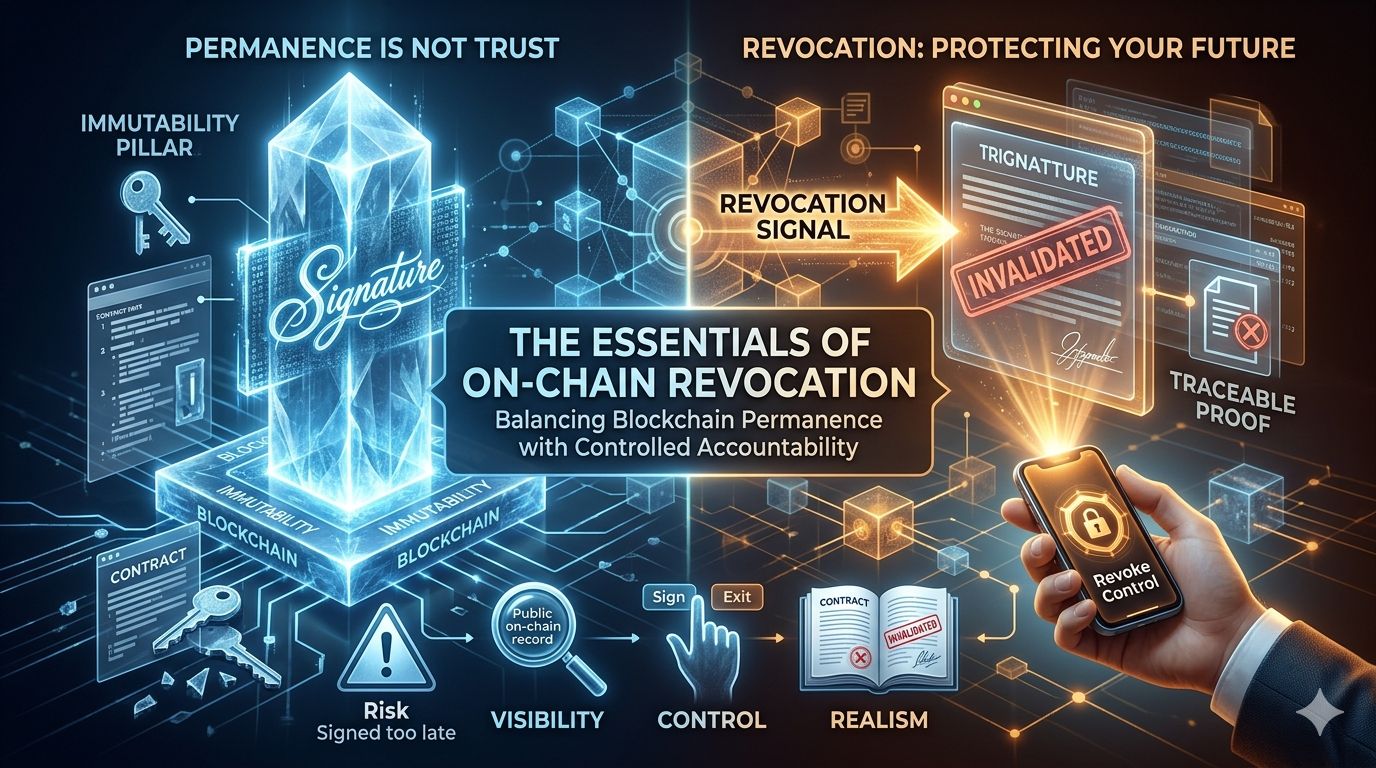
At its simplest, revocation is the ability to say: this signature should no longer be considered valid. Not erased, not hidden, but clearly marked as no longer trustworthy. That distinction matters more than most people think. Blockchain doesn’t forget, and it shouldn’t. But it needs a way to reflect that truth can evolve over time.
Without that, every signature becomes a potential trap.
A well-designed system doesn’t just let you sign; it lets you exit with clarity. It answers questions before you even think to ask them. Who actually has the power to revoke? If that answer isn’t clear, the system already feels unstable. Because if anyone can invalidate your signature, trust collapses. And if only the system can, without your control, then you’re not really in control at all.
Timing matters just as much. Can you revoke anytime, or only under certain conditions? Both approaches can work, but uncertainty cannot. Not knowing whether you can exit is where risk begins to creep in.
Then there’s visibility, which might be the most important part of all. A revocation that isn’t clearly recorded on-chain doesn’t carry real weight. If someone can look at your old signature and still pretend it’s valid, the system has already failed you. Revocation needs to leave a clean, undeniable trace. Something anyone can verify instantly, without relying on hidden layers or off-chain interpretation.
Because if that clarity is missing, people will exploit it.
They’ll reuse old approvals. They’ll lean on outdated signatures. They’ll take advantage of the gap between what is technically true and what is visibly provable. And in a trust-based system, that gap is dangerous.
At the same time, revocation can’t be careless. If it’s too easy, agreements lose meaning. People walk away without consequence. Commitments become fragile. The system starts to feel unreliable in a completely different way.
So the challenge isn’t just adding revocation. It’s designing it with balance.
It should protect users without weakening accountability. It should allow exits without encouraging abuse. It should leave a record that doesn’t erase responsibility, but clearly signals that something has changed.
In that sense, revocation isn’t an “undo” button. It’s more like a statement: this is no longer valid, and here is the proof.
That’s what makes it so fundamental.
When you sign something on-chain, you’re not just interacting with code. You’re attaching your identity, your intent, and sometimes your assets to a permanent record. That’s a serious action. And without a clear way to step away when things go wrong, it becomes a dangerous one.
You shouldn’t need to be perfect to participate safely. You shouldn’t have to assume every interaction will go exactly as planned. And you definitely shouldn’t be locked into something simply because the system forgot to include an exit.
Revocation introduces a kind of realism into blockchain design. It acknowledges that people make mistakes. That systems evolve. That trust isn’t fixed forever, it’s something that needs to be maintained, updated, and sometimes withdrawn.
It shifts the conversation away from blind permanence and toward controlled accountability.
Because real trust isn’t about never changing anything. It’s about knowing that when something does change, there’s a clear, transparent, and fair way to handle it.
And that’s why revocation doesn’t feel like an advanced concept. It feels like something that should have been there from the very beginning.
Basic, quiet, and absolutely essential.
@SignOfficial #SignDigitalSovereignInfra $SIGN
