
I will be real with you I used to think protocols lIke @SignOfficial were just another tool i used without thinking. I log in, check my balances, manage my Identity, and everything felt normal. but the more I dug into how SIGN actually works, the more I realized something that really shook my assumptIons. The system I am using today can quietly change tomorrow, and I mIght not even notice.
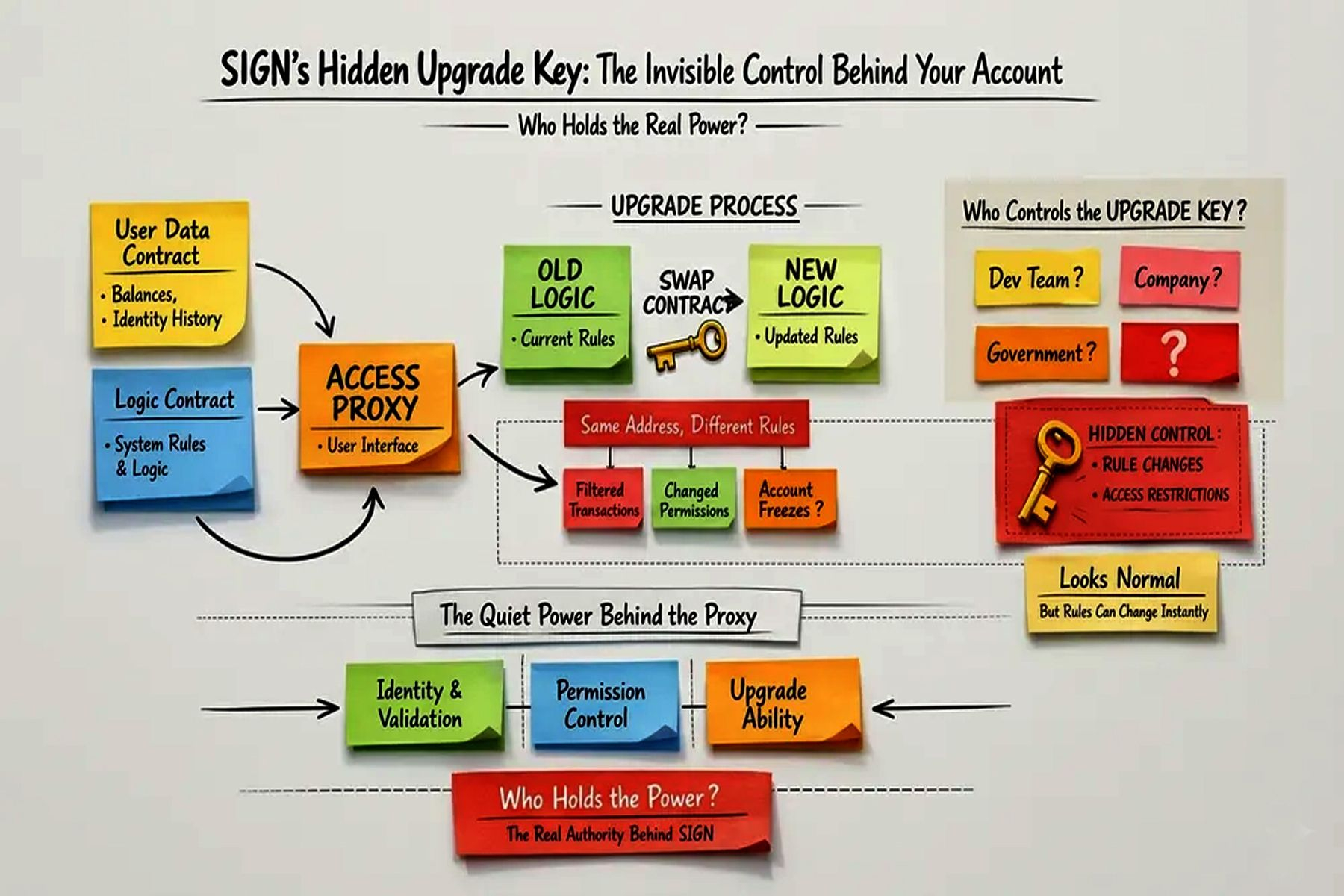
Here is how it works. SIGN does not put all the logic and data into one fixed contract. instead, it splits them into two. one contract holds my data balances, Identity history, everything that makes my account mine. the other contract holds the logic the rules, how the system behaves, what is allowed and what is not. and sitting in front of it all is the proxy, the thing I actually interact with. I think I am using the system normally, but really, I am using the proxy.
the part that really hit me? That logic contract can be swapped out. same contract address. Same user account. DIfferent rules. That is the upgrade. On paper, it sounds useful. bugs happen. improvements are needed. no one wants to migrate mIllions of users every time something breaks. Upgradeable proxies solve that problem neatly. no disruption. everything stays smooth.
But here is where it gets serious. Whoever controls the upgrade key does not just fix bugs. they control the rules of the system. They do not need to shut anything down, freeze accounts, or make a big announcement. they just push a new Implementation behind the proxy. suddenly, transactions can be filtered, permissions can change, access can be restricted, and rules can tIghten all without me noticing. Everything still looks normal.
that is the quiet power of $SIGN design. On the surface, it feels decentralIzed. behind the scenes, there is a lever of control built in. The sign protocol layer makes it even more subtle, because it ties Identity, validation, and approval into the system. upgrades are not just technical they can literally decide who is allowed to do what.
I am not saying upgrades are bad. without them, most systems would break or become useless over time. FlexibIlity is necessary. But let is not pretend it is neutral. Whoever holds the upgrade key holds the real power. if it is a small dev team, that is one level of risk. If it is a company, that is another. If it is a government or central authority, that is a whole different level.
because now I am not just talking about fixing bugs. I am talking about policy being quietly enforced through code. and the scary part? It does not look lIke control. It looks lIke maintenance. That is why I never blindly trust anything upgradeable. Convenience is nice, but it trades permanence for flexibIlity. And flexIbility always belongs to whoever is in charge.
Now, whenever I use SIGN, the first thing i think about is not the interface or my balances. It is the upgrade key. Who controls it? That is the real owner, not the code I can see, not the address I interact with. That is the quiet truth behind the system. UnderstandIng it is the only way to really know who holds the power.
SIGN has made me more aware of how systems that feel decentralized can stIll have hidden control. It is not about fear it is about understanding. If you are using SIGN or any protocol tied to identity, permissions, or approval, take a moment to ask the same question I ask myself: who can upgrade it? Because that person or entity is not just maintaining the system they are shaping it, quietly and completely, while the rest of us keep using it lIke nothing changed.

