
I want to be honest. When I first heard about @SignOfficial I focused mostly on the identity and CBDC side of things. That part of the story is genuinely impressive. But the more I dug into the whitepaper the more I realized I was missing something equally important. TokenTable. And once I understood what it actually does I could not stop thinking about it.Let me explain what TokenTable is and why it matters for anyone holding $SIGN.At its core TokenTable is a programmable asset distribution and tokenization platform. The headline number is 40 million users globally. That is not a projection. That is current real world adoption. But the number alone does not tell you what makes it special. What makes it special is how it works and what it plugs into.When a government needs to send welfare payments to millions of citizens the traditional process is slow, expensive and full of opportunities for fraud. Money passes through multiple intermediaries. People claim payments they are not entitled to. Duplicate payments happen. Funds get lost. The people who need the money most end up waiting the longest.
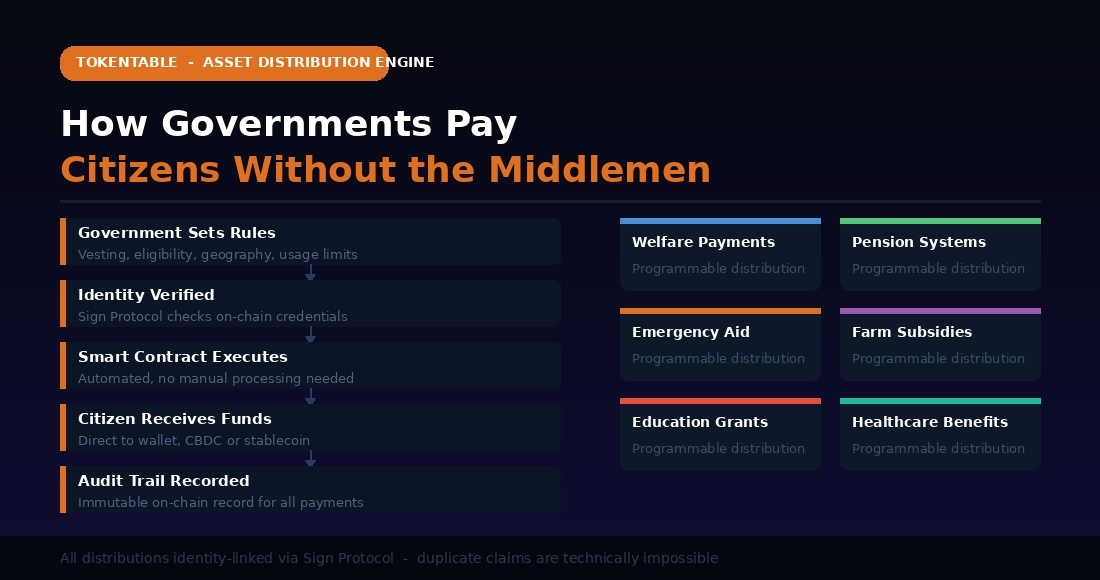
TokenTable removes every one of those problems in a single system.Here is how the flow actually works according to the Sign whitepaper. The government first sets the rules inside a smart contract. This can include vesting schedules for long term benefits, multi stage eligibility conditions that require a citizen to meet several criteria before funds release, geographic restrictions so that subsidies only work in approved regions, and usage restrictions so that for example food subsidies can only be spent on food. Once those rules are locked in the smart contract handles everything automatically.
Before any payment goes out Sign Protocol checks the recipient's on chain credentials. This is the identity layer connecting to the distribution layer. If a person is verified and eligible the payment executes. If they are not the payment does not go through. There is no human in the middle making that decision. The code makes it. That means duplicate claims are technically impossible because you cannot fake a verified on chain identity and you cannot collect the same payment twice from a wallet that has already been marked as paid.
Every single payment is recorded on chain permanently. Governments get a real time audit trail they can show to citizens, oversight bodies and international partners without needing to run a separate audit process. Transparency is built in by default.
Now here is where it gets even more interesting. TokenTable does not just handle cash payments. It also handles something called real world asset tokenization. And this is where Sign starts to look less like a fintech project and more like a complete national infrastructure platform.
Real world asset tokenization means taking physical assets and representing them on the blockchain. Land. Buildings. Art. Government bonds. Public infrastructure. All of it can be turned into a digital token that lives on chain and can be transferred, verified and tracked without paper, without manual registries and without the delays that come with traditional legal systems.
For land registries this is a massive deal. Right now in most countries buying and selling land involves weeks of paperwork, multiple government offices, lawyers, and title insurance because nobody can fully trust the record. With Sign that record lives on chain. It is immutable. Anybody can verify who owns what in seconds. When a property transfers the history of every previous owner is right there. Disputes become easier to resolve because the record cannot be altered. Foreign investors can verify property ownership in a new country without needing to trust a local institution they have never worked with before.
For art and cultural heritage the benefits are similar but the stakes are different. National museums can put their collections on chain with complete provenance records. Every exhibition, every loan to another institution, every restoration is recorded. Forgeries become much harder to sell because buyers can verify the entire history of a piece before purchasing. Governments can protect cultural assets from illicit trade in a way that was never possible with paper records.
For government bonds and treasury securities tokenization brings programmability. A bond can be issued on chain with automated coupon payments built into the contract. Compliance rules get enforced automatically. Secondary market trading happens with instant settlement instead of the days long process that traditional bond markets require.
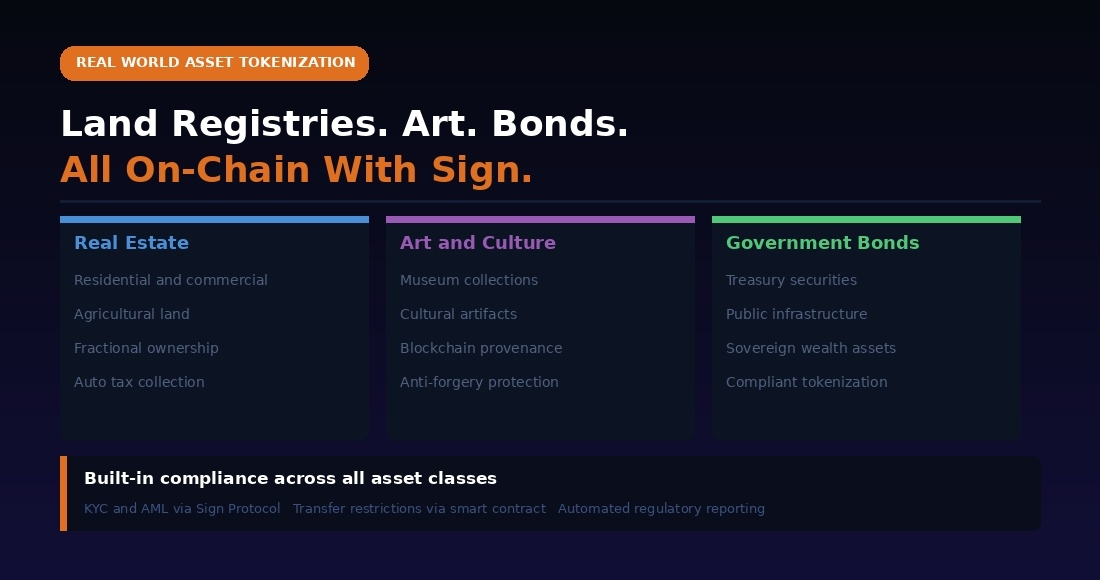
What ties all of this together is the compliance layer. TokenTable does not just tokenize assets and hope for the best. It integrates KYC and AML checks directly through Sign Protocol identity attestations. Transfer restrictions are enforced by smart contract so that only verified and eligible parties can acquire specific asset classes. Regulatory reporting is automated. Cross border asset verification works without needing complex bilateral agreements between governments because everything is on a shared neutral blockchain.
The thing I keep coming back to when I think about TokenTable is that it solves problems governments have been struggling with for decades. Not theoretical future problems. Real problems that are costing money and excluding people right now. And it solves them in a way that actually makes governments more transparent and accountable rather than less.
For anyone thinking about SIGN from a value perspective this is the piece of the puzzle that I think gets underweighted. Identity is compelling. CBDC infrastructure is impressive. But TokenTable is where governments touch millions of citizens every single day. Every welfare payment, every pension, every subsidy, every land transfer that runs through TokenTable is a transaction that runs through Sign infrastructure. And as that adoption grows so does the utility of everything SIGN powers.
@@SignOfficial is not building one thing. They are building an entire operating system for how nations manage money, identity and assets in the digital age. TokenTable is one of the most important parts of that system. Now you know why.