Honestly… I didn't expect to feel this particular kind of discomfort reading a whitepaper.
Not skepticism. not boredom. something closer to irony.
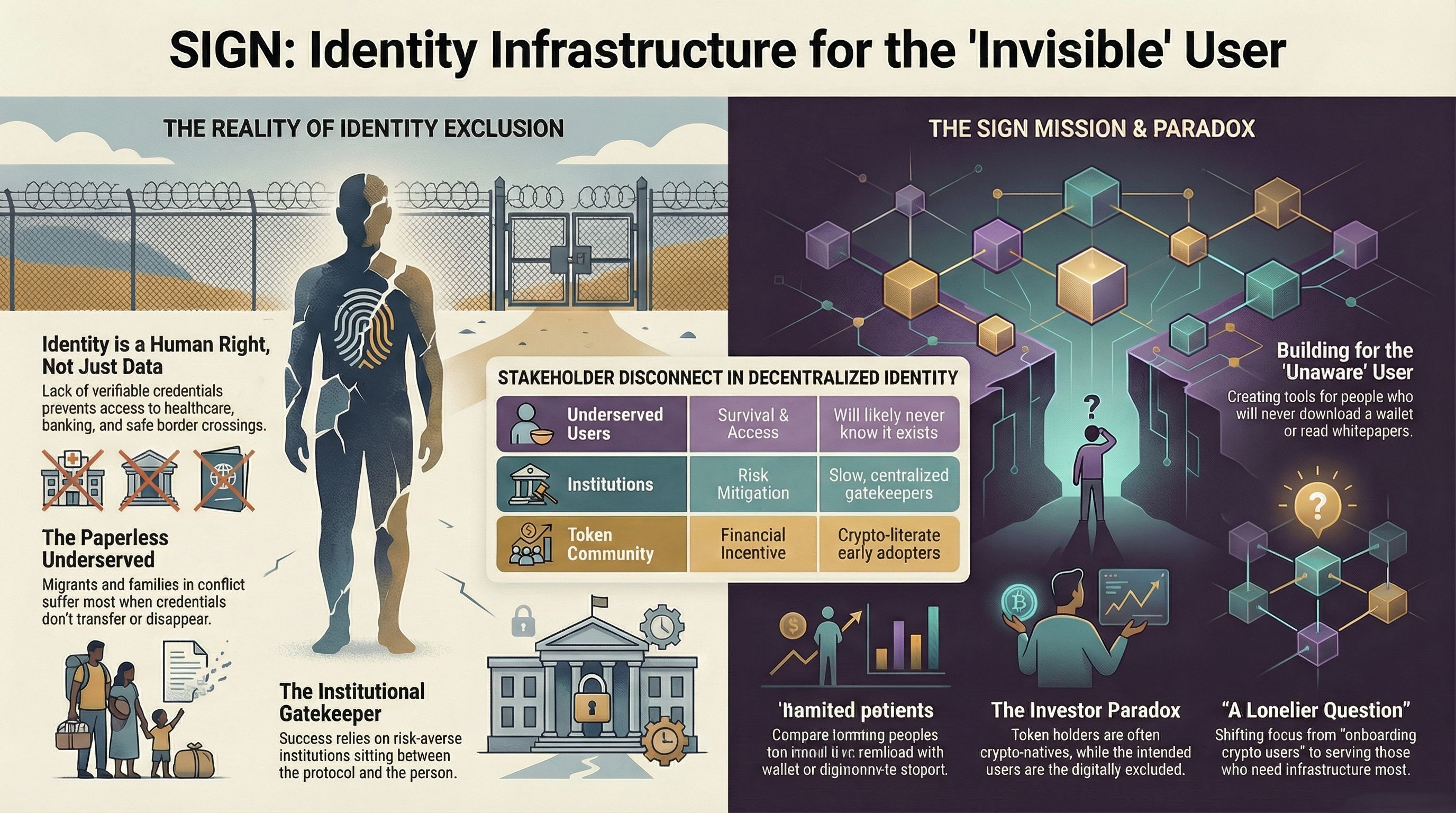
because there's a pattern in this space that nobody talks about directly. the people who design infrastructure for the underserved are almost never the underserved. the people who write the whitepapers, raise the funding, get the early allocations, debate the architecture in english on crypto twitter… are not the people standing at a border crossing with no valid document. are not the migrant worker whose credentials don't transfer. are not the family whose records disappeared in a conflict they didn't choose.
and when I read SIGN's positioning, that tension hit harder than usual.
because the problem they're describing is real. genuinely real. identity infrastructure is broken in ways that hurt actual people in actual places every single day. the gap between having verifiable credentials and not having them isn't abstract. it determines whether you can open an account, sign a contract, cross a border, access healthcare, prove you exist to a system that keeps asking.
so yeah… the problem is right.
but paper has never been the problem.
the real issue is who the conversation is actually for.
because here's what I keep coming back to. the people SIGN could help the most will never download a non-custodial wallet. they will never read a whitepaper. they will never buy a token or track a leaderboard or care about on-chain attestation schemas. they will use whatever their government gives them, on whatever interface their government builds, assuming their government decides to build it at all.
which means SIGN's actual user isn't the person they describe in the pitch.
it's the institution that sits between the protocol and that person.
and institutions are slow. risk-averse. politically constrained. answerable to stakeholders who have never heard of a blockchain and don't intend to learn. getting one institution to pilot something new is a small miracle. getting an entire regional identity ecosystem to migrate toward shared infrastructure requires a level of coordination that has defeated far better-funded efforts than this.
that's not a technical challenge. that's a human one.
then comes the token. because of course.
and here's where the irony sharpens. the token creates a community of people who are financially incentivized to want SIGN to succeed. that sounds good until you realize that community looks nothing like the actual end users. it's traders, farmers, early adopters, crypto natives who will move on to the next thing the moment momentum slows. the people most invested in the token are the least representative of the people the infrastructure is supposed to serve.
that's a strange foundation for something positioned as neutral public good.
there's also a deeper contradiction nobody names directly.
decentralized identity infrastructure still requires centralized trust to reach scale. a credential only means something if the relying party accepts it. the relying party only accepts it if they trust the issuer. the issuer only participates if they trust the protocol. and the protocol only gets trusted if enough powerful institutions decide to back it. somewhere in that chain, the decentralization argument quietly depends on a very small number of very centralized decisions going the right way.
we've seen what happens when they don't.
still… I'll say this.
SIGN is asking a question that most projects are too comfortable to ask. not "how do we onboard the next million crypto users" but "how do we build something that works for people who will never know it exists."
that's a harder question. a lonelier one.
whether the answer is good enough… I genuinely don't know.
but I keep thinking about the person at the border crossing.
and in this space, being unable to stop thinking about something is about as close to a compliment as I get.
@SignOfficial #SignDigitalSovereignInfra $SIGN