
$SIGN In a world drowning in information but starving for verifiable truth, the need for structured, tamper-proof claims has never been greater. Social media amplifies opinions, deepfakes erode visual evidence, and centralized platforms control what we “know” about identities, credentials, ownership, and agreements. Blockchain promised a trustless alternative, but fragmented chains and siloed data often left verification as messy and unreliable as the off-chain world it aimed to replace.
Enter @SignOfficial Sign Protocol — an omni-chain attestation layer that lets anyone create, store, and verify digital claims across blockchains like Ethereum, Solana, TON, and more. What begins as a technical protocol for on-chain attestations quickly starts to feel like something far more foundational: a global trust infrastructure for the digital age.
The Problem: Truth Without Structure Is Just Noise
Without a standardized way to assert and prove facts on-chain, Web3 struggles with basic questions:
• Is this wallet really the owner of that NFT or asset?
• Does this person hold a legitimate certification or credential?
• Was this agreement digitally signed and enforceable?
• How do we verify identity or reputation across apps and chains without relying on centralized gatekeepers?
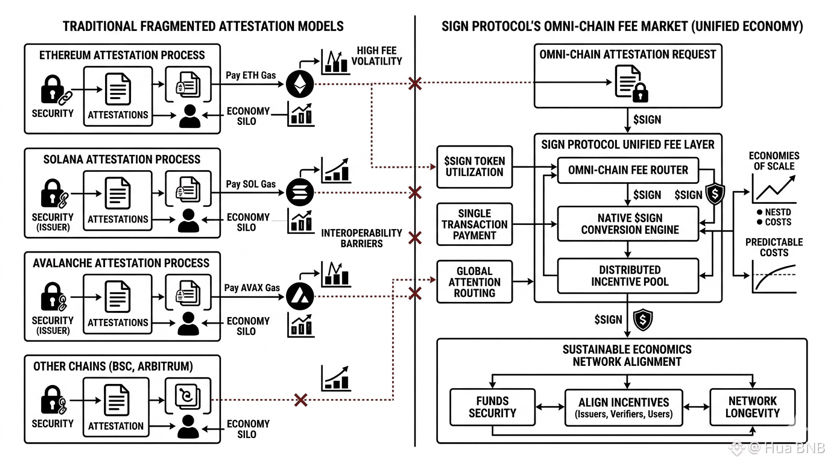
Traditional solutions — off-chain databases, single-chain tools, or centralized “oracles” — introduce single points of failure, privacy risks, or interoperability headaches. Even existing attestation systems (like Ethereum Attestation Service) often remain chain-specific or limited in scope.
Sign Protocol addresses this head-on by treating attestations as first-class, chain-agnostic primitives. An attestation is essentially a cryptographically signed statement: an attester (individual, institution, or smart contract) makes a claim about a subject using a predefined schema (structured data format). These can include identities, ownership proofs, certifications, agreements, or almost any verifiable fact.
Key features that set it apart:
• Omni-chain design: Issue an attestation on one chain and verify it seamlessly on another. No more being locked into a single ecosystem.
• Structured schemas: Data is organized in flexible key-value pairs, making it adaptable yet queryable and verifiable.
• Privacy-preserving tech: Zero-knowledge proofs (ZK), encryption, and selective disclosure allow users to reveal only what’s necessary.
• On-chain + off-chain flexibility: Store evidence publicly for transparency or privately with cryptographic anchors for sovereignty and compliance.
• Verifiability at scale: Anyone can query, retrieve, and cryptographically verify attestations without trusting intermediaries.
This isn’t just “signing documents on-chain” (though it evolved from EthSign’s contract-signing roots). It’s building a universal evidence layer where truth gets structure, and structure enables scalable trust.
Why It Feels Bigger Than “Just a Protocol”
The more you explore Sign Protocol, the less it resembles a narrow tool and the more it starts looking like foundational infrastructure — the kind that underpins entire economies and even sovereign systems.
1. From Web3 Niches to Real-World Utility
Attestations power everything from decentralized identity (DID) and reputation systems to compliant token distributions (via its sister product TokenTable), airdrops, vesting, and governance. Developers can build referral networks, reward systems, or point-based economies on top of verifiable claims. Nations and institutions are exploring it for sovereign blockchain adoption, digital assets, and national-scale identity or compliance layers — with privacy controls and interoperability that respect regulatory needs.
2. Standardizing Trust Across Fragmented Chains
In a multi-chain world, consistency is power. Sign Protocol creates a common language for claims, turning scattered trust mechanisms into a clean, interoperable layer. This quietly shifts Web3 from hype-driven silos toward composable, verifiable primitives — much like how TCP/IP standardized the internet.
3. Sovereignty and Privacy by Design
Its dual-layer approach (public transparency + private/enterprise-grade data bridged by ZK) appeals to both decentralized communities and governments. It enables “trust but verify” at global scale while preserving selective disclosure — you prove you’re over 18 without revealing your exact birthdate, or prove ownership without exposing your full portfolio.
4. Network Effects Potential
Once schemas and attestations proliferate, the protocol becomes more valuable with every new use case. A certification issued by a university can be verified by employers anywhere. An on-chain agreement signed via EthSign becomes enforceable across ecosystems. The protocol starts acting like a shared truth backbone rather than a single app.
Sign’s broader ecosystem (including SignPass, TokenTable, and signatures) reinforces this. It’s not just about attesting facts — it’s about making verifiable data programmable, distributable, and actionable at scale. Some even describe the vision as building toward a “global proof system” or on-chain infrastructure akin to a Web3-era utility layer.
The Bigger Picture: Truth Infrastructure in the Age of AI and Disinformation
As AI generates convincing content and centralized platforms curate reality, the demand for cryptographically grounded truth will explode. Sign Protocol positions itself at this intersection: not as another speculative token project, but as the plumbing that lets decentralized systems (and potentially sovereign ones) operate with verifiable integrity.
It won’t replace human judgment or off-chain institutions overnight, but it provides the missing structure — schemas, signatures, cross-chain anchors — so that when truth needs to be structured and provable, the tools exist on open, permissionless infrastructure.
Of course, challenges remain: adoption beyond crypto natives, regulatory navigation for sovereign use cases, and ensuring the protocol stays neutral and decentralized as it scales. Yet its omni-chain focus, privacy toolkit, and real-world traction (millions of users served through related products, significant token distributions) suggest it’s solving painful problems rather than chasing trends.
Final Thoughts
When truth needs structure, a simple signing tool isn’t enough. You need an attestation layer that’s flexible, interoperable, private when it must be, and transparent when it should be. Sign Protocol started as an evolution of on-chain signing but increasingly feels like the beginning of something larger: a verifiable data fabric for Web3, institutions, and potentially global digital infrastructure.
It’s still early, and like any foundational technology, its true impact will show in what gets built on top of it. But if you’re watching where real trust infrastructure is quietly being laid — not just hype cycles — Sign Protocol is hard to ignore.
The protocol may have a name, but the layer it’s building feels destined to become much bigger.
What do you think — is attestation infrastructure the next quiet primitive that changes how we trust online? Drop your thoughts below.

(Article inspired by ongoing discussions in the Sign community and its technical vision as an omni-chain attestation protocol.)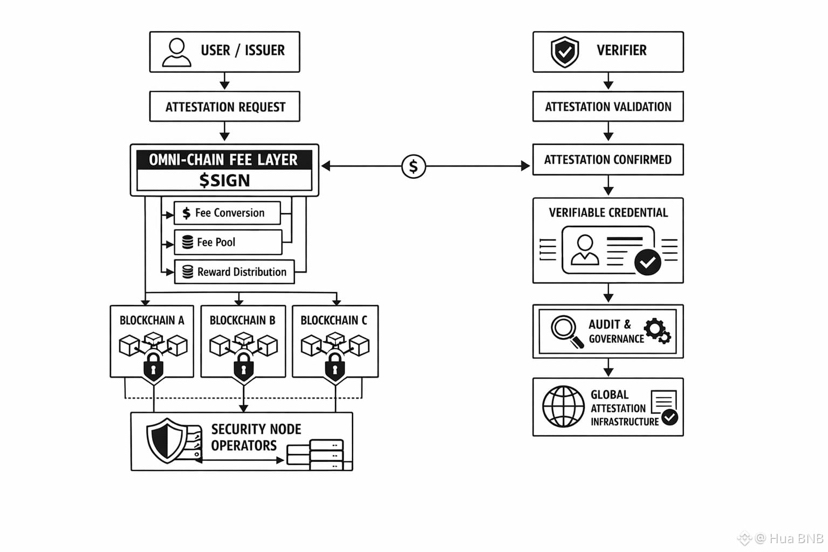
#signdiditalsovereigninfra #Sign #USNoKingsProtests #BitcoinPrices #TrumpSeeksQuickEndToIranWar