
Most digital systems today can move money instantly, but they still struggle to move trust. Verification is slow, fragmented, and often repeated across platforms. SIGN approaches this differently by turning trust into something that flows continuously rather than something that gets checked at isolated points. Instead of treating identity, credentials, and distribution as separate layers, it connects them into a single system where proof directly influences access and value.
At its core, SIGN introduces attestations as reusable units of truth. Unlike traditional credentials that sit idle after issuance, these proofs can travel across applications and chains. A single verification event does not stay locked in one platform; it becomes portable and usable in multiple contexts. This changes behavior in a meaningful way. Users no longer need to repeatedly prove the same thing, and systems no longer need to re-verify what has already been cryptographically established. Trust becomes something that compounds over time instead of resetting at every interaction.
What makes the model more compelling is how closely verification is tied to token distribution. In most ecosystems, these two processes are disconnected. One system determines eligibility, and another handles rewards. SIGN merges them into a continuous loop where proof directly triggers allocation. This creates a structure where eligibility is not guessed or loosely filtered but precisely defined and enforced through verifiable data. The outcome is a more controlled and transparent distribution process, reducing waste, abuse, and inefficiencies that are common in open or poorly targeted airdrops.
The system’s growth becomes clearer when viewed through behavioral signals rather than surface-level hype. Processing over 6 million attestations within a year suggests repeated and embedded usage, not one-off events. Distributing more than $4 billion worth of tokens to tens of millions of wallets indicates that the infrastructure is already operating at significant economic scale. The trajectory toward expanding wallet participation shows increasing reliance on structured distribution rather than random allocation models. At the same time, verification speeds measured in seconds demonstrate that the system is fast enough to function within live user experiences instead of slowing them down. The diversity of use cases, from audits and developer reputation to agreements and identity validation, points toward horizontal adoption, which is a key trait of infrastructure-level systems.
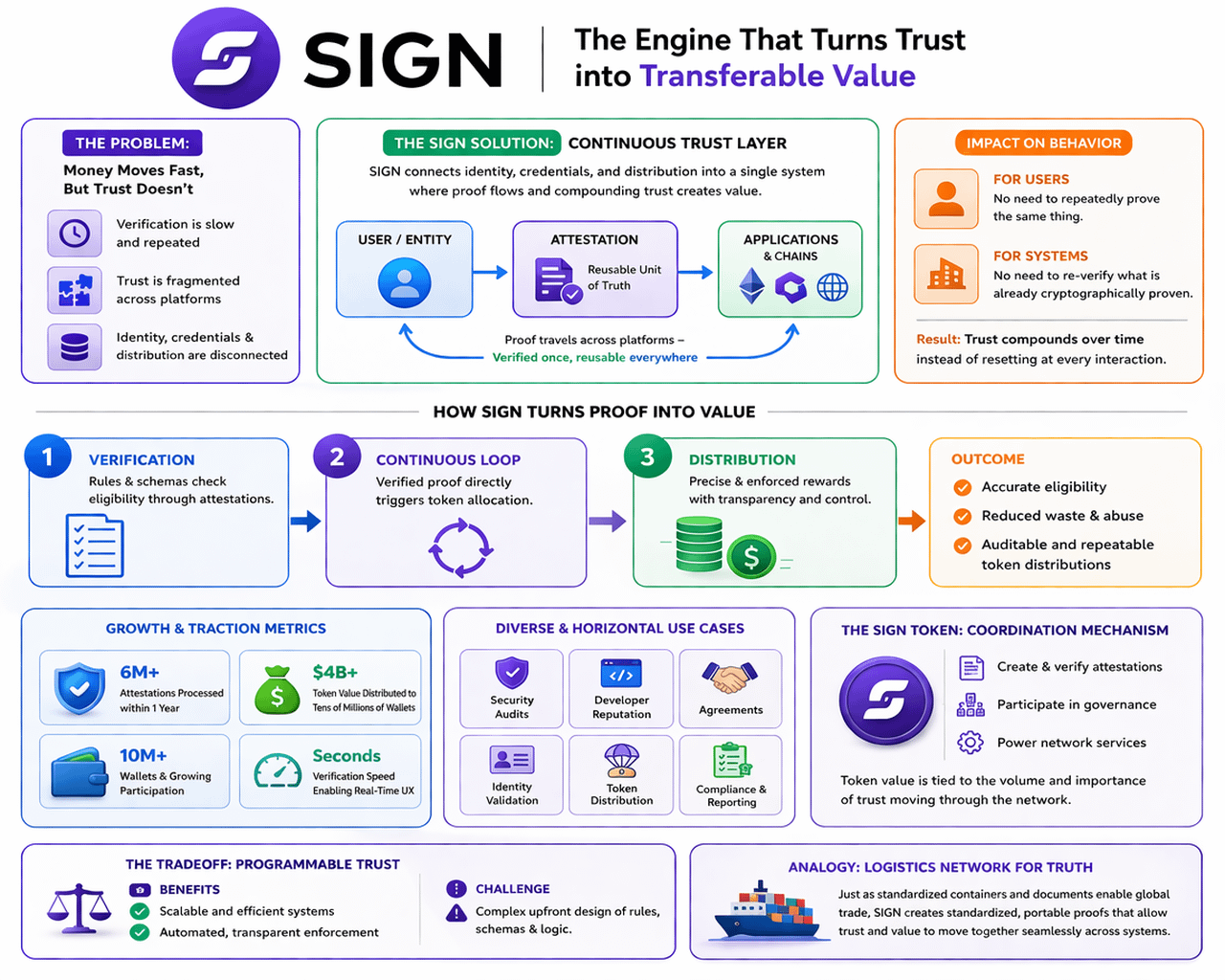
The role of the SIGN token fits into this flow as a coordination mechanism rather than a passive asset. It is used in creating and verifying attestations, participating in governance, and supporting the underlying services that maintain the system. Its relevance increases as more proofs are created, verified, and utilized across applications. In this sense, the token’s value is linked to the volume and importance of trust moving through the network, not just speculative demand.
The ecosystem itself is expanding in a quiet but structurally important way. Instead of focusing on consumer-facing hype, it is embedding itself into processes that require reliable verification. Security audits are becoming attestations that can be referenced and reused. Developer identities are turning into portable reputations. Agreements are being transformed into verifiable records. Token distributions are evolving into rule-based systems that can be audited and repeated. This type of growth is less visible but far more durable because it integrates into how systems operate rather than how they market themselves.
There is, however, an important tradeoff. Making trust programmable does not eliminate complexity; it shifts it. Instead of manual checks and human judgment during execution, systems must define rules, schemas, and verification logic upfront. This increases the burden on builders and governance structures. If designed well, it creates scalable and efficient systems. If not, it risks becoming rigid and difficult to adapt. The challenge for SIGN is to maintain flexibility while scaling its verification and distribution layers.
A useful way to understand SIGN is not as just another protocol or token platform, but as a logistics network for truth. Just as global trade depends on standardized containers and verifiable documentation, digital systems increasingly need standardized proofs that can move without losing meaning. SIGN is building those containers for trust, allowing verification and value to move together.
The current signals suggest that the system has moved beyond experimentation and into real usage. Millions of attestations, billions in distributed value, and expanding cross-domain adoption indicate that it is already functioning as infrastructure. The real question now is whether it can scale without sacrificing usability. If it succeeds, it becomes a foundational layer where proof and value move together seamlessly. If it struggles with complexity, adoption may slow despite strong underlying technology. At this stage, SIGN sits in a position where it is not yet obvious to everyone, but it is already shaping how trust is structured and distributed behind the scenes.
#SignDigitalSovereignInfra @SignOfficial $SIGN
