
I’ve heard “on-chain governments” thrown around enough times to stop taking it seriously.
Most of the time it’s just a big idea with no real path behind it. So when I saw SIGN being mentioned in that context, my first reaction was the same… probably just another stretch.
But after going through their roadmap, it didn’t feel as forced as I expected.
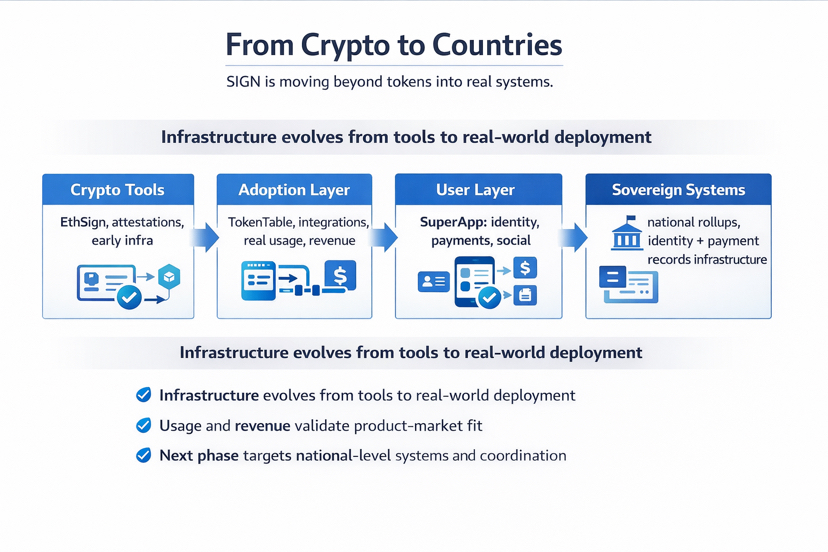
What stood out first wasn’t the timeline, it was the pattern. EthSign back in 2021, funding in 2022, TokenTable in 2023… that’s normal progression. But the interesting part is where those pieces start connecting.
Getting recognized by something like Singpass isn’t trivial. Integrating with systems like Plaid for verifiable financial data… that’s where things stop being purely crypto and start touching real infrastructure.
And then there’s revenue.
Around $15M in 2024, roughly in line with what they raised. That matters more than people admit. A lot of projects are still running on narrative and runway. This suggests something is actually being used.
Then you look at what’s next.
The SuperApp direction for 2025 feels like their attempt to pull users into one place. Identity, payments, social… all tied together through attestations. I’m not fully convinced here. Super apps are hard even with massive distribution. But if they manage to align identity with incentives, it could accelerate usage faster than most protocols manage.
Still, that’s not the part I keep thinking about.
It’s the sovereign rollup angle.
Strip away the jargon and it’s basically offering countries a full blockchain stack. Identity, payments, records… something they can deploy instead of building from scratch. That’s a very different target compared to typical crypto users.
And in regions where infrastructure is fragmented, that’s not a small improvement.
It’s a leap.
You can imagine the impact. Instead of separate systems for identity, payments, and records, everything ties into a shared verification layer. That changes how trust moves across institutions.
But this is also where things get complicated fast.
Cross-chain systems are already messy. Different assumptions, different finality, different formats. Keeping everything in sync is hard enough at a protocol level. Now scale that across multiple countries, each with its own rules and constraints… it’s not just technical anymore.
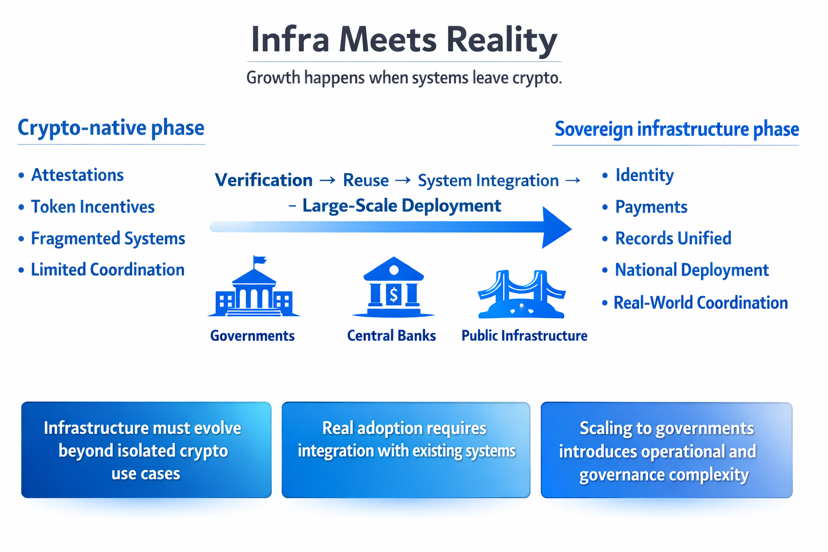
It’s operational. And political.
There’s also the question of control.
If SIGN becomes part of national infrastructure, who actually owns that system? Ideally, governments should run their own nodes, define their own standards. If too much depends on one provider, you start running into vendor lock-in, and that’s not something any country is comfortable with.
So there are real risks here.
But I can’t ignore what’s already happening.
This isn’t just a roadmap with ideas. There are actual deployments, experiments, systems being tested in real environments. And once that starts, even at a small scale, it changes how I look at the project.
Because now it’s not just competing inside crypto.
It’s testing itself against the real world.
What I keep coming back to is the core bet.
SIGN seems to believe that verification matters more than execution. Don’t manage state everywhere. Prove something once, and make that proof reusable across systems.
If that works, it scales in a very different way.
If it doesn’t, it probably collapses under complexity like a lot of ambitious infrastructure plays.
Either way, this feels like one of the few roadmaps that might actually collide with reality instead of staying inside theory.
And that alone makes it worth watching.