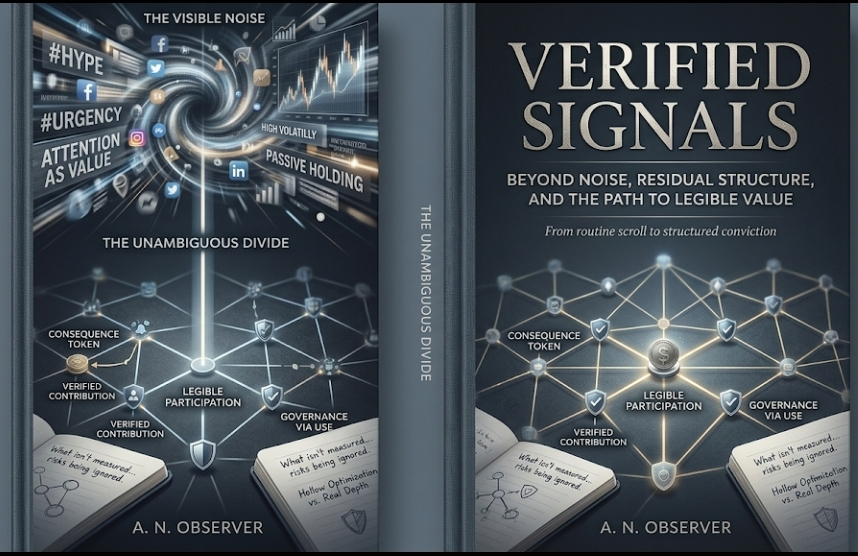
@SignOfficial t was just another routine scroll, the kind where everything starts blending together—announcements, threads, confident takes that all feel strangely familiar. I had a few dashboards open, half paying attention, when I came across a quiet conversation. No hype, no urgency. Just a simple idea being discussed: systems don’t reward effort, they reward what they can verify.
That stayed with me longer than I expected.
There was a time when I trusted visibility. If something showed up everywhere, I assumed it mattered. Attention felt like a proxy for value. But over time, that assumption starts to break. You see too many cycles where noise outpaces substance. Where participation looks high from the outside but leaves no lasting trace inside the system itself.
This project feels like it’s built in response to that gap.
It doesn’t try to interpret effort. It doesn’t attempt to measure intent or reward presence alone. Instead, it narrows its focus to something far more rigid: signals that can be proven. That might sound limiting, but it’s actually where things start to become more honest. Not fair in a human sense, but consistent in a system sense.
Because once you remove interpretation, you also remove ambiguity.
Participation here seems to only matter when it leaves behind something structured—something that can be checked without relying on trust. That shift changes the entire dynamic. Contribution is no longer about being seen. It’s about being recorded in a way the system can actually use.
And that’s where the token starts to feel different.
It doesn’t appear as the centerpiece. It feels more like a consequence. Something that emerges once participation has already been validated. That distinction is subtle, but important. In most ecosystems, tokens drive behavior first, and meaning gets layered on later. Here, meaning seems to come first—at least structurally—and the token follows.
That doesn’t make it immune to speculation. Nothing really is. But it does create a different kind of pressure. If the system only recognizes verified signals, then the path to earning or influencing outcomes becomes narrower, more defined. You can’t just be active. You have to be legible to the system.
Over time, that could reshape how coordination works.
If influence starts aligning more with verified contribution than passive holding, governance itself begins to shift. Not in a dramatic or idealized way, but gradually. Those who consistently produce signals the system can recognize may carry more weight than those who simply hold tokens without interacting.
But this is also where I slow down.
Because every verification system carries assumptions. What gets measured defines what matters. And what isn’t measured, no matter how valuable, risks being ignored. If the system defines signals too rigidly, it can miss nuance. If it defines them too loosely, it opens the door to manipulation.
That balance is fragile.
There’s also a behavioral layer that’s harder to ignore. When people understand how a system evaluates them, they adapt. Sometimes in productive ways, sometimes in ways that feel mechanical. The risk isn’t just gaming—it’s hollow optimization. Actions that technically qualify, but don’t carry real depth.
I’ve seen that happen before.
So conviction, at least for me, doesn’t come from the idea alone. It comes from watching how the system evolves under pressure. Whether the signals it recognizes remain meaningful over time. Whether participation continues when rewards become less exciting. Whether the structure holds when attention moves elsewhere.
Because that’s the real separation this project seems to highlight.
Between what looks valuable and what is actually usable. Between those who hold and those who contribute. Between activity that feels meaningful and activity that leaves a verifiable trace.
Most systems blur those lines. This one is trying to define them more clearly.
I didn’t walk away convinced. But I did walk away more attentive.
Because the longer I spend in this space, the less I trust what’s visible, and the more I pay attention to what persists quietly underneath. Not the noise, not the narrative—but the structure that remains when both start to fade.
And in the end, that’s where value proves itself. Not during the phase when everything feels active and alive, but later—when the excitement settles, participation becomes intentional, and only thI wasn’t looking for a new project that day.
It was just another routine scroll, the kind where everything starts blending together—announcements, threads, confident takes that all feel strangely familiar. I had a few dashboards open, half paying attention, when I came across a quiet conversation. No hype, no urgency. Just a simple idea being discussed: systems don’t reward effort, they reward what they can verify.
That stayed with me longer than I expected.
There was a time when I trusted visibility. If something showed up everywhere, I assumed it mattered. Attention felt like a proxy for value. But over time, that assumption starts to break. You see too many cycles where noise outpaces substance. Where participation looks high from the outside but leaves no lasting trace inside the system itself.
This project feels like it’s built in response to that gap.
It doesn’t try to interpret effort. It doesn’t attempt to measure intent or reward presence alone. Instead, it narrows its focus to something far more rigid: signals that can be proven. That might sound limiting, but it’s actually where things start to become more honest. Not fair in a human sense, but consistent in a system sense.
Because once you remove interpretation, you also remove ambiguity.
Participation here seems to only matter when it leaves behind something structured—something that can be checked without relying on trust. That shift changes the entire dynamic. Contribution is no longer about being seen. It’s about being recorded in a way the system can actually use.
And that’s where the token starts to feel different.
It doesn’t appear as the centerpiece. It feels more like a consequence. Something that emerges once participation has already been validated. That distinction is subtle, but important. In most ecosystems, tokens drive behavior first, and meaning gets layered on later. Here, meaning seems to come first—at least structurally—and the token follows.
That doesn’t make it immune to speculation. Nothing really is. But it does create a different kind of pressure. If the system only recognizes verified signals, then the path to earning or influencing outcomes becomes narrower, more defined. You can’t just be active. You have to be legible to the system.
Over time, that could reshape how coordination works.
If influence starts aligning more with verified contribution than passive holding, governance itself begins to shift. Not in a dramatic or idealized way, but gradually. Those who consistently produce signals the system can recognize may carry more weight than those who simply hold tokens without interacting.
But this is also where I slow down.
Because every verification system carries assumptions. What gets measured defines what matters. And what isn’t measured, no matter how valuable, risks being ignored. If the system defines signals too rigidly, it can miss nuance. If it defines them too loosely, it opens the door to manipulation.
That balance is fragile.
There’s also a behavioral layer that’s harder to ignore. When people understand how a system evaluates them, they adapt. Sometimes in productive ways, sometimes in ways that feel mechanical. The risk isn’t just gaming—it’s hollow optimization. Actions that technically qualify, but don’t carry real depth.
I’ve seen that happen before.
So conviction, at least for me, doesn’t come from the idea alone. It comes from watching how the system evolves under pressure. Whether the signals it recognizes remain meaningful over time. Whether participation continues when rewards become less exciting. Whether the structure holds when attention moves elsewhere.
Because that’s the real separation this project seems to highlight.
Between what looks valuable and what is actually usable. Between those who hold and those who contribute. Between activity that feels meaningful and activity that leaves a verifiable trace.
Most systems blur those lines. This one is trying to define them more clearly.
I didn’t walk away convinced. But I did walk away more attentive.
Because the longer I spend in this space, the less I trust what’s visible, and the more I pay attention to what persists quietly underneath. Not the noise, not the narrative—but the structure that remains when both start to fade.
And in the end, that’s where value proves itself. Not during the phase when everything feels active and alive, but later—when the excitement settles, participation becomes intentional, and only thI wasn’t looking for a new project that day.
It was just another routine scroll, the kind where everything starts blending together—announcements, threads, confident takes that all feel strangely familiar. I had a few dashboards open, half paying attention, when I came across a quiet conversation. No hype, no urgency. Just a simple idea being discussed: systems don’t reward effort, they reward what they can verify.
That stayed with me longer than I expected.
There was a time when I trusted visibility. If something showed up everywhere, I assumed it mattered. Attention felt like a proxy for value. But over time, that assumption starts to break. You see too many cycles where noise outpaces substance. Where participation looks high from the outside but leaves no lasting trace inside the system itself.
This project feels like it’s built in response to that gap.
It doesn’t try to interpret effort. It doesn’t attempt to measure intent or reward presence alone. Instead, it narrows its focus to something far more rigid: signals that can be proven. That might sound limiting, but it’s actually where things start to become more honest. Not fair in a human sense, but consistent in a system sense.
Because once you remove interpretation, you also remove ambiguity.
Participation here seems to only matter when it leaves behind something structured—something that can be checked without relying on trust. That shift changes the entire dynamic. Contribution is no longer about being seen. It’s about being recorded in a way the system can actually use.
And that’s where the token starts to feel different.
It doesn’t appear as the centerpiece. It feels more like a consequence. Something that emerges once participation has already been validated. That distinction is subtle, but important. In most ecosystems, tokens drive behavior first, and meaning gets layered on later. Here, meaning seems to come first—at least structurally—and the token follows.
That doesn’t make it immune to speculation. Nothing really is. But it does create a different kind of pressure. If the system only recognizes verified signals, then the path to earning or influencing outcomes becomes narrower, more defined. You can’t just be active. You have to be legible to the system.
Over time, that could reshape how coordination works.
If influence starts aligning more with verified contribution than passive holding, governance itself begins to shift. Not in a dramatic or idealized way, but gradually. Those who consistently produce signals the system can recognize may carry more weight than those who simply hold tokens without interacting.
But this is also where I slow down.
Because every verification system carries assumptions. What gets measured defines what matters. And what isn’t measured, no matter how valuable, risks being ignored. If the system defines signals too rigidly, it can miss nuance. If it defines them too loosely, it opens the door to manipulation.
That balance is fragile.
There’s also a behavioral layer that’s harder to ignore. When people understand how a system evaluates them, they adapt. Sometimes in productive ways, sometimes in ways that feel mechanical. The risk isn’t just gaming—it’s hollow optimization. Actions that technically qualify, but don’t carry real depth.
I’ve seen that happen before.
So conviction, at least for me, doesn’t come from the idea alone. It comes from watching how the system evolves under pressure. Whether the signals it recognizes remain meaningful over time. Whether participation continues when rewards become less exciting. Whether the structure holds when attention moves elsewhere.
Because that’s the real separation this project seems to highlight.
Between what looks valuable and what is actually usable. Between those who hold and those who contribute. Between activity that feels meaningful and activity that leaves a verifiable trace.
Most systems blur those lines. This one is trying to define them more clearly.
I didn’t walk away convinced. But I did walk away more attentive.
Because the longer I spend in this space, the less I trust what’s visible, and the more I pay attention to what persists quietly underneath. Not the noise, not the narrative—but the structure that remains when both start to fade.
And in the end, that’s where value proves itself. Not during the phase when everything feels active and alive, but later—when the excitement settles, participation becomes intentional, and only the signals that truly matter continue to show up.e signals that truly matter continue to show up.e signals that truly matter continue to show up.
#SignDigitalSovereignInfra $SIGN