
If I’m being honest, Sign Protocol is the kind of project I would normally scroll past in two minutes.
I’ve seen too many similar setups. Clean narrative, reasonable thesis, infrastructure angle, token attached. It sounds good enough to survive a few cycles of attention, then slowly blends into the same background noise everything else eventually becomes.
So I came into this with that mindset. Don’t trust the framing. Strip it down. Look for where it breaks.
And weirdly, it starts making more sense when I stop trying to fit it into the usual crypto template.
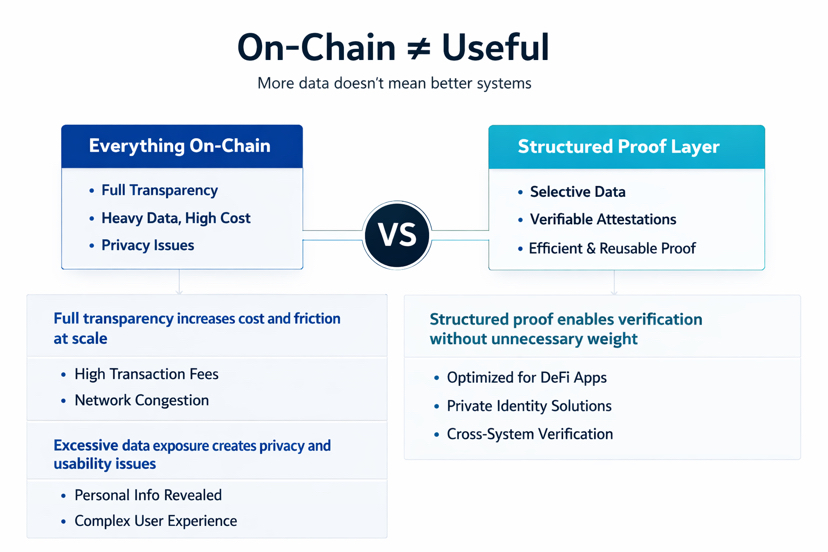
Because a lot of this space still acts like putting something on-chain automatically makes it useful. That idea doesn’t really hold up anymore. Public by default sounds great until cost becomes an issue, or privacy becomes an issue, or scale becomes an issue. Then everything just turns into friction.
Heavy systems, exposed data, awkward workarounds… and people still pretend transparency solved trust, when most of the time it just reshaped the problem.
That’s where Sign Protocol caught my attention.
Not because it’s loud. It’s not. Not because it looks perfect. It doesn’t. But it feels like it’s aimed at something that actually exists. Systems don’t just need data. They need proof. Something you can verify later without relying on screenshots, intermediaries, or guesswork.
That part doesn’t get talked about enough.
What I keep coming back to is that Sign doesn’t treat “everything on-chain” as the goal. It feels more selective. More aware that not all data needs to be public, permanent, and heavy. That’s a small shift in mindset, but it changes how systems behave over time.
Crypto spent years pushing everything toward full visibility.
Now it feels like some of that was just… overkill.
Sign comes across a bit more grounded in that sense. It’s not trying to force one extreme. It’s trying to structure proof in a way that stays usable without dragging unnecessary weight around.
I’m not saying that guarantees anything.
Execution is always the real test. Broad ideas are easy. Turning them into something people actually rely on is where most projects fail. I’ve seen enough of that to stay cautious no matter how clean something sounds.
But there’s a difference here that’s hard to ignore.
It doesn’t feel like it’s built for one narrow use case or one temporary narrative. It feels more like it’s sitting under a broader set of problems. Trusted records, verifiable claims, systems that need proof without exposing everything.
That kind of flexibility usually matters more over time.
Because if something only works inside one trend, it doesn’t last. If it can plug into multiple contexts, it at least has a chance.
Still, I’m not assuming the market will recognize that early.
It usually doesn’t.
The market is still stuck in cycles of attention, chasing what’s easy to understand and quick to react. Meanwhile, the slower infrastructure plays either get ignored… or quietly become necessary.
That’s the part I’m watching.
Because the real question isn’t whether this sounds good. It’s whether it becomes something people depend on without thinking. The kind of layer that disappears into the system, but removing it would break everything around it.
That’s when it gets real.
Until then, it’s still being tested like everything else.
But I can’t ignore why it sticks with me.
After going through so much recycled noise in this space, you start recognizing when something is at least pointing at a real problem. Not inventing one for the sake of a narrative.
And that’s usually enough to make me pause a little longer.