
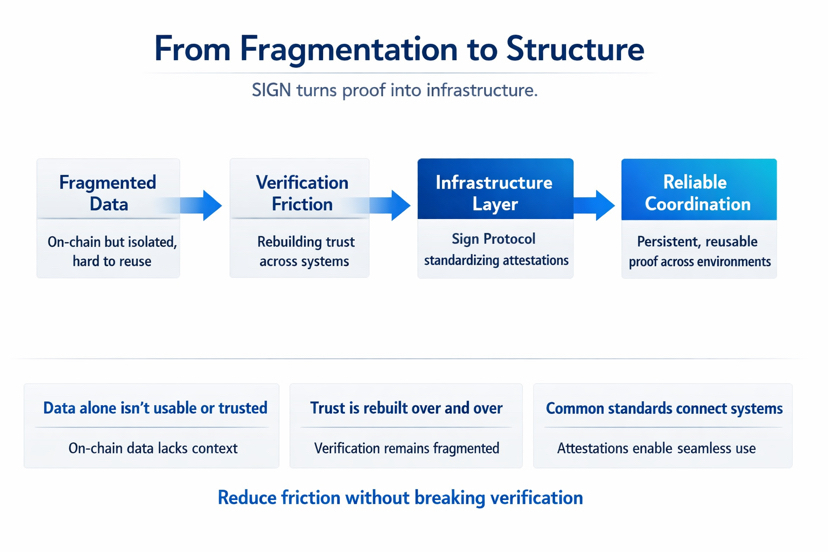
I keep coming back to Sign Protocol, not because it’s loud, but because it isn’t.
That alone already separates it a bit.
This market is full of projects that know exactly how to present themselves. Strong narratives, clean positioning, everything designed to grab attention quickly. And for a while, that works. Until it doesn’t. Then you realize most of it was just surface.
Sign doesn’t really feel like it’s playing that game.
It feels more like it’s sitting somewhere underneath, working on a part of the system people don’t pay attention to until it starts breaking. And for me, that part has always been trust. Or more specifically, what happens to proof after it exists.
Because crypto has this habit of assuming that “on-chain” automatically means clear, reliable, and usable.
It doesn’t.
Data can exist everywhere and still be fragmented. Hard to verify across contexts. Hard to reuse without rebuilding logic. Hard to trust once it moves outside the environment it was created in. That’s where things get messy, and that’s where most systems quietly lose efficiency.
That’s the layer Sign seems to be targeting.
Not in a flashy way. Which is probably why it’s easy to overlook. Projects like this don’t give you that quick hit of excitement. They don’t fit neatly into a one-line narrative you can trade around.
They take longer to understand.
And maybe longer than the market usually has patience for.
I like that it feels closer to infrastructure than performance. It’s not trying to sit at the center of attention. It’s trying to become part of the plumbing. And yeah, that sounds boring. But I’ve been around long enough to know that the things people call boring early are often the things that matter later.
Still, I’m not assuming anything.
Targeting a real problem doesn’t guarantee anything. I’ve seen plenty of good ideas fail because adoption never showed up, or because the market simply chose something louder instead. That happens more often than people admit.
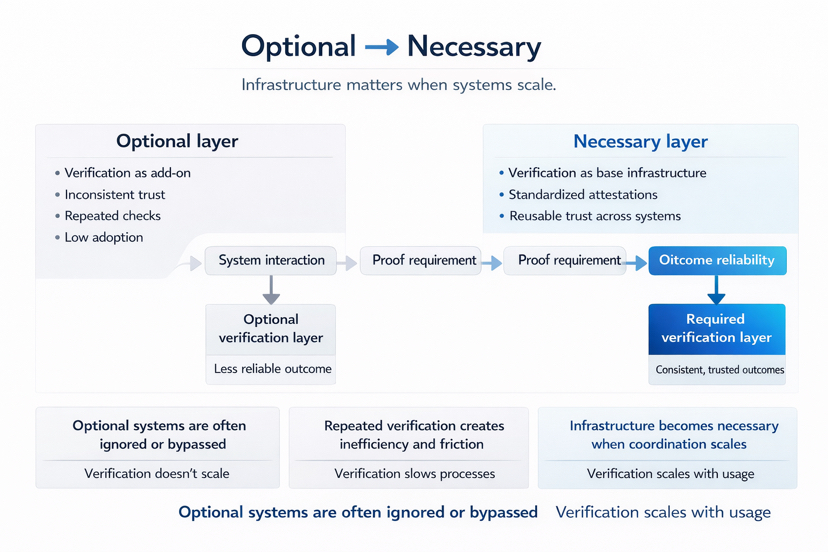
So the question I keep asking is simple.
Does this become necessary, or does it remain optional?
Because that’s the line that decides everything.
If crypto keeps scaling, if more serious systems start interacting with it, then verification stops being a nice-to-have. It becomes part of the base layer. Not something you add later, but something you rely on when things get messy. When disputes happen. When distribution matters. When systems need to coordinate without constantly resetting trust.
That’s where Sign starts to feel relevant.
It’s not about excitement. It’s about whether it fits into that moment where vague systems stop working and structure becomes necessary.
And I think that’s why it stays on my radar.
It doesn’t feel like it’s built for one short cycle. It feels like it’s trying to survive multiple. That’s a different mindset, and you can kind of see it in how it’s framed. Less about a single use case, more about sitting underneath a range of interactions where records need to hold up and claims need to remain verifiable.
That’s harder to build.
But also more durable if it works.
If it works.
That’s always the part that matters. Not the idea, but the conversion from idea to actual usage. I’m less interested in what a project says it can do, and more interested in the moment where people start depending on it without thinking.
That’s when you know it stuck.
And I think that’s why I haven’t written this off.
It doesn’t feel like a project trying to capture a moment. It feels like one trying to outlast it. Maybe that’s enough to keep watching for now.
Or maybe I’m just noticing something that still hasn’t fully shown itself yet.