

I’ve been staring at $SIGN’s order books and on-chain flows for a few weeks now, and something clicked that I haven’t seen anyone really call out yet. Most people are still running the same tired script: “16% circulating, massive FDV, unlocks coming watch it dump.” But the tape and the wallets tell a different story. The token isn’t behaving like a typical VC paperweight waiting to be sold. It’s trading like a high velocity utility asset where real protocol demand keeps recycling the same small float over and over, creating a structural bid that scheduled releases simply can’t overwhelm. That’s the non-obvious edge I keep coming back to.
Let me walk you through what I’m seeing, numbers first, because this only works if the data holds up.
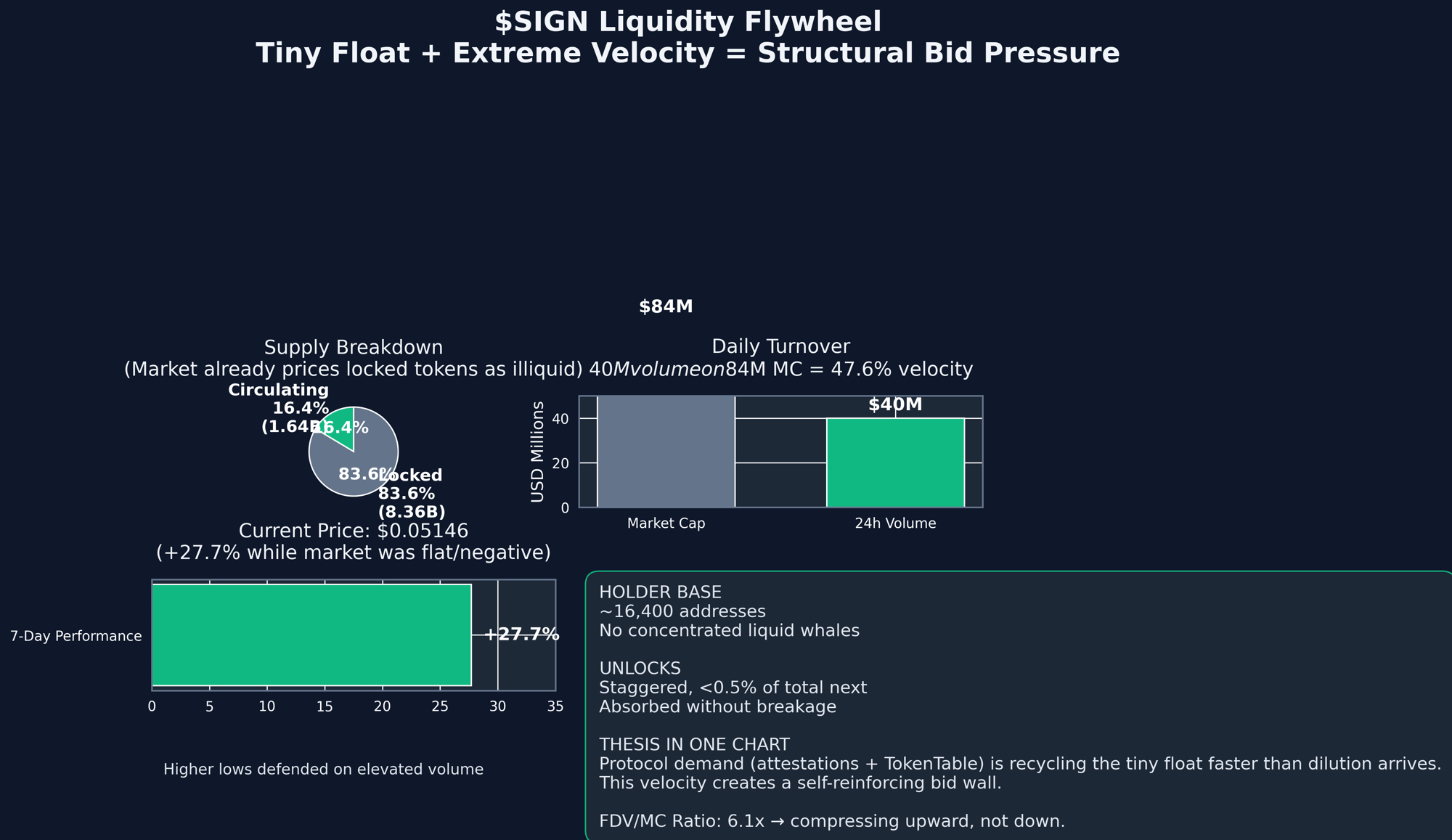
The circulating supply sits at roughly 1.64 billion out of 10 billion total about 16.4%. Market cap around $84 million, fully diluted north of $515 million. On any given day the token turns over $40 million in spot volume. That’s not a one off hype spike; it’s been running at 45-60% of the entire market cap for weeks. I’ve watched similar low float names before, and usually that kind of turnover fades fast once the narrative cools. Here it’s sticking. Every sell order gets absorbed almost immediately, and the price keeps making higher lows even on red days for the broader market. That velocity isn’t artificial it’s coming from actual users who need the token to interact with attestations, distributions, and incentives, then redeploy it right back into the ecosystem.
Zoom in on the price action itself. The token is sitting near $0.051 after posting a clean +27% over the last seven days while most alts were flat or down. It’s holding well above the February lows and refusing to retest them despite the obvious macro noise. What stands out to me is how the buy side defends these levels on elevated volume instead of the usual thin air rally that collapses. This isn’t retail FOMO chasing a tweet; it feels like participants who are already inside the protocol recipients of TokenTable payouts, attestation verifiers, stakers are treating SIGN as working capital rather than a lottery ticket.
The unlock calendar is another piece that looks scary on paper but plays out differently in practice. Next release is April 28 to backers small relative to the float and the rest is staggered linearly across years all the way to 2030. No massive cliff events. Previous small unlocks have come and gone without breaking structure. The market has essentially front-run the dilution fear and decided the released supply is being eaten by genuine demand instead of flooding the books.
Holder distribution adds to the picture. Around 16,400 addresses own the circulating tokens, and there’s no obvious whale cluster sitting on the liquid float waiting to exit. Top wallets look like exchange hot wallets and protocol treasuries rather than concentrated VC bags ready to dump. That fragmentation means selling pressure stays opportunistic and scattered, while fresh demand from national programs or enterprise attestations flows straight into the same distributed pool and tightens the effective supply even further.
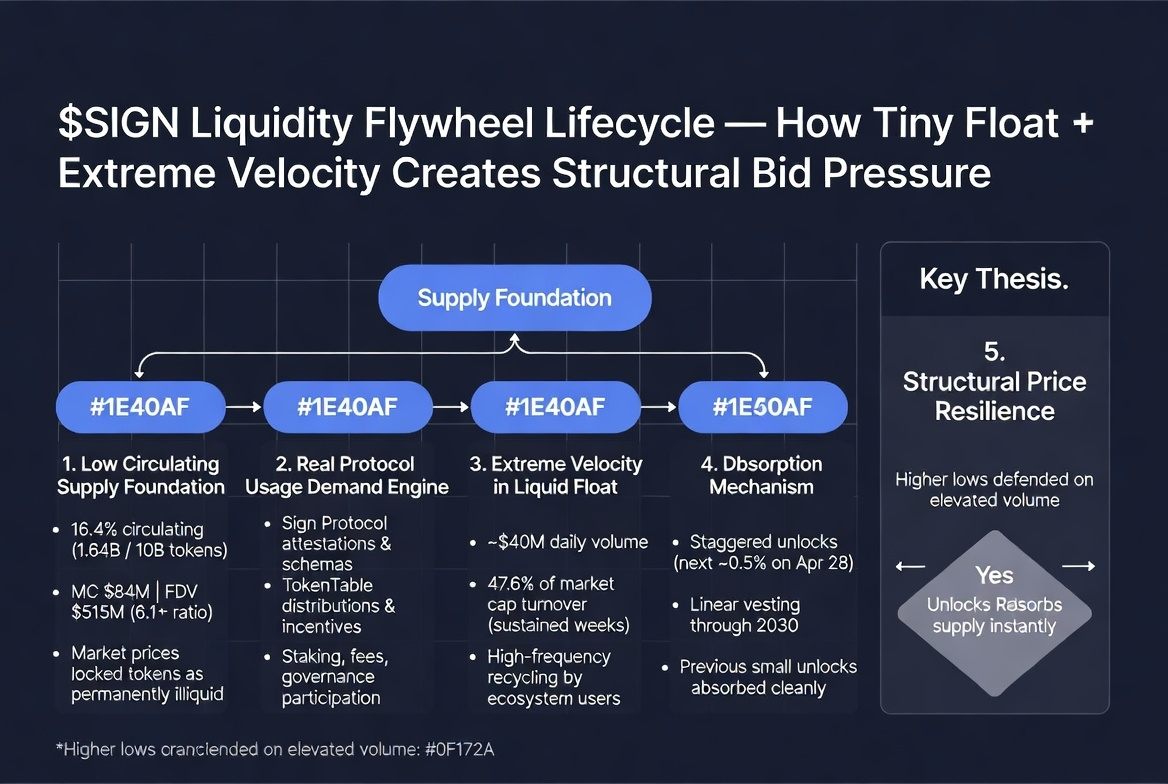
Put it all together and the thesis feels pretty clean: $SIGN’s market structure has already internalized the dilution overhang as irrelevant because the tiny float is in constant high velocity rotation driven by protocol usage. The token isn’t waiting for the rest of the supply to “catch up” it’s pricing as if the locked portion is functionally illiquid for the foreseeable future, and the circulating piece is too useful (and too small) to satisfy demand without price clearing higher.
Of course there’s a real counterargument, and I’d be lying if I ignored it. Skeptics will say the volume is still mostly speculative rotation wash on CEX pairs or short term capital parking ahead of the next narrative catalyst and that once even modest backer unlocks hit, the velocity collapses and the price re-rates toward a more “sensible” multiple of the FDV. Fair point. High turnover can mask fragility if the underlying protocol revenue never actually accrues to token holders in a meaningful way.
What would make me even more convinced over the next few months? Volume staying north of 30% of market cap through the April/May unlock window while price either holds or pushes new local highs. Holder count climbing steadily without big consolidated wallets appearing. And any uptick in on-chain usage (attestations processed or TokenTable distributions) showing a clear correlation with sustained buy side pressure rather than one off spikes.
What would kill the thesis for me? A sharp drop in volume below 20% of market cap right after an unlock, accompanied by price breaking the $0.045 zone on accelerating sells. Or clear evidence of concentrated liquid wallets dumping in sync with release dates. Or worst of all usage metrics rising while the token price decouples to the downside.
Right now the data keeps pointing the same direction for me. $SIGN isn’t trading like another generic lowfloat token waiting for the rug. It’s trading like a closed loop utility whose limited liquid supply is already in structural demand. The rest of the market is still debating the unlock schedule. The order books moved on weeks ago. I’m positioned accordingly, and I’ll keep watching the same handful of metrics to see if the flywheel keeps spinning.
@SignOfficial #SignDigitalSovereignInfra $SIGN
