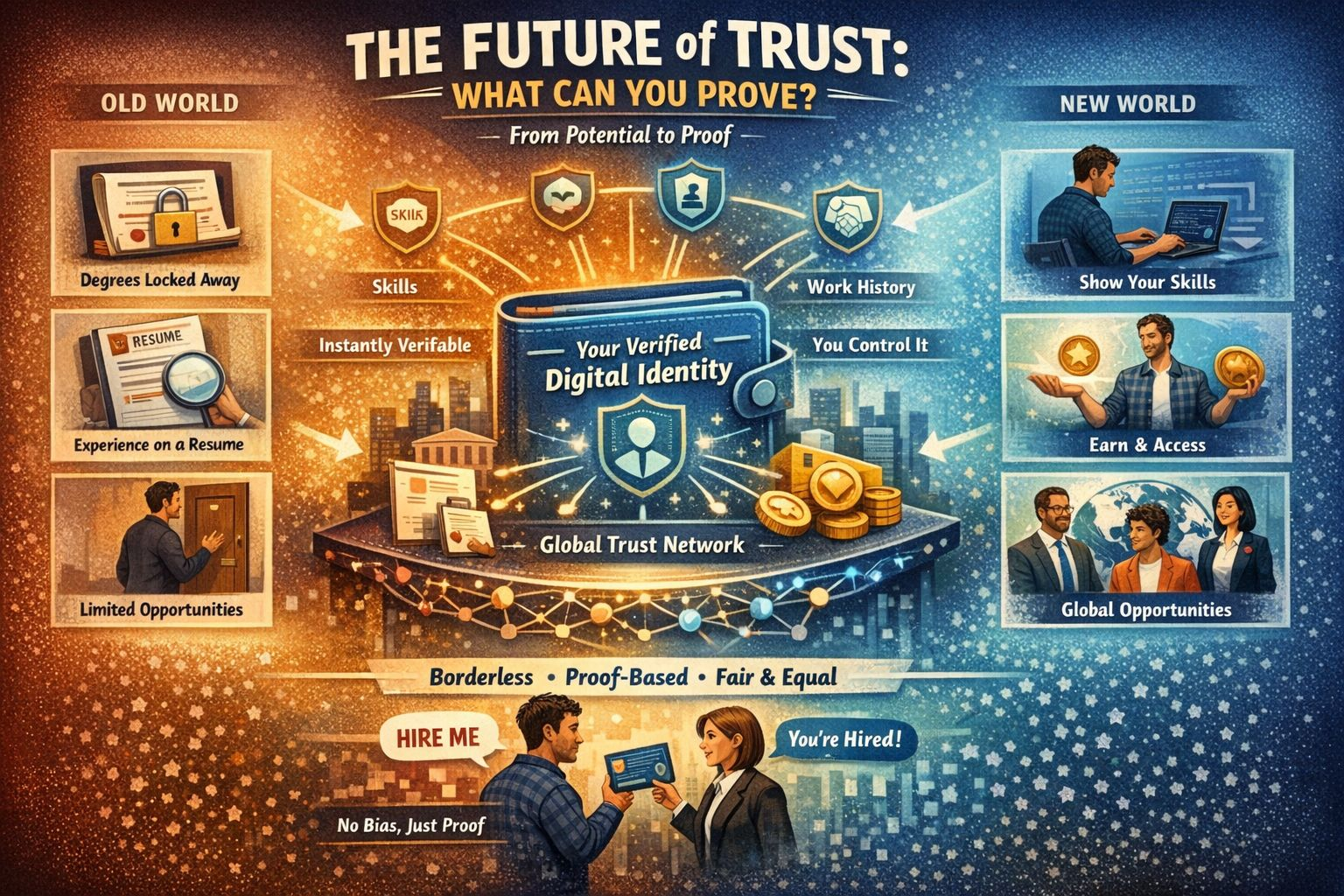
A few months ago, a friend of mine applied for a remote job. He’s one of those people who quietly builds impressive things—apps, tools, solutions to real problems—but never talks about it much. He didn’t have a big-name degree or a famous company on his résumé. Just real skills. Real work. Still, he got rejected. Not because he wasn’t capable, but because he couldn’t prove it in a way the system understood. That’s when something becomes painfully clear: we don’t live in a world where talent wins—we live in a world where verified talent wins. And that gap, between being capable and being believed, is where millions of people get stuck.
Now imagine a different reality. Imagine if everything you’ve ever done—your education, your work, your skills—lived in a secure digital space that only you control. No one can fake it, no one can alter it, and anyone can verify it instantly. No emails, no waiting, no awkward back-and-forth. Just one click, and your truth becomes undeniable. That’s the idea behind what people call a global infrastructure for credential verification and token distribution. It sounds technical, but at its heart, it’s very human. It’s about making sure your effort doesn’t get lost just because the system can’t recognize it.
In today’s world, your achievements are scattered. Your degree sits in a university database. Your experience lives on a résumé. Your skills are often invisible unless someone gives you a chance to show them. In this new system, all of that becomes something stronger—verified digital credentials. Think of them like locked badges of truth that can’t be forged or manipulated. When someone sees them, they don’t have to “trust” you in the traditional sense. The proof is already there, built into the system itself. Trust is no longer a feeling or a guess—it becomes something almost mathematical.
Verification, which used to be slow and uncertain, becomes instant. Instead of sending documents or waiting for approvals, you simply share your credential, and it confirms itself. It’s either real or it’s not. And what makes this even more powerful is the privacy it offers. You don’t have to reveal everything about yourself just to prove one thing. You can show that you’re qualified without exposing your entire history, or prove your eligibility without handing over sensitive personal data. It creates a rare balance where you can be both trusted and private at the same time.
Then comes the part that quietly changes everything: value. In this system, your verified credentials don’t just sit there—they can actually do something for you. They can unlock opportunities, trigger payments, grant access, or even give you a voice in decision-making systems. Your actions turn into proof, and that proof turns into value. No middleman deciding your worth, no gatekeeper filtering your chances. It’s a shift from being judged to being recognized.
If we go back to my friend and place him in this future, the story changes completely. Every project he worked on is verified and connected to his identity. When a company looks for talent, they don’t ask where he studied—they ask what he has done. He shares his profile, and within seconds, his skills are confirmed, his work is visible, and his credibility is clear. There’s no bias, no guesswork. He gets selected not because someone took a chance on him, but because the system finally understood him. And in that moment, something bigger happens: opportunity detaches from privilege and attaches to proof.
This shift matters more than it first appears. It slowly removes the invisible advantages that have shaped opportunities for decades—where you were born, who you know, which institutions recognize you. Instead, it creates a world where proof travels with you. A talented person in a small town can compete globally. A self-taught learner can stand next to a university graduate on equal ground. Your identity becomes something you own, not something stored and controlled by others.
Of course, no system is perfect. Questions still remain about who gets to issue these credentials, how to prevent manipulation, and whether new forms of gatekeeping will emerge. Because even when technology changes, power doesn’t disappear—it shifts. And the real challenge will always be protecting the fairness of this system while it grows.
Still, something important is happening beneath the surface. We are moving toward a world where your identity is not defined by where you come from, but by what you can prove. Where your achievements don’t need translation or validation from institutions. Where your value is recognized instantly, without friction. It’s not a loud revolution, but it’s a deep one—because it changes how humans trust each other in a digital world.
At the end of the day, everyone is asking for the same thing: a fair chance to be seen for who they really are. Not filtered through outdated systems, not judged by incomplete signals, but understood clearly and honestly. And maybe this new way of building trust finally brings us closer to that.
The future won’t ask where you came from—it will simply ask: what can you prove?