
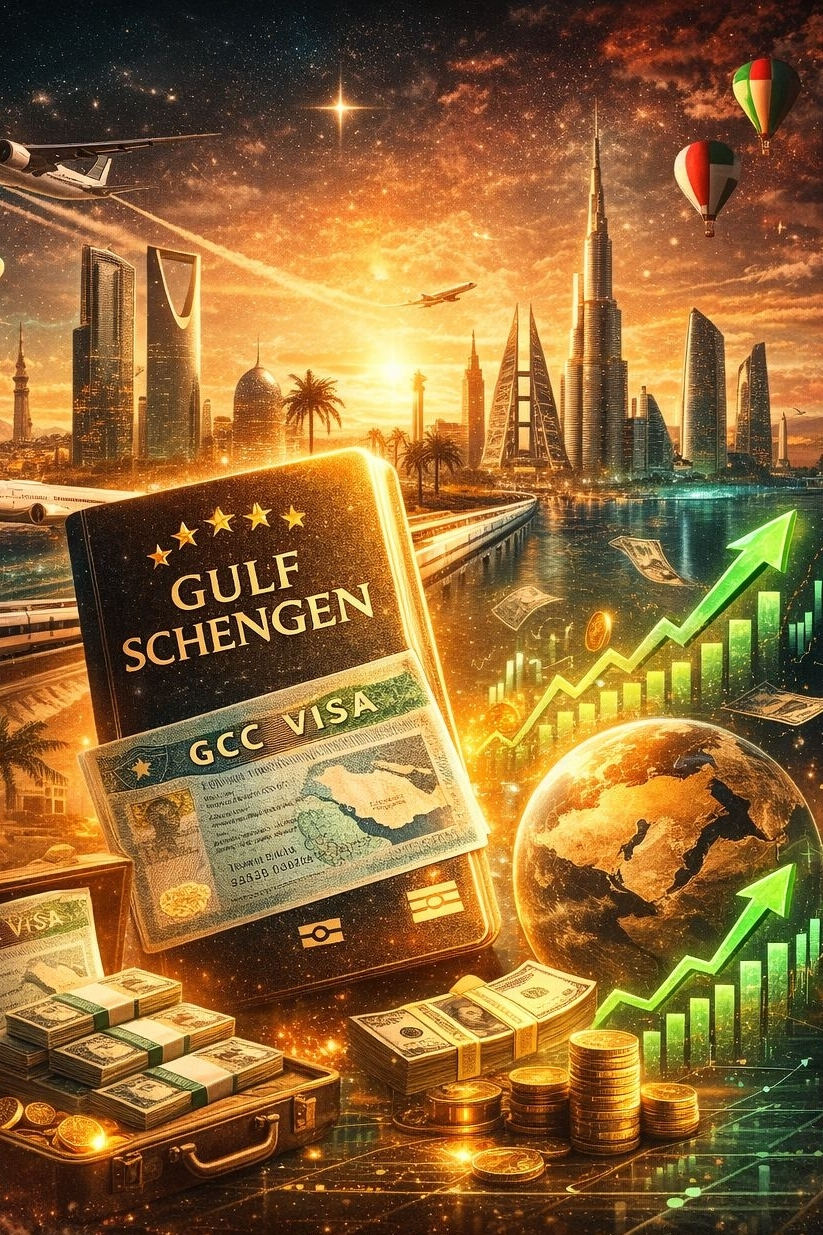
With the launch of the unified Gulf visa system (Gulf Schengen) in 2026, we are not only talking about facilitating travel but also about an economic and financial restructuring of one of the world's most important growth regions.
(“Gulf Schengen Initiative – Travel and Tour World”)
📊 First: the macroeconomic impact
Unified visas mean:
Increase in tourist stay duration
Increase in average spending per visitor
Transforming the Gulf from separate destinations to a unified tourism market
Economically, this directly reflects on: ✔ Non-oil GDP
✔ Government revenues
✔ Balance of payments through foreign currency flows
This aligns with the goals of diversifying the economy in Saudi Arabia, the UAE, and Qatar.
(“Saudi Vision 2030 & Regional Tourism Growth”)
✈️ Second: the financial impact on airlines and transport
Companies like:
Saudia
Riyadh Air
Emirates
Qatar Airways
Etihad
It will be the biggest beneficiary, not only from increased flight numbers but from:
High occupancy rates
Growth in revenue per seat (Yield)
Expansion of transit routes (Transit Hub Effect)
Financially, this could lead to: 📈 Improved cash flows
📈 Increase in capital investments
📈 Higher ratings for the sector in the medium term
(“Airlines Growth Outlook – Travel and Tour World”)
🏨 Third: tourism as a lever for investment
The Gulf Schengen enhances:
Investment in hotels
Entertainment
Exhibitions and conferences (MICE)
This creates an economic multiplier effect that extends to:
Real estate
Services
Jobs (“Tourism Multiplier Effect – World Travel Insights”)
💰 Fourth: the financial and investment dimension
From a financial perspective:
Increase in tourism flows = improvement in liquidity
Diversification of income sources reduces dependence on energy
Attracting long-term foreign capital
This enhances financial stability and reduces the sensitivity of Gulf economies to oil price fluctuations.
(“Regional Economic Stability – IMF Regional Outlook”)
📌 Analytical summary:
Gulf Schengen is not just a tourism decision.
But a strategic economic-financial tool that enhances: ✔ Non-oil growth
✔ Global competitiveness of the region
✔ Investment attractiveness
We are on the verge of a step that could transform the Gulf from a flight hub to a comprehensive global economic and tourism platform.
💬 The real question: Will we see in 2026 the beginning of a new phase where travel becomes a major financial driver for Gulf growth?
🧾 Sources:
(Travel and Tour World – Gulf Schengen 2026)
(World Travel & Tourism Council Reports)
(IMF Regional Economic Outlook)