

The KOSPI index rises 5.63% and gold surges 4%, as Asian markets recover from the largest drop in two days since April.
Chinese buyers flood the Shenzhen gold market ahead of the Lunar New Year, providing crucial support for the recovery of precious metals.
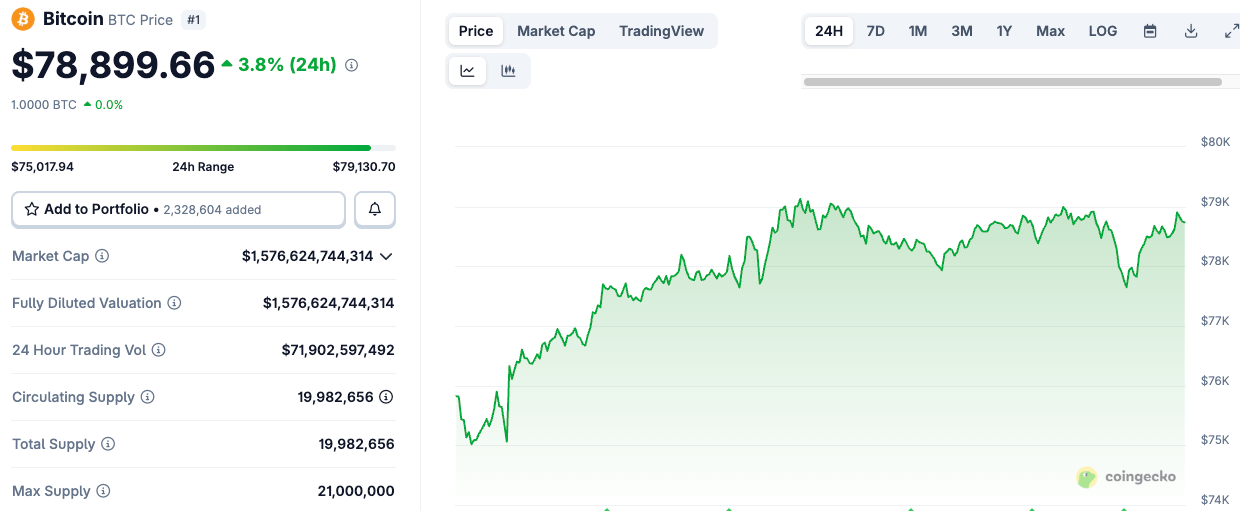
Bitcoin rebounds 4%, reaching $78,899, but its weekly drop of 12% is double the 5% decline of gold, extending its underperformance since the end of 2024.
Asian stocks and precious metals saw a strong recovery on Tuesday, after the largest drop in two days since April, but Bitcoin continues to lag in its recovery.
The divergence highlights a persistent trend since the end of 2025: traditional assets continue to attract capital, while cryptocurrencies struggle to keep pace.
Asian markets register strong gains
The MSCI Asia-Pacific index rose 2.2%, recovering most of Monday's losses. South Korea's KOSPI led the region with a gain of over 5.63%, followed by Japan's Nikkei 225 with 3.90%, and India's Sensex with 2.70%.
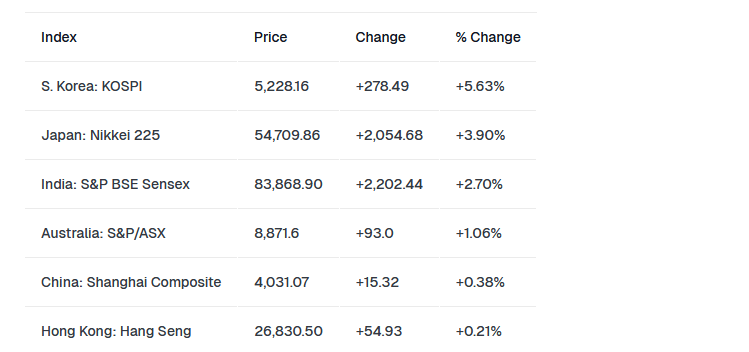
South Korea, which market analysts describe as the best-performing stock index in the world this year, saw its market recover after Monday's sharp decline. Technology stocks rose across the region, with Nasdaq 100 futures also up after Palantir released a better-than-expected sales outlook.
The Hang Seng and Shanghai Composite indices in Hong Kong also closed higher, with gains of 0.21% and 0.38%, respectively, marking a recovery across the region.
Recovery of losses in gold and silver
Gold rose 3.25% to $4,810 an ounce, while silver surged 8% to over $83, recovering some of the losses after a record high that abruptly unwound at the end of last week.
Precious metals reached historic highs last month amid renewed concerns over geopolitical instability, currency devaluation, and threats to the Federal Reserve's independence. A wave of purchases by Chinese speculators fueled the rise before it reversed on Friday.
Chinese buyers supported the recovery. Over the weekend, buyers flocked to the country's largest gold market in Shenzhen to stock up on jewelry and gold bars ahead of the Lunar New Year holiday, which begins on February 16.
Deutsche Bank maintained its forecast that gold will rise to $6,000 an ounce, while Pepperstone noted that the fundamentals supporting gold remain virtually unchanged since the correction.
Bitcoin lags behind in the recovery
Bitcoin recovered 4% in 24 hours, reaching $78,899, nearly matching the daily gain of gold. However, the weekly outlook reveals a different story.
Over seven days, Bitcoin fell 12.1%, more than double the 5.06% drop in gold during the same period. The leading cryptocurrency dropped from over $92,000 to less than $75,000 before recovering to current levels.
This pattern echoes a trend that emerged at the end of 2025, when Korean retail investors migrated from cryptocurrencies to stocks as the KOSPI reached historic highs. At that time,
The trading volume on the five major cryptocurrency exchanges in Korea plummeted by more than 80%, while the stock market rose 71.8% year-to-date.
The divergence suggests that, although cryptocurrencies are participating in the broader recovery of risk assets, they continue to underperform traditional assets both in the magnitude of gains and the speed of recovery.
What's next
Analysts remain cautious about predicting a bottom. Some warn that trying to catch a falling knife remains risky and that investors should be wary of the risk of a dead cat bounce, while others characterize the commodity price movement more as a liquidation of leveraged positions than a change in fundamentals, viewing it as a market to watch for vulnerabilities and extremes.
For Bitcoin, the main question is whether it will be able to narrow the performance gap relative to traditional assets or if the pattern of relatively lower performance will persist, as it has since the end of 2024.
