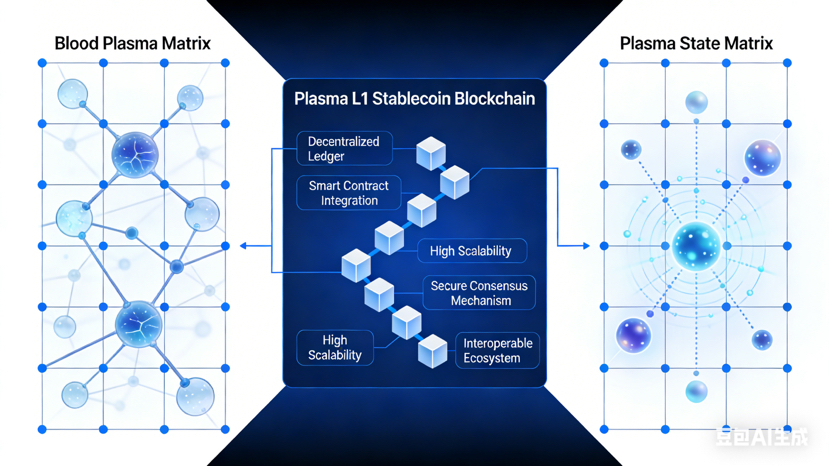
Plasma @Plasma is a Layer 1 blockchain specifically designed for stablecoins. Why is it called plasma? Plasma has multiple meanings in different fields.
The term plasma originates from the ancient Greek word πλάσμα, meaning "to shape, model, cast," referring to "something that has been shaped or molded." In the 18th century, biologists discovered that plasma appeared to be a plastic, molded medium, with blood cells suspended within it; hence it was named plasma. By the 20th century, American chemist Irving Langmuir found that just as plasma is a medium for transporting blood cells, ionized gas serves as a medium for transporting charged particles, thus the term "plasma" was also applied to it. Plasma aims to build a globally most liquid and high-performance stablecoin network, becoming a medium specifically designed for the flow of stablecoins. It is not a general-purpose public chain; its core design goal is to provide low-cost, high-efficiency, and high-performance infrastructure for global stablecoin transactions. It natively supports zero-fee USD transfers, custom Gas tokens, and confidential payments, and is fully compatible with EVM, implementing the PlasmaBFT consensus algorithm based on Fast HotStuff for second-level finality, with a built-in trust-minimized native Bitcoin bridge allowing BTC assets to be used across chains.
Of course, as a new blockchain, Plasma's long-term security and degree of decentralization still need time to be tested, and it also faces competition from other stablecoin dedicated chains, such as Stable. The price of xpl has dropped significantly from its high point of ten thousand U, but this does not mean that the project has lost its prospects.