
Stepping back from the peak of the NFT bubble to the AI infra unicorn, Alex Atallah executed the most precise 'time machine' retreat of the Web3 era.
In 2022, when OpenSea's valuation soared to $13.3 billion and individual wealth exceeded $2 billion, this CTO chose to leave at the peak. At that time, many people couldn't understand—why leave when the NFT market was booming?
Eighteen months later, the answer was revealed: his new company OpenRouter grew tenfold in seven months, securing $40 million in investments from a lineup of all-stars including a16z, Sequoia, and Menlo Ventures, with a valuation of $500 million.
This is not luck, but a carefully planned 'methodology replication'.
From NFT to AI: Two victories of the same aggregation philosophy.
Alex Atallah's background is robust: Stanford Computer Science, Palantir engineer, OpenSea co-founder. He revealed the underlying logic of his two startups in a podcast:
"OpenSea organized this very heterogeneous inventory and put it together in one place... You see a lot of those similarities with how AI works today."
Translated, it means: find the fragmented ecosystem and create an aggregation layer.
In the era of NFTs, the metadata standards are a chaotic mess, OpenSea unified the market. In the AI era, with 300+ large model APIs being different, OpenRouter unified the interfaces.
At the beginning of 2023, when the mainstream narrative was still 'OpenAI dominates the world', Atallah made an extremely counter-consensus judgment: 'If a large model can be trained for $600, there will be tens of thousands of models in the future, and they will need a 'market.'
Today, this prophecy has come true. Claude, Gemini, Llama, Mistral, DeepSeek, almost every week there are new players entering the market. In the era of model explosion, the aggregation layer is the infrastructure.
What exactly is OpenRouter?
Simply put, it is the 'Ctrip' of the large model world.
Developers want to use a model, the traditional path is:
• Register for a Claude account → Wait for API quota → Write a set of integration codes.
• Finding it too expensive → Want to switch to an open-source model → Rewrite a set of APIs.
• Want to try a new model → Write another set of code.
OpenRouter ended this nightmare with a single API:
• Unified interface: Calling GPT-4's code, switching to Claude only requires changing one parameter.
• Automatic price comparison: Automatically select the cheapest/fastest model for the same task.
• Load balancing: Is Claude at capacity? Automatically switch to a backup model.
Over 300 models, 60+ providers, all plug-and-play.
When AI meets crypto: the aggregation revolution in parallel worlds.
Interestingly, the success of OpenRouter is astonishingly similar to the stories unfolding in the crypto market.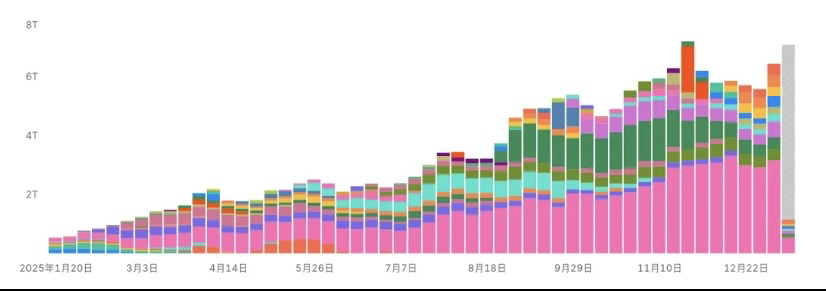
In 2024, one of the biggest narratives in the crypto market is liquidity aggregation. From 1inch to Jupiter, from cross-chain bridges to intent protocols, they are all doing the same thing: aggregating fragmented liquidity so that users don't have to worry about backend complexity.
This perfectly mirrors the logic of OpenRouter:
• DeFi: There are too many DEXs, users need aggregators to find the best prices.
• AI: Too many models, developers need aggregators to find optimal performance.
• DeFi: Gas fee fluctuations require smart routing.
• AI: Token prices fluctuate, requiring intelligent scheduling.
As CoinDesk's latest data shows, BTC is currently stabilizing above $95,000, ETH has surpassed $3,300, and the entire crypto market cap has returned to $3 trillion. But the real opportunity is no longer in the tokens themselves, but in the infrastructure layer.
In the past 30 days, stablecoin payment volume grew by 40%, and DeFi protocol revenue hit a new high since 2022. What does this indicate? As the market matures, users no longer care about the underlying protocols, only about who can provide a simpler and cheaper entry.
OpenRouter is at this critical juncture in the AI market.
Data flywheel: a moat deeper than technology.
OpenRouter's most underestimated asset is its largest multi-model usage dataset across the entire network.
Millions of developers call every day, generating real-time feedback:
• Which model has the highest coding efficiency?
• Which model has the best cost-performance ratio for mathematical tasks?
• Which provider is most likely to go down at night?
This data has created the most authoritative LLM rankings in the industry, even Andrej Karpathy has publicly recommended them. In April 2025, OpenAI even chose to anonymously launch GPT-4.1 on OpenRouter to obtain unbiased developer feedback.
Data → Ranking → Users → More Data. Once the flywheel starts turning, the moat will dig deeper and deeper.
5% commission: elegant or fragile?
The business model is simple: you spend $100, OpenRouter takes $5.
No markup, just charge a 'toll.' This aligns with the traditional SaaS model in Europe and America—maintaining neutrality is key to gaining trust.
But the doubts are also considerable:
• Open source alternative LiteLLM: free, self-deployable, currently swallowing privacy-sensitive clients.
• Major clients bypassing: When usage reaches a certain scale, direct integration with manufacturers is more cost-effective.
• Price war: After competition intensifies, the 5% fee may drop to 3% or even 2%.
A team of 8 has achieved nearly $100 million in annual GMV, with productivity comparable to early Instagram. However, maintaining a 100x PS valuation depends on quickly establishing a network effect before the open-source siege.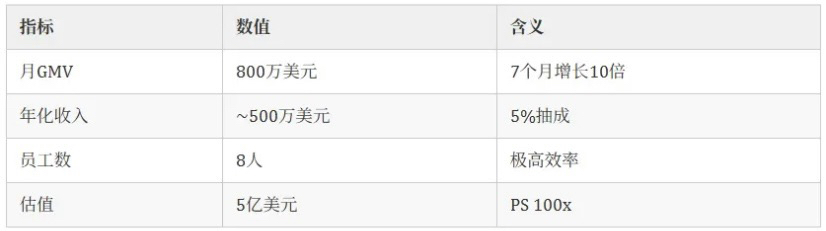
The final battle of the developer economy.
The story of OpenRouter reveals a grander trend: we are moving from 'model worship' to 'pragmatism.'
In 2023, developers competed on who could use GPT-4. In 2024, the competition is about who can achieve the same effect at the lowest cost. In 2025, everyone will only care about one thing: how to make users unaware of the underlying model switching.
This is very similar to the evolutionary path of the crypto market. In 2021, users cared about which chain had higher TPS. In 2024, they only care about whether the wallet can complete cross-chain exchanges with one click.
The more complex the technology, the more valuable the aggregation layer becomes. This rule applies whether in AI or crypto.
CoinDesk's latest data shows that institutional investors invested over $2 billion in the AI+Crypto crossover field in Q4 2024. A16z's latest fund allocated 40% to AI infrastructure. This indicates that capital has understood: AI's 'DeFi summer' has not arrived yet, but the infrastructure is already picking up speed.
Advice for developers.
If you are an AI application developer, what should you do now?
1. Don't heavily invest in a single model: OpenAI's blockade risks and Claude's capacity limits indicate that relying on a single vendor is akin to handing over your lifeline to someone else.
2. Early use of aggregation layers: OpenRouter or LiteLLM, first solve flexibility issues. After the business takes off, consider cost optimization.
3. Pay attention to rankings: OpenRouter's model ranking is 100 times more reliable than manufacturers' self-praise; it is generated by consuming real tokens.
4. Prepare for 'model arbitrage': For the same task, the preview price of GPT-4o is three times that of Claude 3.5, with only a 5% difference in quality. The money saved is all profit.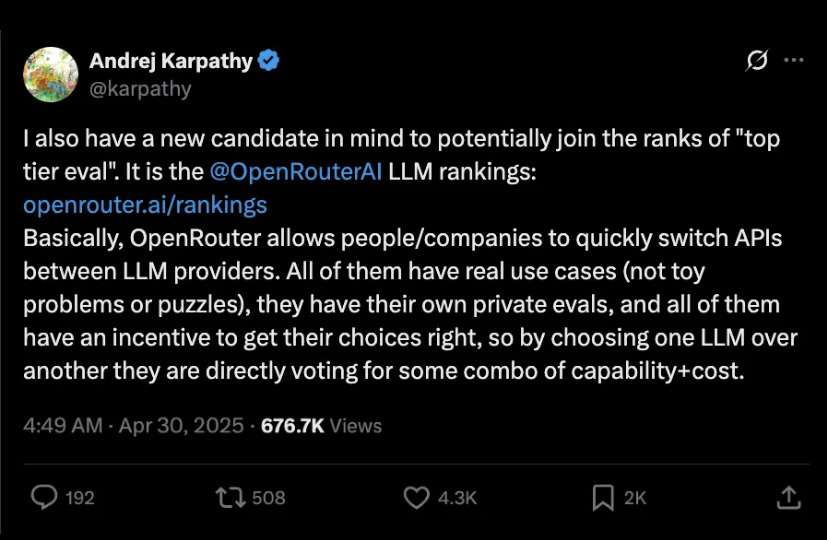
The value of the time machine.
Atallah's two successes are not rooted in cutting-edge technology, but in the precise control of the 'time machine.'
He will leave before the bubble bursts and lay out before trends explode. This kind of intuition is worth more than any code.
Can OpenRouter become the next Stripe or Plaid? The answer lies in two pieces of data:
• The crypto market has already proven: the value of aggregation layers > underlying protocols.
• The AI market is proving: reasoning costs will account for over 60% of knowledge enterprise expenditures.
When hundreds of thousands of models are running simultaneously, whoever controls the routing controls the entry.
Interactive topic: What is the most troublesome model switching issue you face when developing AI applications? Will you choose an aggregation platform like OpenRouter, or stick to your own integration? Feel free to share your practical experiences in the comments!
If you feel that this article helped you understand the underlying logic of AI infrastructure, please like and share it with fellow developer friends. Follow this account for continuous deep dives into the ultimate showdown between open source and business! #OpenRouter #美国核心CPI低于预期 #Strategy增持比特币 #美国民主党BlueVault #加密市场观察 $BTC


