

As the total market value of global stablecoins surpasses $300 billion and annual transaction volume exceeds traditional payment giants, the performance bottlenecks of existing public chains—high fees, transaction delays, and Gas token thresholds—have become key obstacles to the widespread adoption of Web3 payments. Against this backdrop, Plasma, a high-performance Layer 1 public chain focused on stablecoin payments, has drawn market attention to the next generation of payment infrastructure with its dual design of 'zero fees + Bitcoin-level security.'
🔍 Technical Architecture: Balancing Efficiency and Security
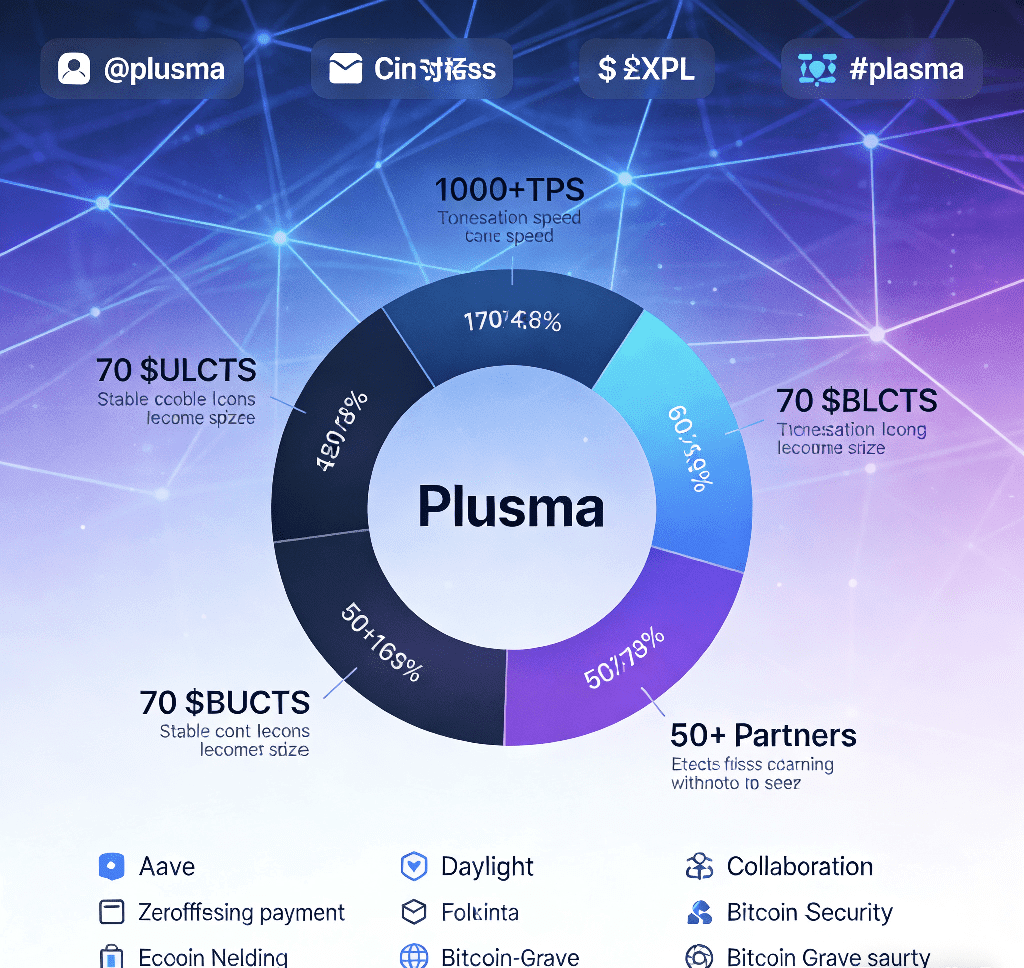
Plasma achieves over 1000 TPS and block confirmation speeds of less than 1 second through an improved PlasmaBFT consensus mechanism while maintaining EVM compatibility, supporting seamless migration of mainstream DeFi protocols. Its core innovation lies in the zero-fee mechanism in the payment process, allowing users to transfer using stablecoins like USDT without incurring additional costs, and enabling complex transactions to directly pay Gas using USDT or BTC, significantly lowering the usage threshold. On the security front, the project ties asset security deeply to Bitcoin's PoW network through a threshold signature bridge and Bitcoin network state anchoring, attempting to seek a viable path between decentralization and efficiency.
🌱 Ecological Progress: From Payment Networks to Financial Stacks
In the early stages of Plasma's launch, it performed remarkably in the DeFi sector: the total locked value (TVL) quickly climbed to nearly $5 billion, with stablecoin locked value exceeding $7 billion, and 24-hour DEX trading volume breaking $200 million. In terms of ecological cooperation, it has partnered with the African payment service provider Yellow Card, covering cross-border remittance scenarios in over 20 countries, and launched neobank products that integrate storage, consumption, and financial management functions. On the capital side, it has raised a total of $74 million, with investors including Framework Ventures, Founders Fund, and others, while also receiving ecological support from Tether and Bitfinex.
📊 Long-term Planning and Value Logic

According to its roadmap, Plasma will focus on the standardization and scaling of stablecoin payments from 2024 to 2026, targeting high-inflation areas; from 2027 to 2029, it plans to introduce modules such as decentralized identity and on-chain credit systems, gradually building a financial operating system; the vision after 2030 is to become underlying financial public infrastructure. In terms of token economics, the total supply of XPL is 10 billion, with a deflationary mechanism and long-term team lock-up arrangements, currently with a circulating market value of about $2.66 billion.
💡 Industry Insight: Can Vertical Public Chains Open Up a New Payment Landscape?
The stablecoin market is shifting from scale expansion to deepening experiences. Plasma aims to establish a differentiated advantage in the payment vertical with zero fees, low thresholds, and high compatibility. Its development path also reflects a current market trend: amidst the increasingly fierce competition among general-purpose chains, specialized chains optimized for specific scenarios may become the next focal point of infrastructure evolution.
The evolution of the payment track has never stopped. As on-chain transaction volumes approach traditional financial networks, the balance between experience and security will be the key to success or failure. Do you see a future for vertical public chains in the payment field? Feel free to leave a message for discussion.#Plasma #Layer1 #Web3支付