
Finally have some free time, this article will cover Maple's token economics, ecosystem integration, and challenges in one go
I. Token Economics
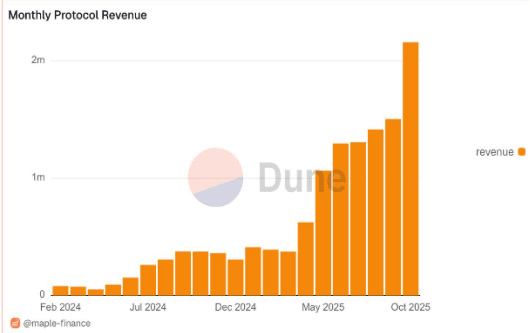
Maple's token economic model has undergone a major iteration, successfully transitioning from the initial inflationary incentive model to a real yield and deflationary model centered around $SYRUP , aiming to directly convert the protocol's commercial success into token value.
1. Token
Current core governance token — $SYRUP — governance rights + value capture
Original protocol token — $MPL — has entered the phase of elimination and migration
2.$SYRUP status
Total Supply: 1216127147 (fixed, no further issuance)
Circulating supply: 1,138,689,196 (circulation rate ≈93.6%)
Price: 0.27 USD
Market cap: $310,634,413
3. Value capture mechanism
A. Protocol revenue sources: 10% interest share + 1.5% Delegate management fee
B. Value return: 100% of protocol revenue goes to treasury — automatic $SYRUP buyback — all bought $SYRUP tokens are permanently destroyed; simultaneously, Syrup Strategic Fund (SSF) is activated, with an additional 25% of revenue used for ecosystem buybacks and development
Actual buyback data for 2025:
Month Buyback Amount / USD Burned Quantity (SYRUP) Notes
October / First month 0.87m ≈3.5m MIP-019 effective period
November 3.42m ≈138m Growth of 293%, full 100% revenue buyback effective, SSF additional 25% ecosystem buyback
Dec. 1–Dec. 2 2.2m ≈8.9m $1.1m+ buyback in week of Dec. 1, $1.1m adjustment on Dec. 2, monthly total over $6.5m
4. Token allocation and migration
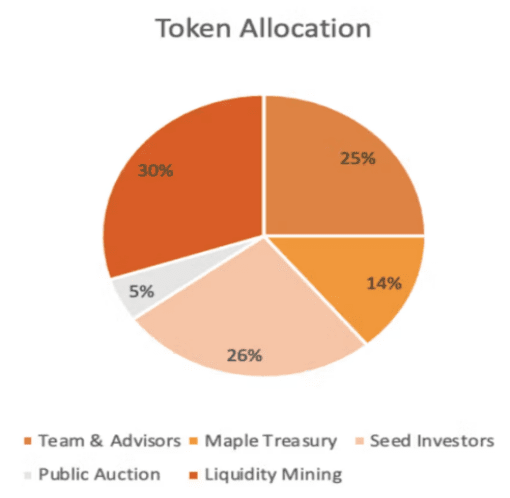
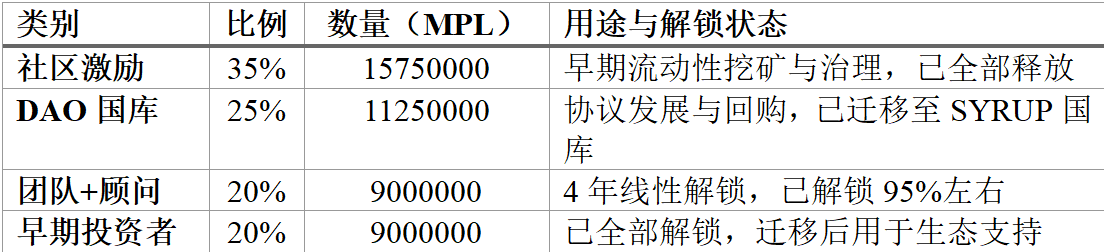
Initial $MPL token supply is 45 million, primarily allocated to community incentives, DAO treasury, team, and investors.
From November 6, 2024 to February 2025 (90 days total), $MPL holders can migrate their tokens at a fixed rate of 1 MPL : 100 SYRUP. Unconverted MPL after the deadline is automatically deemed unclaimed. This makes $SYRUP the sole core token for community governance and value capture.
5. Governance rights and security safeguards
Ordinary parameter changes: $SYRUP holders vote + 3-day Timelock
Core upgrades and major decisions: 5/8 institutional multisig + 7-day Timelock
Other security measures:
All governance proposals require Snapshot community voting + on-chain execution;
Treasury multisig separation (buyback-only);
In 2025, Syrup Strategic Fund (SSF) is introduced, with 25% of protocol revenue additionally used for ecosystem buybacks and development (MIP-019 extension)
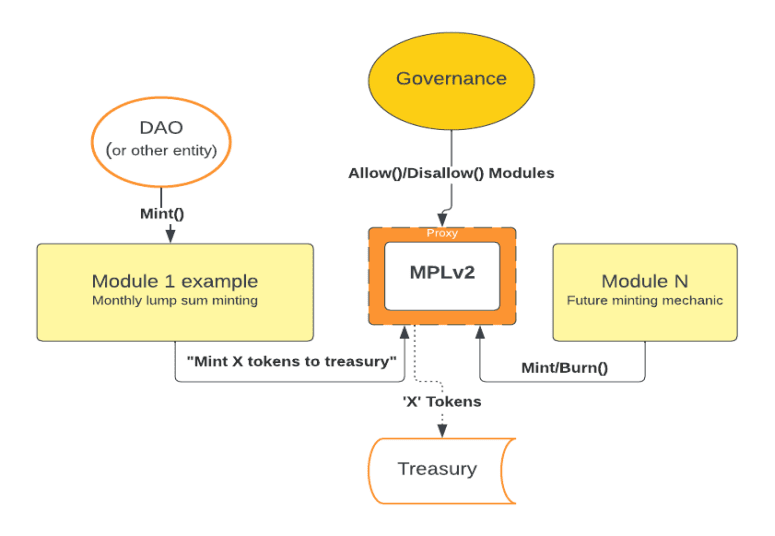
6. Deflationary mechanism and future value drivers
Since MIP-019 became effective, the protocol has entered a permanent net deflationary state (weekly burn volume > any remaining unlock). Expected circulating supply will continue to significantly decline from 2026 onward.
Protocol revenue scales linearly with TVL growth.
Expansion of RWA/BTC products aligns with surging institutional demand for fixed income
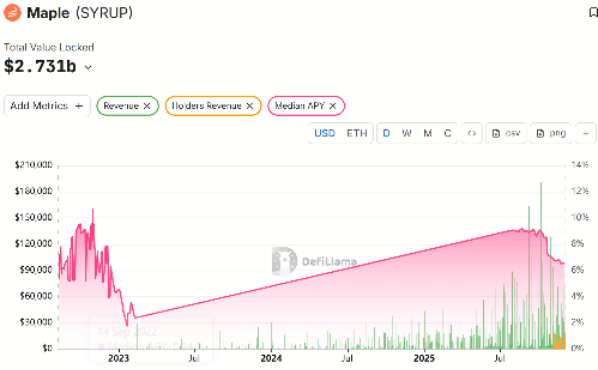
7. Potential risks
Buybacks are subject to stability of protocol revenue, affected by interest rate fluctuations;
Governance concentrated in institutional multisig may affect decentralization.
II. Ecosystem Integration

1. Borrower and capital provider ecosystem
Borrowers (Borrowers):
Focus on high-quality institutions: 28 active borrowers in 2025 (600% increase from 2024), including top-tier crypto market makers, trading firms, mining pools, and emerging TradFi players. Loan types are primarily fixed-term (90–180 days), with average interest rates of 8–9%, and active loan book size around $1.68B.
Capital providers (Lenders):
Institutional side attracts Spark, BlackRock BUIDL Fund, family offices;
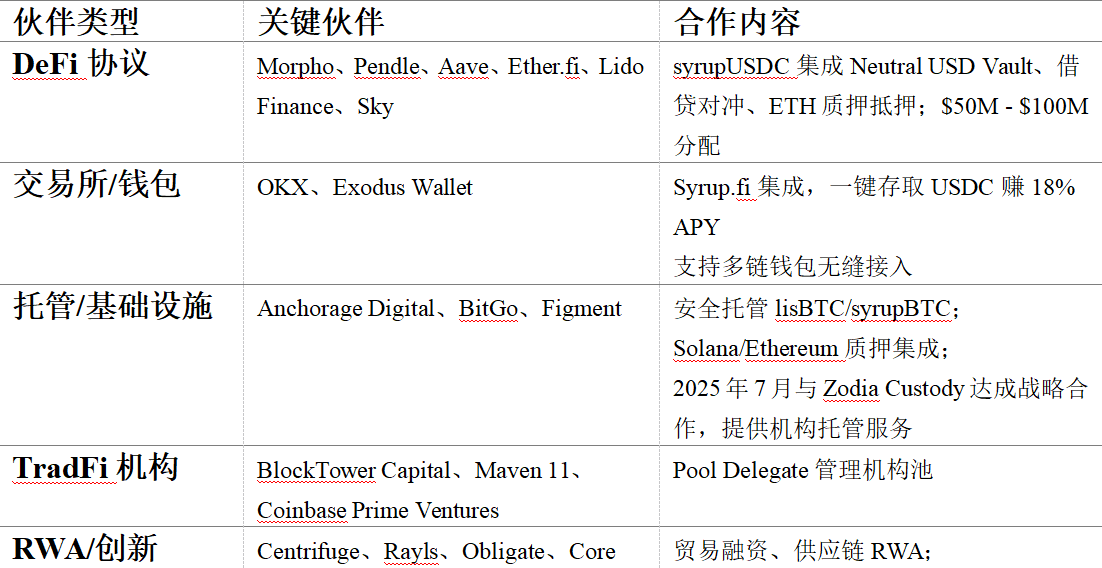
DeFi side attracts retail users via Syrup.fi, integrating wallets like OKX Wallet/Exodus, with user count exceeding 100,000. In 2025, the first $100M+ loan from TradFi partners is added, accelerating institutional inflows.
2. Strategic partners
III. Risks and Challenges
1. Lending risk
Borrower default; concentrated withdrawal requests may create liquidity pressure; Delegate negligence may lead to flawed risk assessment
The 2022 Orthogonal Trading default event caused a $54M loss, accounting for 20% of TVL at the time
2. Technology and security risks
Contract vulnerabilities; DeFi hacks
3. Legal and regulatory risks
DeFi regulatory tightening such as EU MiCA and potential U.S. stablecoin legislation may restrict uncollateralized loans and RWA products;
4. Decentralized governance challenges
Core upgrades rely on 5/8 institutional multisig, where members are primarily core team and key Delegates, potentially leading to centralized decision-making bias or conflicts of interest, undermining community trust.
5. Market competition challenges
Ongoing innovation from traditional DeFi giants and emerging RWA forces may compete for market share
