Introduction
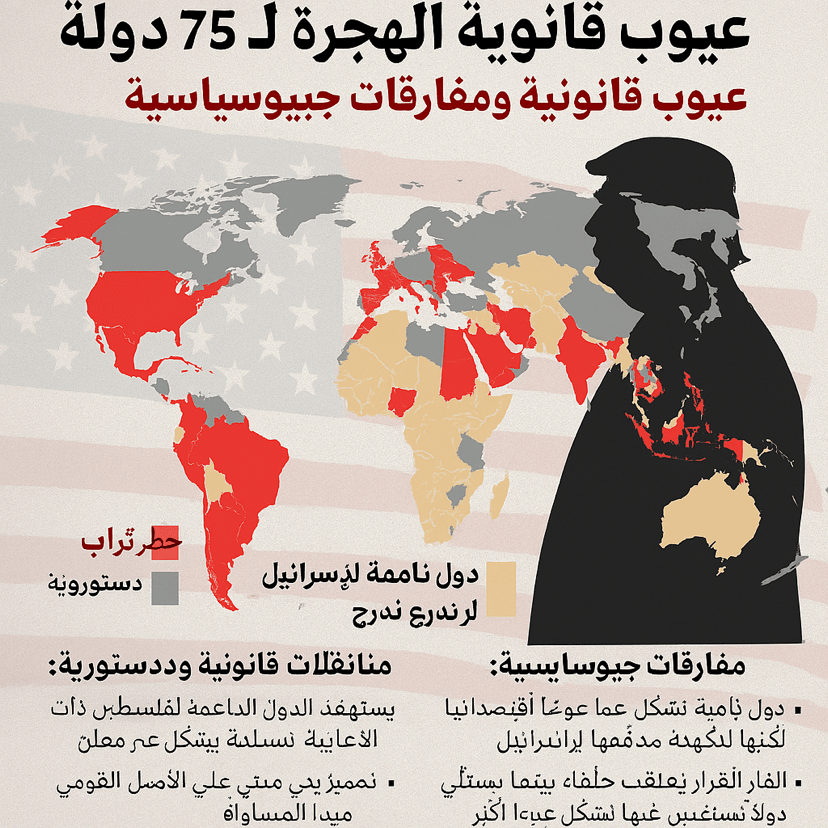
In January 2026, the Trump administration announced a suspension of immigration visas for citizens of 75 countries. The stated justification was economic: immigrants from these countries were alleged to burden government assistance programs. However, upon closer examination, the decision reveals legal and constitutional flaws, and exposes geopolitical contradictions tied to international alliances, particularly with Israel. This article consolidates all previous analyses into a single, comprehensive text, highlighting the glaring contradiction between the U.S. Constitution and this executive action.
---
First: The stated basis versus reality
• The stated justification: Protecting the American economy from the burden of immigrants.
• The reality: Countries like Mexico, India, and the Philippines, which are the largest sources of immigration and economic burdens, were not included.
• The result: The decision is not purely economic, but selective, serving a political agenda linked to the alliance with Israel and penalizing countries that support Palestine.
---
Second: Legal and constitutional flaws
1. The First Amendment (Freedom of Religion)
• It stipulates preventing any law targeting a specific religion or limiting the freedom to practice it.
• Most of the included countries have a Muslim majority, making the decision an unannounced religious discrimination.
2. The Fifth Amendment (Due Process)
• It ensures that any government decision must be based on fair procedures.
• The decision lacks accurate data and is based on political selectivity, making it contrary to the principle of procedural justice.
3. The Fourteenth Amendment (Equal Protection Under the Law)
• It stipulates that all persons should enjoy equal protection under the law.
• The decision discriminates against immigrants based on national and religious origin, which is a direct violation of the principle of equality.
---
Third: Geopolitical contradictions
Exempt countries despite the economic burden
• India, Mexico, the Philippines, Nigeria, Turkey: All developing countries, high immigration rates, but were not included.
• The unstated reason: Its strong ties with Israel or its role in politically and economically supporting it.
Countries included despite the alliance
• Egypt, Brazil, and Russia were included despite being important economic or political partners.
• This creates a stark contradiction: Why are allied countries penalized while others with a greater economic burden are exempt?
Negative impact on the American economy itself
• Many immigrants from these countries work in vital sectors: health, agriculture, technology.
• Preventing them creates a labor shortage and harms the American economy.
• The paradox: The decision claims to protect the economy but in reality weakens it.
---
Fourth: An expanded analytical table showing the contradictions
Country Economic situation/immigration Relation with Israel Paradox
India Developing country, massive immigration rates Extensive military and technological cooperation Clear economic burden but exempt
Mexico The largest source of immigration to America Official relations with Israel Not included despite being the largest source of immigration
The Philippines A major source of labor immigration Stable relations with Israel Economic burden but politically protected
Nigeria The largest African economy, increasing immigration rates Security and agricultural relations with Israel Economic and security burden but exempt
Turkey Economic crisis, notable immigration rates Intelligence and trade cooperation with Israel NATO member, not included
Ukraine Economic crisis and massive immigration Close relations with Israel Not included despite the burden
Poland Notable immigration rates Strong ties with Israel Exempt despite the burden
Romania High immigration rates Official relations with Israel Not included
Indonesia The largest Islamic country, increasing immigration Indirect trade relations with Israel Exempt to avoid a political crisis
Argentina Economic crisis and notable immigration Official relations with Israel Not included despite the burden
Colombia Source of immigration, economic crisis Strong ties with Israel Exempt
South Africa Notable immigration rates Economic relations with Israel Partially exempt
---
Fifth: Legal Precedents
Trump v. Hawaii (2018)
• Addressed the travel ban imposed by Trump on several predominantly Muslim countries.
• The Supreme Court upheld the decision at that time, considering that the president has broad authority under the Immigration and Nationality Act (INA).
• However, it acknowledged the existence of controversy over allegations of religious discrimination, and emphasized that any decision should be reviewed if it is based on an unlawful basis.
• The new decision is more selective and clear in discrimination, making it prone to annulment.
Other issues in immigration
• Chy Lung v. Freeman (1875): Affirmed that states cannot enact discriminatory laws against immigrants.
• United States v. Texas (2023): Clarified that immigration policies must respect due process.
---
Sixth: The impact on national interest
• The decision harms the American economy by reducing skilled labor.
• It weakens American foreign policy and creates a negative image of it globally.
• It reinforces the image that America practices political and religious discrimination, which contradicts its constitutional values.
---
Conclusion
Trump's decision to ban immigration visas for 75 countries is not merely an administrative economic measure; it is a racist and politically biased decision that serves a geopolitical agenda linked to the alliance with Israel. The contradictions are clear: Developing countries with economic burdens were not included because they are allies of Israel, while poorer countries supporting Palestine were included. This selectivity proves that the decision is unconstitutional, as it is based on religious and political discrimination, harming the American economy and foreign policy.
Therefore, the U.S. Supreme Court must intervene to annul or halt it, in order to uphold the principles of equality, religious freedom, and due process, and to preserve the national interest.