The Walrus @Walrus 🦭/acc token can also earn rewards through staking. It operates on a proof-of-stake network, allowing WAL token holders to earn rewards by staking their tokens, thus ensuring network security.
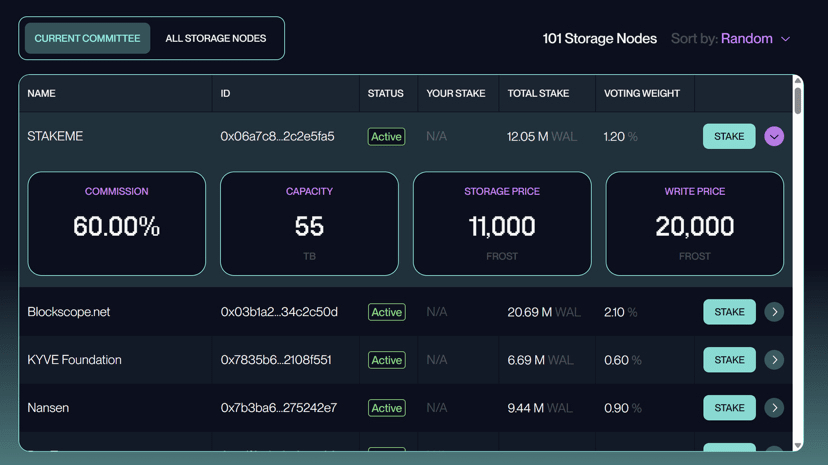
The staking entry can be found on the official website: https://stake-wal.wal.app/, but it seems to only support the slush wallet on the Sui chain. Current returns and node status are as follows:
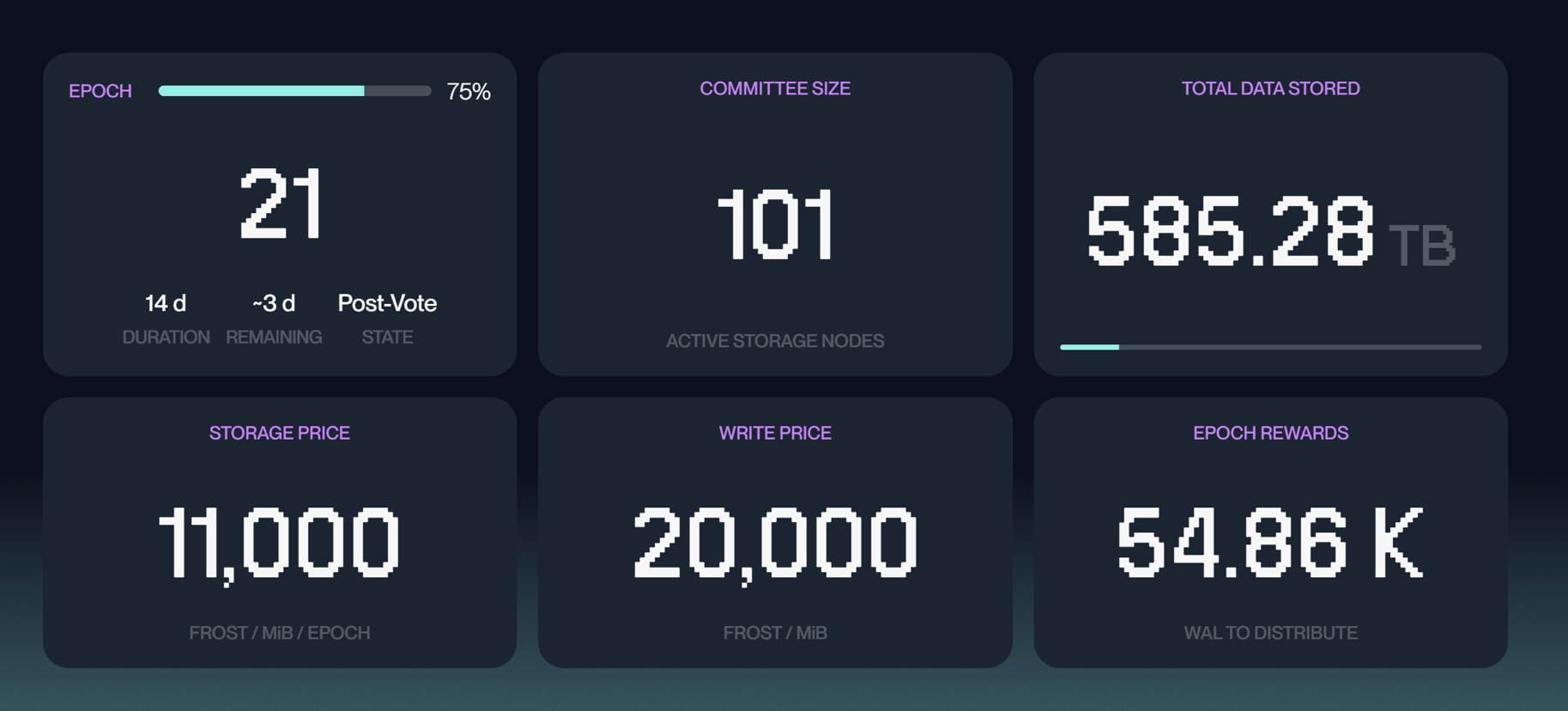
Some terms might be hard to understand:
1. Frost: A fund subsidy mechanism in the Walrus protocol designed to increase early network adoption and growth. By subsidizing storage costs, it ensures early nodes have sufficient income and distributes rewards to stakers, driving network launch.
2. MiB: This is something everyone understands, a unit of measurement for storage space, used in Walrus to measure the amount of data stored by users online, and serves as the basis for calculating storage costs and network resources.
3. Epoch: A fixed time period in the Walrus network, lasting 14 days, which serves as the basic unit of time for the distribution of staking rewards, settlement of storage fees, and updates on network status. This is similar to the recent Bitway, where it takes 14 days to withdraw after unstaking.
The operation mechanism of Frost can be simply described as a ‘start-up capital pool’. The protocol reserves a portion of WAL tokens as subsidies, which are used to cover the difference between the ‘actual price paid by users’ and the ‘market operational costs of storage nodes’. This way, users can access storage services at a lower price in the early stages of the project, while storage nodes can generate revenue to cover costs, and stakers can also share in the rewards, thus rapidly promoting network growth. The storage fees paid by users will be gradually released to stakers over each Epoch. In Walrus's storage services, storage fees are proportional to the amount of data stored (in units like MiB) and the duration of storage (in number of Epochs).