
Detailed Explanation of the 123 Trading Rule and Its Application in Contract Trading [Compiled over 2 hours, hoping it helps you]
Let me briefly explain the origin of the 123 trading rule and the scope of its application:
The 123 trading rule (also known as the 123 rule) originates from the Dow Theory and is a classic method in technical analysis for identifying trend reversals. It confirms the end of the previous trend and the start of a new one through three key conditions, particularly suitable for clear trending markets such as stocks, futures, and contract trading.
Since it's the 123 rule, it must involve three conditions, meaning three small segments of price movement!
The three conditions don't necessarily have to appear in strict order — as long as all are satisfied, the reversal signal is confirmed. This rule is simple and practical, often used together with the 2B rule to filter out false signals.
I'll explain the 2B rule in a future update!
Below 👇 I'll explain the three core conditions of the 123 rule
Trendline broken: the original trendline is no longer valid.
In an uptrend, price breaks below the uptrend line.
In a downtrend, price breaks above the downtrend line.
This indicates the original trend has temporarily ended.
Failed test of previous high/low (no new high or new low is made):
In an uptrend, a rebound forms a lower high (unable to break the previous high).
In a downtrend, a pullback forms a higher low (unable to break the previous low).
This indicates the original trend momentum is weakening.
Crossing the prior short-term extreme:
In an uptrend, price breaks below the previous short-term low.
In a downtrend, price breaks above the previous short-term high.
This confirms the reversal is valid.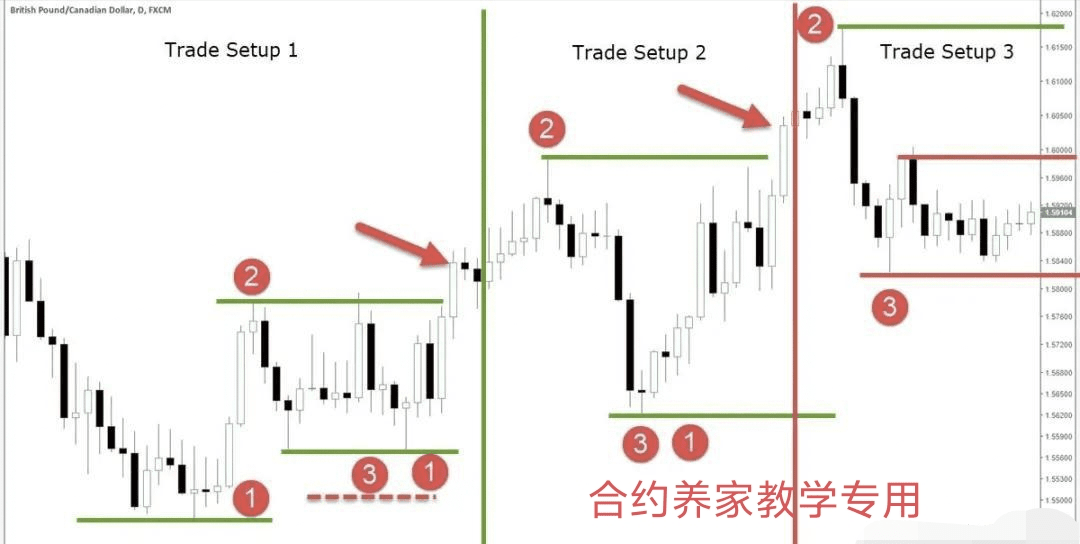
With the help of diagrams, you'll find it very simple!
Let me give you an example:
For example, if a price declines continuously, draw a downtrend line connecting the lows from the start of the decline, then look for whether the three conditions are met:
Price breaks above the recently drawn trendline (condition 1).
After moving up, price pulls back and tests the previous low but fails to make a new low (forms a higher low, condition 2).
Price rises again and breaks above the previous short-term high (condition 3).
→ All three conditions are met, confirming a bullish reversal — consider going long.
Conversely, in a sustained uptrend, you can also look for reversals this way — if all three conditions are met, consider going short!
Isn't it simple? If you don't understand, just look at it a few more times and you'll get it — and never forget.
Always keep learning and stay up to date!
Below 👇 I'll explain how the 123 rule is applied in our contracts
Contract trading is highly volatile, with strong trends and high leverage — the 123 rule is especially suitable for capturing large-scale trend reversals, offering significant profit potential!
Practical application steps:
Identify the trend — draw trend lines on a higher time frame (e.g., 4-hour or daily chart), and wait for condition 1 to occur (a breakout).
Wait for confirmation — observe condition 2 (failed test) and condition 3 (crossing the prior extreme). Enter only after all conditions are met.
Going long: open a long position when condition 3 breaks upward.
Going short: open a short position when condition 3 breaks downward.
Position sizing and risk management:
Entry point: after condition 3 is confirmed.
Stop-loss: place it near condition 2 (previous high/low) or just outside the trendline.
Take-profit: at the previous high/low resistance level.
Filtering false signals — this is what I always talk about: fake breakouts or fake breakdowns:
Volume is the true test: if volume increases during a reversal, the signal is more reliable.
Final summary of what I personally consider the key points:
The essence of the 123 rule is capturing reversals after a trend has exhausted itself. Simply drawing trend lines and applying the three conditions enables you to significantly improve your ability to catch major trends in the contract market.
Classmates, did you get it? 😂
If my sharing helps your trading, please keep following!