1. Information is opaque, untrue, unprofessional, a scam, unregulated, unethical, and without limits.
2. There is a significant disparity in capital strength, and opponents can directly lead or even control the market. When large funds enter, they lock in chips, and when they exit, it's like pulling the rug out from under. They can take breaks if their capital is large enough to control liquidity; when they buy, prices rise, and when they sell, prices fall. The next buyer stops losses in desperation.
3. There is a gap in experience and skills; the traders are winners filtered by market experience. We are not competing against new investors but rather against experienced traders in terms of skills and expertise.
4, Negative return game: in the crypto market, there's no company profit or dividend like in stocks. Although transaction fees seem low per trade, they become a significant portion of profits when engaging in short-term trading.
5, Timing disadvantage pit: price spikes cause margin calls, while favorable prices are only available for short periods. With limited energy, you can't monitor the market 24/7. A stop-loss and a take-profit at the same price level—yet you might not execute the take-profit via limit order, while a margin call will never miss. The price remains unchanged, but your account and position are gone. Only traders with extremely high skill can use limit orders to achieve fair timing opportunities.
6, Leverage liquidation fees and slippage: in crypto futures, especially altcoins, liquidation fees under high leverage can reach as high as 15% at 10x leverage. On a large scale, this 15% is already an astonishing rate—probably even higher than casinos. After placing a position in isolated margin mode, still set a stop-loss before the liquidation price. Avoid using high leverage whenever possible.#爆仓
7, Risk-taking pit: excessive desire. For large capital, an annual return of 30% is already satisfactory. But small capital often aims for doubling, even doubling in a month, a week, or even a day—sometimes even once. This reflects poverty of ambition and impatience, leading to all kinds of mistakes.
8, Price judgment pit: focusing on whether the price seems cheap, fearing high prices. Getting stuck in long-term drawdowns or hesitating to act. What exists is reasonable. The truth is that market trends always move from one extreme to another.#价格
Trying to catch tops or bottoms often leads to stampedes. Assuming a 20-point drop or 30-point rise will trigger a large reversal, but in reality, it's hard to judge tops or bottoms during an ongoing rally. Trading against the trend in the middle often leads to rapid deep losses or stop-outs. Especially when price breaks through levels—hourly waves breaking daily levels is possible.
9, Floating loss mindset pit: beginners aren't sensitive to floating losses, but veteran traders become overly cautious once they suffer floating losses, even falling into self-doubt. Veteran traders often make money slower than new traders. They tend to over-watch, over-tight stop-losses, and try to capture every small wave, resulting in missing major trends. To catch big moves, you must be willing to tolerate small floating losses.
10, Patience pit: the end-of-period often corresponds to the largest price movement. Lack of patience leads to floating losses, and without patience, you won't get the big gains. There's no such thing as price opportunity or volume opportunity, but there is timing opportunity.
11, Human nature loss-cutting pit: unable to cut losses, afraid of losses, hold losing positions, even add to them to average down costs. Love holding losing positions, chasing breakeven without loss on a single trade. As soon as there's a floating profit, want to taste the sweet immediately, unwilling to delay gratification.
12, Human nature impulse pit: triggered by various information stimuli, you may act impulsively—such as increasing trade frequency after consecutive losses, or opening trades immediately after days of inactivity. Idle hands can't resist opening trades. You can't hold floating profits, rush to exit early, then get restless and open a counter-trend position. Holding a wrong position until a good opportunity comes, but then you can't open a trade anymore. Don't constantly stare at current price changes; instead, study historical market behavior.
13, Human nature panic pit: it's best not to trigger this condition at all. Set a 10% single-loss cap with unconditional stop-loss and take a break. Markets specifically target losers. Losers aren't killed by opponents—they are crushed by their own panic and stampedes. Regardless of whether the market rises or falls, the stronger the move, the greater the panic, and the faster they die.
14, Beyond-experience pit
If you can't distinguish between high and low prices, the larger the cycle, the greater the price volatility—even to absurd levels. Experts die from catching the bottom. A single long-term cycle can last up to 72 years, 18 years, 54 months, 60 weeks, 105 days, or 52 days. Being able to clearly see weekly-level cycles is already very impressive; those who don't understand daily charts are gambling on intraday short-term trades. Getting key points wrong in major cycles can easily lead to account zeroing. The power of cycles across different timeframes will叠加 and accelerate when they resonate. If you look at BTC prices starting from 2009 (which is the 4th global financial cycle, 8th monthly cycle, and the beginning of its birth), subsequent prices have repeatedly reached absurd highs (beyond experience). According to my cycle theory, holding until the second half of 2027 is optimal.#周期
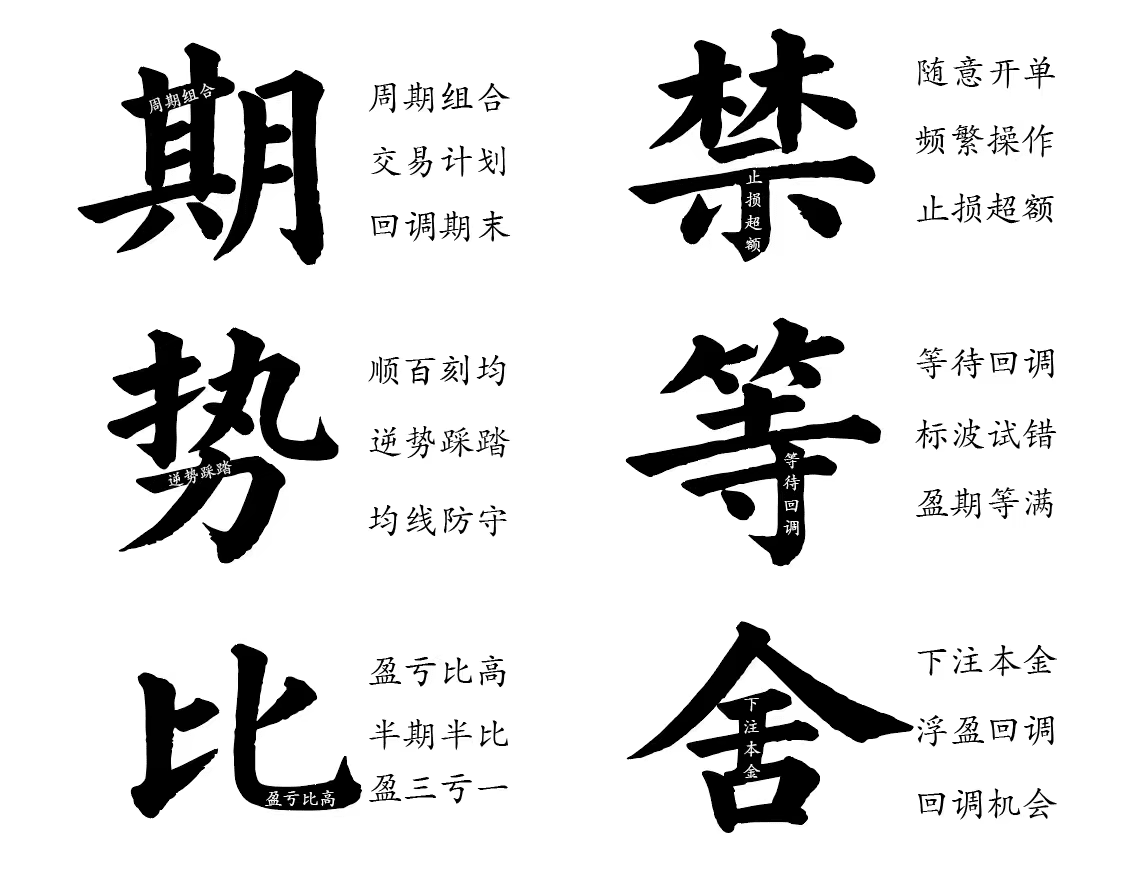
A great trader must trade their own plan: define position size and risk, define trading cycle, define minimum target move, define pattern conditions, execute orders via limit orders, and set stop-losses.#交易禁忌
I set five trading prohibitions for myself
Prohibit diversification, don't trade random coins
Prohibit short-term trading, no ultra-short-term trades
Prohibit going against the trend, never try to catch tops or bottoms
Prohibit early entry, don't enter too early, don't exit too early
Prohibit holding losing positions, no holding of losses allowed