
TL;DR
AI trading has been fully stress tested by the market—and it has failed.
What Web3 truly needs in the next stage is AI-driven asset management, not smarter trading bots that merely chase short-term alpha.
1. The AI trading experiment has already failed
The main narrative of the last round of AI × Crypto almost revolved around AI trading.
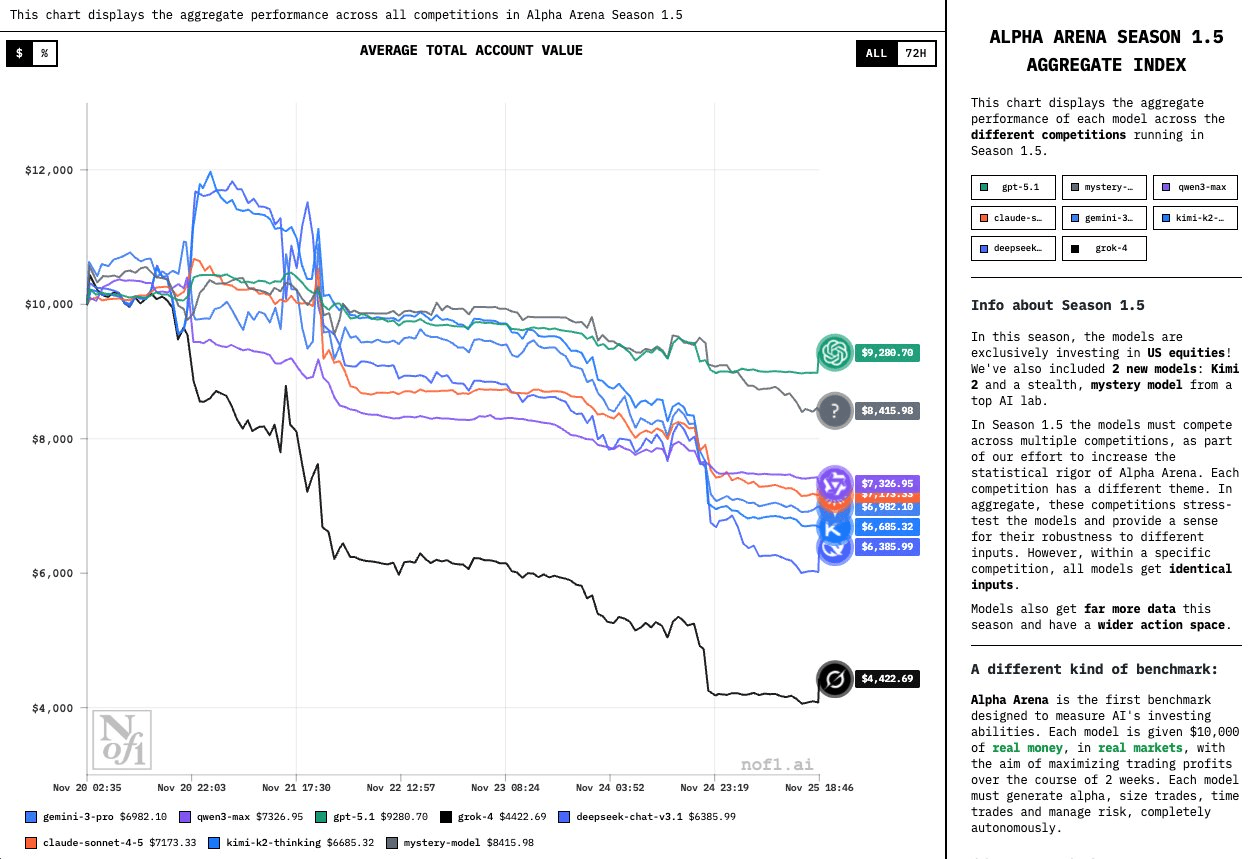
A typical case is the AI trading competition initiated by nof1.ai:
Real funds
Automated strategies
Zero human intervention
Conceptually, very Web3-native.
But the reality is:
A market reversal is enough to cause almost all participating strategies to collapse.
This is not because the model is not good enough,
but because the direction was wrong from the beginning.
2. AI trading, at its core, is still gambling
Regardless of whether it's packaged as a Bot, Agent, or Autonomous Trader, AI trading has the same structural problems:
Relying on short-term alpha
Assuming a single market environment
Extremely fragile under extreme volatility and liquidity shocks
In the DeFi world, this structure does not 'occasionally fail', but inevitably fails.
3. The real issue: AI is being used at the wrong level
The challenge of Web3 has never been in the 'ordering' itself, but in management:
Cross-chain, cross-asset portfolio risk
Diversified sources of returns (DeFi / CeDeFi / RWA / CEX)
Rapid switching between narratives, emotions, and liquidity cycles
These are all system-level issues—
and system-level issues are precisely where AI truly excels.
Not prediction,
but management.
4. AI asset management is the more Web3-native path
A truly Web3-native AI should not be a signal tool, but should play the role of:
On-chain capital allocator
Portfolio-level risk managers
Automated execution and real-time monitoring layer
The core issues also change accordingly:
From: 'How much did this trade earn?'
Turn into:
Can this structure run the entire cycle?
Can it gracefully degrade under extreme market conditions?
Is the return sustainable, composable, and verifiable on-chain?
This is AI asset management.
5. What is Sumplus
Sumplus — an AI asset management protocol centered around stablecoins.
Sumplus does not attempt to predict the market with AI, but focuses on:
Stablecoin priority for capital anchoring
Decomposing and allocating returns to different risk layers such as DeFi / CeDeFi / RWA / CEX CTA
Risk control, asset allocation, and disciplined execution driven by AI
The goal is not to achieve extreme returns,
but to ensure steady asset growth.
6. This is the upgrade of the narrative from 'trading logic' to 'asset management logic'
In Sumplus's design, there is a very clear but also very 'anti-consensus' premise:
The goal is not to achieve the highest annualized return, but to ensure that funds are not eliminated in any market environment.
This is the essential difference between Sumplus and the previous generation of AI trading projects.
The default assumption of AI trading is:
The market will certainly provide captureable short-term alpha
As long as the model is 'smarter', it can continue to win
This model has almost zero effectiveness under the current bear market conditions
While Sumplus's assumption is exactly the opposite:
The market is mostly unpredictable
Extreme market conditions in Web3 will certainly occur
Single strategy, single risk exposure will eventually be breached
Therefore, Sumplus chooses a set of asset management-level thinking:
Not betting on a single market direction, but implementing long strategies and multi-risk layer combinations
Not chasing extreme returns, but prioritizing control of drawdowns and systemic risks
Not using AI to predict prices, but for asset scheduling, risk monitoring, and dynamic rebalancing
In this structure, returns do not come from a one-time 'betting on the market',
but from long-term, compounding, sustainable capital allocation capabilities.
#Aİ #AIAgent