


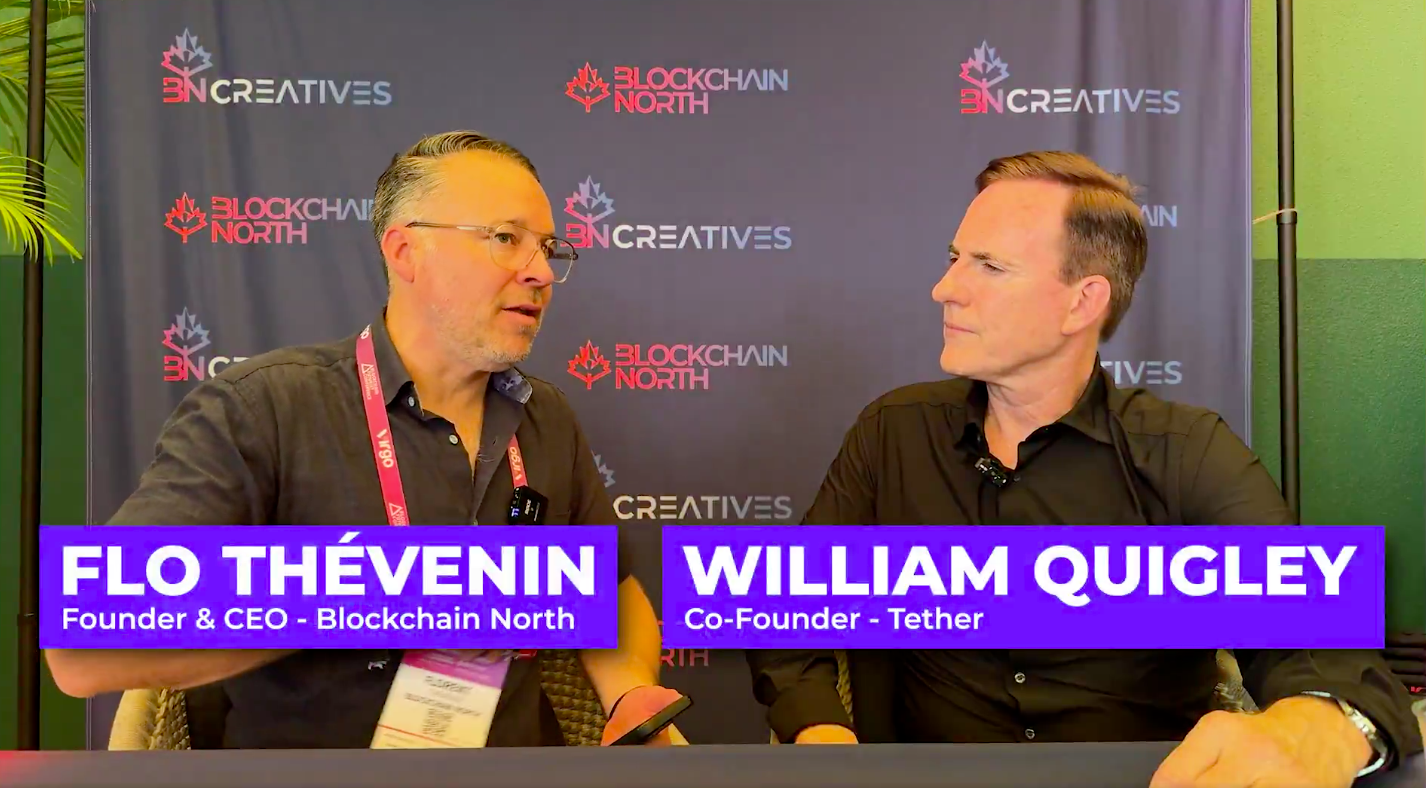
In a recent interview with Flo Thevenin, founder and CEO of Blockchain North, William Quigley, co-founder of WAX and Tether, stated that stablecoins will dominate the global payments space. The relevant interview content is as follows:
Flo Thevenin: You are a veteran in the industry. While I'm not sure if you like that title, it's indeed true. In an industry that has only been developing for seventeen years, you have been deeply involved for fourteen years, making your credentials quite substantial. How do you view the evolution of this industry? What clear and objective evaluation do you have regarding the current state of the industry?
William Quigley: Of course. Our initial thought was that for those in gray areas like virtual goods trading, breaking through the constraints of traditional banking systems is crucial. We must establish such a system. Fourteen years ago, whether it was online gambling platforms or e-commerce companies struggling to obtain banking services, it was hard to explain to outsiders why a payment method other than PayPal was needed. After all, from a Western perspective, people would question, 'What else is needed besides credit cards and PayPal?' But in reality, 90% of the global population cannot open a bank account.
Flo Twining: You are absolutely right.
William Quigley: Moreover, users settling in currencies other than the dollar bear extremely high fees during currency exchange.
Flo Twining: That's right.
William Quigley: You need to know that in certain business areas, the cost of exchanging local currency for dollars or euros can be as high as 40%. So if you hold a Western perspective, you might think, 'I have a credit card, and I have Venmo and PayPal' — I understand your point, but I said fourteen years ago and still hold this view: In the U.S., there is no need for cryptocurrency. Of course not, you have the world's most advanced payment system and financial system.

Flo Twining: This is also the point that Jeff Bezos has always emphasized. You should know what he often says about the 'price of tomorrow,' right? Innovation often starts from the margins, doesn't it? When Amazon was first established, it was not needed in downtown New York City because there were exquisite brick-and-mortar bookstores everywhere.
William Quigley: I have been involved in venture capital for thirty-five years and have always advised young investors: Don't judge investment opportunities with your narrow preconceived notions, because your perspective is too limited.
Flo Twining: You are not their target audience.
William Quigley: That's right; it almost never is. You listeners need to understand that anyone trying to conduct cross-border finance or payments outside the U.S., even today, knows how difficult it is. So cryptocurrency can indeed help people understand the existing problems more clearly. My point is that except for stablecoins, no cryptocurrency will ever truly become mainstream for cross-border payments. Previously, I attended a discussion where a smart person said, 'No, no, no, we process payments worth a billion every year' — he was in the cryptocurrency payment service. I asked him, 'What percentage does that account for?' He replied, 'Tether accounts for 60%.' Stablecoins account for 90% in total. I then countered, 'So you only have 10% of your business — that is $100 million — involving non-stablecoins. And the global payment flow is as high as $1 trillion a year, and you only process a billion? That's hardly worth mentioning. What truly matters is always stablecoins. Now the U.S. has announced that any business meeting specific conditions can issue stablecoins, which means that people in the U.S. and across Europe will start to engage with stablecoins. What worries me is that while using stablecoins can significantly reduce costs, especially for banks, they will not pass on the savings to users but will keep them for themselves.
Flo Twining: What do you think about the popularity of cryptocurrency? Here, the popularity refers to government intervention in the cryptocurrency industry. After all, you have pointed out that those who truly benefit are often marginalized groups and underserved markets. We see that the adoption rate of cryptocurrency in places like Argentina, Vietnam, and Nigeria is much higher than in Canada — like my country. So when the world's number one economy starts to dominate cryptocurrency development, what are your thoughts? I have asked many people, and they all believe that the biggest driver of cryptocurrency popularity is Trump.
William Quigley: That is indeed the case.
Flo Twining: Is this a good thing or a bad thing?
William Quigley: If you trade cryptocurrency to make money, then that's definitely a good thing.
Flo Twining: This is also the main reason most people get involved in cryptocurrency.
William Quigley: That's right. I think instead of avoiding reality, it’s better to say that those who avoid it are foolish — that's the fact. In the U.S., anyone with a brain wouldn't use cryptocurrency for everyday expenses (except stablecoins), because that would trigger a taxable event.
Flo Twining: It's the capital gains tax, right?
William Quigley: Or it could be a loss, right? But you must record the trading situation.
Flo Twining: No one can do that.
William Quigley: Can you imagine people having to keep track of every purchase, every coffee they buy, or they could go to jail? That's absurd. So nothing can be widely adopted. But stablecoins are different; they do not create taxable events. I think that in the past two years, the increased attention to cryptocurrency has almost entirely been due to Wall Street allowing ETF listings. This provides a way to trade cryptocurrencies in a securitized manner, right? Companies like MicroStrategy are essentially leveraged Bitcoin hedge funds that ordinary investors can buy into publicly. Ah, that's fine; after all, most trading on Wall Street is speculative, right? It's not what long-term holders do. So that's okay. But aside from stablecoins, I must say, Bitcoin extremists, we cannot expect to see millions or even billions of people using Bitcoin to buy and sell goods daily. It ultimately is not an efficient payment system.
Flo Twining: Okay, we need to wrap up. I would like to ask you to give us your most certain market prediction in 30 seconds — it doesn’t have to be a specific price, and it might not even be necessary. Perhaps it could be a somewhat contrarian viewpoint, something you believe will happen. So please look into your 'crystal ball' and foresee trends that most people around you have not noticed or do not believe.
William Quigley: I think the market — I used to be a contrarian, and now the market direction is as I predicted. So it's hard to say something like 'this is completely different from the current mainstream view.' We have clearly moved away from the four-year cycle model, and that is beyond doubt. Perhaps this counts as a contrarian view; I'm not sure. I don't believe we will see a crash similar to the bear market cycle after previous bull markets.
Flo Twining: Do you think the market is permeable?
William Quigley: I don't think so. I believe the market will oscillate within a narrow range for quite a long time.
Flo Twining: Understood. Very interesting, thank you very much.
*Warm reminder: This article is for popular science only and does not constitute any investment advice!