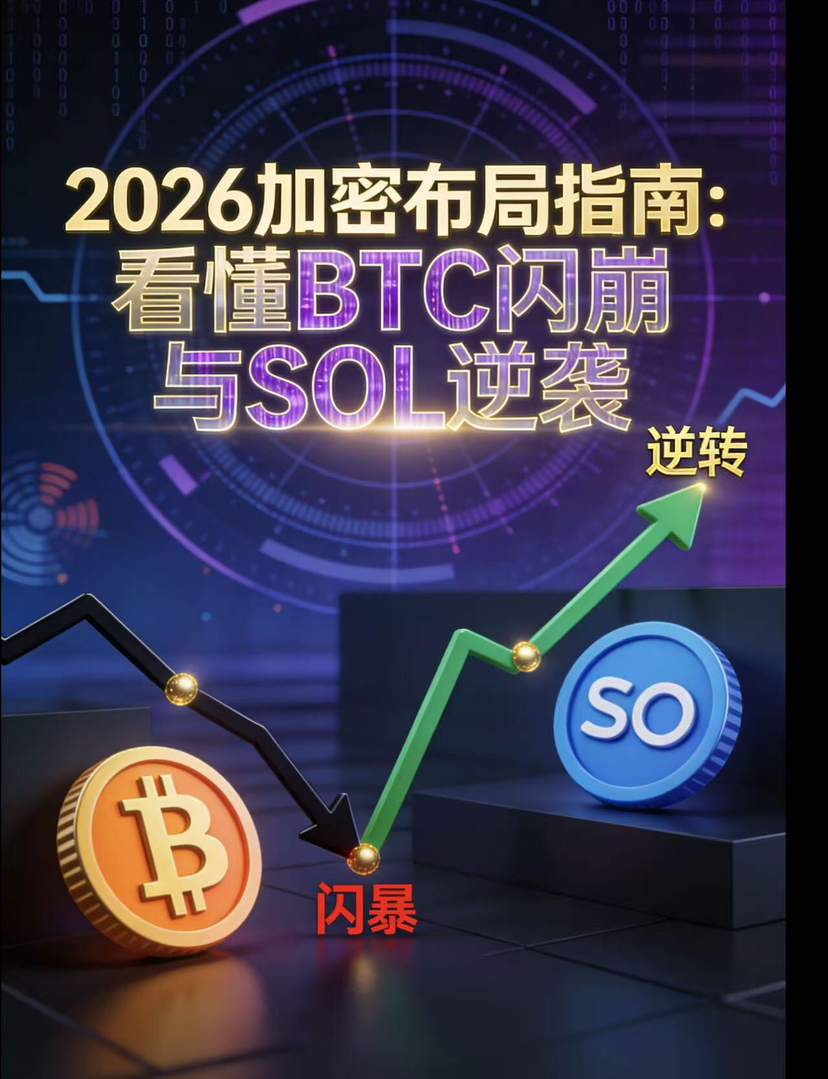
The cryptocurrency market at the end of 2025 can be described as a dramatic scene of 'ice and fire'. On one side, Bitcoin's sudden flash crash triggered a massive liquidation of billions, while on the other side, Solana's key upgrade led to a booming ecosystem; institutional giants are busy 'tax harvesting' by selling off while quietly accumulating through ETFs. Behind this year-end market movement lies the core logic of cryptocurrency investment in 2026.#BTC #加密市场观察
The BTC flash crash is not the end of the world, but rather an 'allocation window' for institutions.
The Bitcoin flash crash on December 26 caused $136 million in funds to evaporate instantly, catching both long and short investors off guard. Many believed the bull market had completely extinguished, but overlooked the key seasonal factor of 'year-end tax loss harvesting'—investors sell underperforming crypto assets to offset gains from other assets, thereby reducing their tax burden. This operation was amplified in the low liquidity market at year-end, leading to short-term price fluctuations.
The real signal lies in institutional actions: the world's largest asset management company BlackRock holds over 660,000 BTC through the Bitcoin ETF, accounting for more than 3% of the total supply, equivalent to an exposure of $72.4 billion. In the eyes of institutions, Bitcoin is no longer a speculative tool, but a 'hard asset' like gold. Meanwhile, the gold token XAUT has soared alongside gold prices, reaching a historic high of $4,425, with a total market cap exceeding $4.38 billion, becoming a new favorite for safe-haven funds. This means that even with extreme fluctuations in the crypto market, capital is still seeking a 'safe harbor.'
SOL's rise relies not only on popularity but also on technological breakthroughs.
Solana, once criticized for network outages and node centralization, made a complete turnaround by the end of 2025. After the core Alpenglow upgrade, the performance of SOL achieved a qualitative leap: TPS stably surpassed 15,000 transactions, potentially reaching 20,000 in extreme cases, double that before the upgrade; Layer 2 expansion significantly reduced transaction fees by 60%, with the cost of small transfers being less than $0.01.
More importantly, SOL has solved the most headache-inducing decentralization problem—node thresholds have been reduced by 40%, with the number of full nodes increasing from over 1,800 to over 2,500, and the distribution range expanding from Europe and America to Southeast Asia and Africa. The ecology has also exploded, with chain games and meme coins continuing to thrive, attracting traditional financial teams to settle in and launch institutional-level DeFi applications, with monthly trading volume exceeding $1 billion. Now, SOL has transformed from a 'toy for young people' into a powerhouse contributing to 53% of global on-chain fee economic activities.
However, it is important to be cautious, as SOL's historical risk of outages has not been completely eliminated, and the risk remains higher than ETH. For ordinary investors, high elasticity means high volatility, and risk control must be done before heavy investment.
The two keywords for crypto investment in 2026: regulatory implementation and ecological differentiation.
The regulatory and institutional trends by the end of the year have set the tone for the 2026 market. Pro-crypto Michael Selig has been appointed CFTC Chairman, and the White House has indicated that legislation on crypto market structure will be implemented in January, signaling the industry's farewell to 'wild growth' and the arrival of clear regulatory boundaries. Institutional actions are even more aggressive: the total amount of crypto mergers and acquisitions in 2025 reached $86 billion, and Coinbase spent $2.9 billion to acquire Deribit; 11 crypto companies raised $14.6 billion through IPOs, with traditional capital accelerating its influx.
In the face of such a market, how should investors position themselves? Conservatives can anchor on BTC and ETH, relying on institutional holdings and ecological maturity to mitigate risks; aggressive investors can take small positions in SOL, betting on its technological upgrades and ecological dividends, but must set strict stop-loss lines.
Ultimately, the crypto market in 2026 is no longer an era where 'buying with closed eyes guarantees a rise,' but a critical year that tests investors' ability to discern 'true value' from 'false popularity.'
Finally, I want to ask everyone: do you think the biggest dark horse in the crypto market in 2026 will be SOL? Can BTC break through the $100,000 mark? Feel free to share your thoughts in the comments!$SOL