
Bitcoin when it was first launched (2009–2010)
At that time, the value of BTC was almost zero.
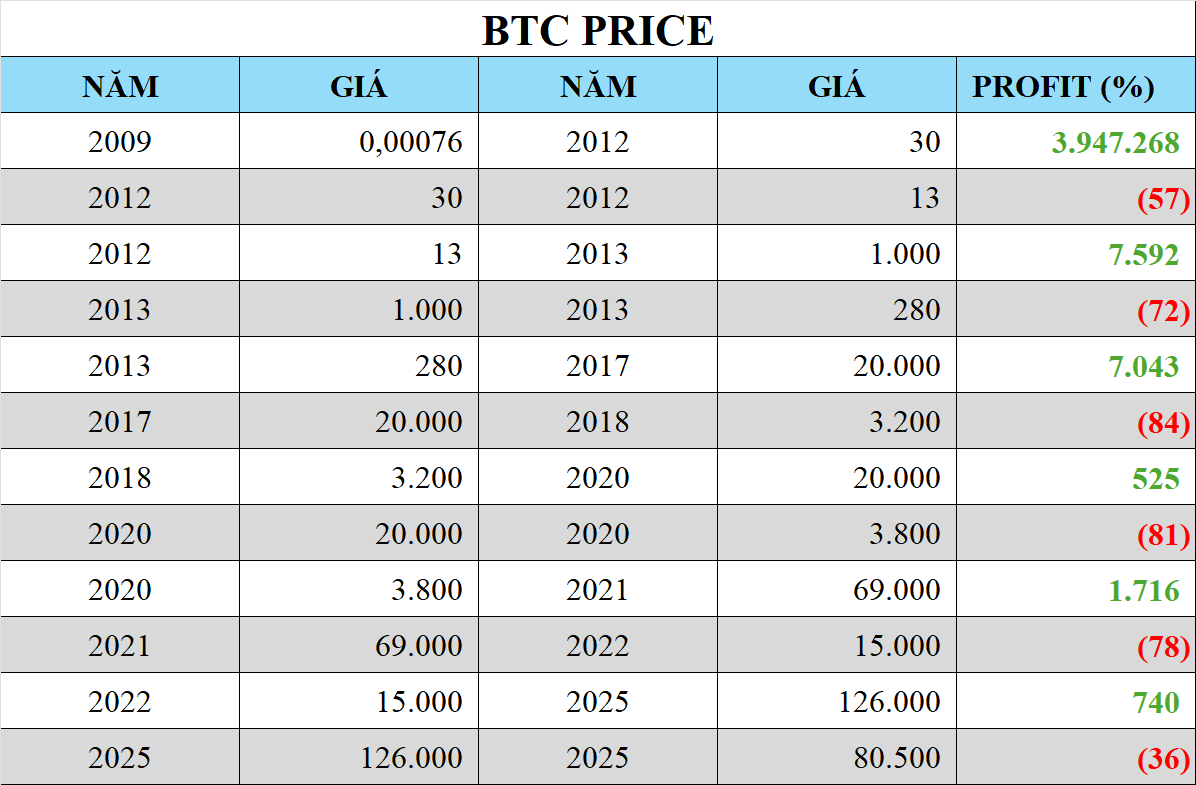
The first official BTC transaction was priced at approximately $0.00076/BTC. A significant event.
The most notable event was a transaction involving 10,000 BTC exchanged for two pizzas in 2019.
2010 – this day has become a frequently mentioned anniversary in the Bitcoin community – Bitcoin Pizza Day.
2. First growth cycle: 2011–2013
2011BTC surpasses a few USD, reaching
The year-end saw a significant increase thanks to increased investment.
2012: BTC reached its all-time high of $30/BTC. It then returned to a lower level.
The price was around $13/BTC – if you look at the current price drop, you can see that BTC has lost value.
more than half its value.
2013:BTC marked a phenomenal growth spurt amidst a series of controversies.
regarding its true value. At the same time, there has been a surge in illegal activities using it.
The fact that BTC was allowed to operate has led to it being labeled as a Bitcoin scam.
Despite the endless controversies and doubts from investors, BTC still remains.
Reaching levels above $1000/BTC and 👉 This is considered a cycle
The first bull market attracted global attention.
Similar to the previous cycle, after reaching its peak, BTC entered a bear market.
The price is trading at over $200-$300/BTC. Compared to its peak, BTC has split 5-6 times.
Many speculators have turned against and criticized BTC in
many years.
One of the biggest crises during this period was the large stock exchange.
Mount Gox, most notably due to hacking and poor management, serves as a wake-up call.
Risks in the fledgling cryptocurrency industry. Thousands of users lose all their BTC on exchanges.
Trading activity, severely shaken confidence, and Bitcoin's already declining price have continued to fall.
deeper.
However, at this point, Microsoft began to take an interest and accept payment via
BTC for its business activities, opening up a period of immense potential.
and noteworthy from the Organizing Committee.
Next growth cycle: 2015–2017
After a correction phase in late 2013–2014, Bitcoin began a new bull run from 2015.
2015 – 2016: This period laid a solid foundation for the Organizing Committee.
This cycle is being driven by increased attention to cryptocurrencies and the growth of exchanges.
Following the significant changes of 2013–2014, the next two years focused on stability.
Stabilization and preparation for the future. By 2015, the price of Bitcoin stabilized around $200–$600. This is often referred to as the "teenage period" of Bitcoin, when the hype had subsided.
But technological advancements continued quietly.
2015 marked the emergence of Ethereum – a new blockchain platform that introduced smart contracts. The appearance of Ethereum in mid-2015, along with its native currency Ether (ETH), demonstrated that blockchain technology could expand its applications beyond Bitcoin. This also sparked a wave of ICO fundraising, as startups began issuing new tokens on these blockchains.
For Bitcoin, 2016 brought renewed optimism. In July 2016, Bitcoin underwent its second halving, reducing the block reward from 25 BTC to 12.5 BTC. Awareness of these
The halving cycle became increasingly clear, and many believed that the reduced supply would continue to support prices (as happened after the first halving – the idea of making money during the halving season originated from this). In the second half of 2016, the price of Bitcoin rose again, surpassing the $1,000 mark by the end of the year.
year – the first time since the 2013 peak.
2017 – The Great Rise of Bitcoin: 2017 was a milestone that helped Bitcoin and the entire industry.
Crypto is booming with the mainstream public.
Bitcoin started the year at $1,000 and ended it at nearly $20,000 – a 20-fold increase in just one year. This craze stemmed from: media coverage, increased accessibility (more exchanges and brokerage services), and the FOMO effect of seeing previous investors get rich quickly. The ICO craze exploded, with thousands of projects launched on Ethereum or other blockchains. Bitcoin's dominance was at times diminished as coins like Ether and Litecoin also surged.
This period also saw significant technical debate surrounding network scaling. In August 2017, disagreements between development teams led to the creation of a major fork.
This led to the creation of Bitcoin Cash (BCH) – a new coin with a larger block size, allowing for the processing of more transactions. This is the most famous fork of Bitcoin, yet it did not affect the value of the original Bitcoin.
Early 2018 – Crash After Peak: Immediately after its peak in late 2017, the price of Bitcoin plummeted.
Very quickly. In Q1 2018, the crypto bubble burst: Bitcoin fell from nearly $20,000 to $6,000 in just February and hit a low of around $3,200 in December. Many small investors suffered heavy losses. Hundreds of small projects, especially ICOs, lost all their value.
or go bankrupt.
2018 became a year of "purification" for the market. On the policy side, governments, after a reactive 2017, began discussing stricter regulations on cryptocurrencies.
BTC has also split six times from its peak. And of course, other coins have suffered the same fate.
4. The 2020–2021 cycle: Bitcoin becomes a major digital asset.
2020–2021 – New Highs & Institutional Investor Involvement: Bitcoin entered a new phase from 2020–2021, impacted by the COVID-19 pandemic, which caused economic instability and massive financial stimulus packages. As global markets panicked, the price...
Bitcoin plummeted from around $8,000 to $3,800 in March 2020, but then a large influx of money followed, with the view that Bitcoin was a safe haven from inflation.
At this point, the price of BTC has once again split by six since its most recent peak.
2021:
BTC reached its historical peak around68.000–69.000 USD
👉 This is a growth cycle with the participation of large investment funds and a strong attraction of global capital flows. The "digital gold" model is gaining increasing attention, reflecting its role as a long-term store of value.Bitcoin.
A number of major financial powers and large investment funds have begun long-term accumulation plans and are aggressively participating in the market. One example is the Salvadoran government's purchase of BTC for accumulation, with investment funds also getting involved.
In mid-2023, BlackRock – the world's largest fund – filed for licensing.
Permission granted for spot Bitcoin ETFs in the US.
However, in November 2022, a price crisis occurred. BTC dropped.
It's still at $15,000/BTC.
Compared to its previous peak, BTC has also lost 80% of its value.
5. 2024–2025 Cycle: New ATH
2024–2025: Bitcoin continues
It reached a new, higher peak — surpassing $100,000 and recording an all-time high (ATH) above $126,000.
USD in 2025.
After reaching its peak, BTC undergoes corrections, with the lowest price following...
It peaked at $80,500. Investors' assets in BTC at this point evaporated by more than 30%.
However, investors remain optimistic that BTC will continue to thrive.
A bull run and setting new highs in the new season. So, is this the start of a new growth cycle for BTC?
When will it take place? Let's discuss your ideas!