
A subtle revelation from Ripple's Chief Technology Officer, David Schwartz 👨💻, has ignited deep discussions in the community $XRP 🔥. What seemed like a technical clarification could redefine how Ripple manages its locked tokens and how institutions view the long-term value of XRP 📈. The message was clear: Ripple's custody system may be evolving into something much more sophisticated than anyone expected. 🤯
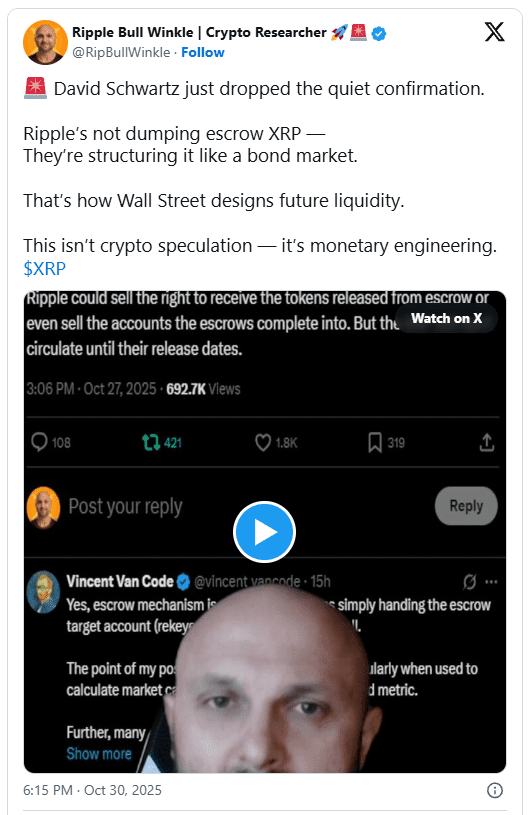
👉The Silent Confirmation That Changed Everything 🔄 In a recent clip shared by Ripple Bull Winkle 🐂, Schwartz confirmed that Ripple can sell or transfer rights over future XRP locked in custody. However, he emphasized that those tokens cannot circulate until their scheduled release dates. 🗓️ This single statement changed the entire narrative surrounding Ripple's escrow. It made it clear that Ripple's approach involves structuring rights to future tokens, similar to financial instruments, rather than selling existing $XRP like typical crypto sales. ❌
👉From Crypto Sales to Engineered Liquidity 🧠 Ripple Bull Winkle succinctly explained this transformation, saying: “That’s not called dumping. It’s called engineered liquidity.” 💡 His comments suggest that Ripple's escrow could help create structured liquidity without flooding the market with immediate supply. 💧 By designing contracts linked to future releases, Ripple could allow institutions to buy predictable exposure to future liquidity, without increasing the $XRP in circulation today. 🏦 This reflects how bond markets operate 📊, where value is traded based on expected payments rather than current cash.
👉Building a Digital Bond Market 🌉 According to Bull Winkle, “Ripple is literally designing a new digital bond market when XRP becomes the settlement asset for institutional-grade money.” 👑 This comparison is not far-fetched. Bonds and other debt instruments rely on scheduled liquidity, and Ripple's escrow system already embodies that principle by releasing $XRP monthly over time. ⏳ If Ripple packages these rights into a regulatory framework, institutional investors could treat contracts related to $XRP as digital securities: a monetary architecture that merges blockchain technology with traditional finance. 🤝
👉The Monetary Architecture of the Future 🏗️ Bull Winkle added: “This is not a crypto exaggeration, this is a real-time monetary architecture.” 🏛️ That statement captures the magnitude of what Ripple could be designing. Instead of a company dumping tokens, Ripple could be designing a liquidity framework that reflects global debt markets, with XRP as the central settlement asset. 🎯 By structuring escrow rights as tradable instruments, Ripple effectively transforms its token management strategy into a liquidity system modeled on Wall Street principles. 🗽 The result could be a seamless bridge between crypto assets and institutional capital flows. ✨
👉The Bigger Picture 🔭 Schwartz's comments, amplified by Bull Winkle's interpretation, offer a glimpse into Ripple's long-term financial vision. The company seems focused not on speculation, but on designing systemic liquidity for the future financial order. 🌐 If Ripple's escrow rights evolve into structured digital instruments, $XRP it will not only be a cryptocurrency: it could serve as the foundation for a programmable ecosystem similar to bonds. 💎 In Bull Winkle's words, “Schwartz not only confirmed his strategy: he confirmed the real blueprint of how $XRP becomes part of the global system.” 🗺️ Ripple's quiet confirmation could, over time, prove to be the most powerful statement in the evolution of digital finance. 📝
#xrp #Ripple #davidschwartz #BonosDigitales
➡️ Follow Alezito50x for market alerts and strategy analysis. 🧠