
16/10/2025 Plume Article #58
PLUME is making RWA assets efficient, trusted, and scalable through its marketplace and relayer ecosystem, making it easier to trust blockchain infrastructure.
PLUME is creating a new benchmark for marketplace and relayer ecosystem RWA (Real World Asset) trading. Its goal is to create markets where tokenizing, trading, and validating real assets is as seamless as on any centralized system.
This backbone is supported by three pillars -
Trust and Quality Control, User Experience, and Scalability and Infrastructure Credibility.
If all three become strong, the PLUME marketplace can become the growth engine of any RWA-focused chain.
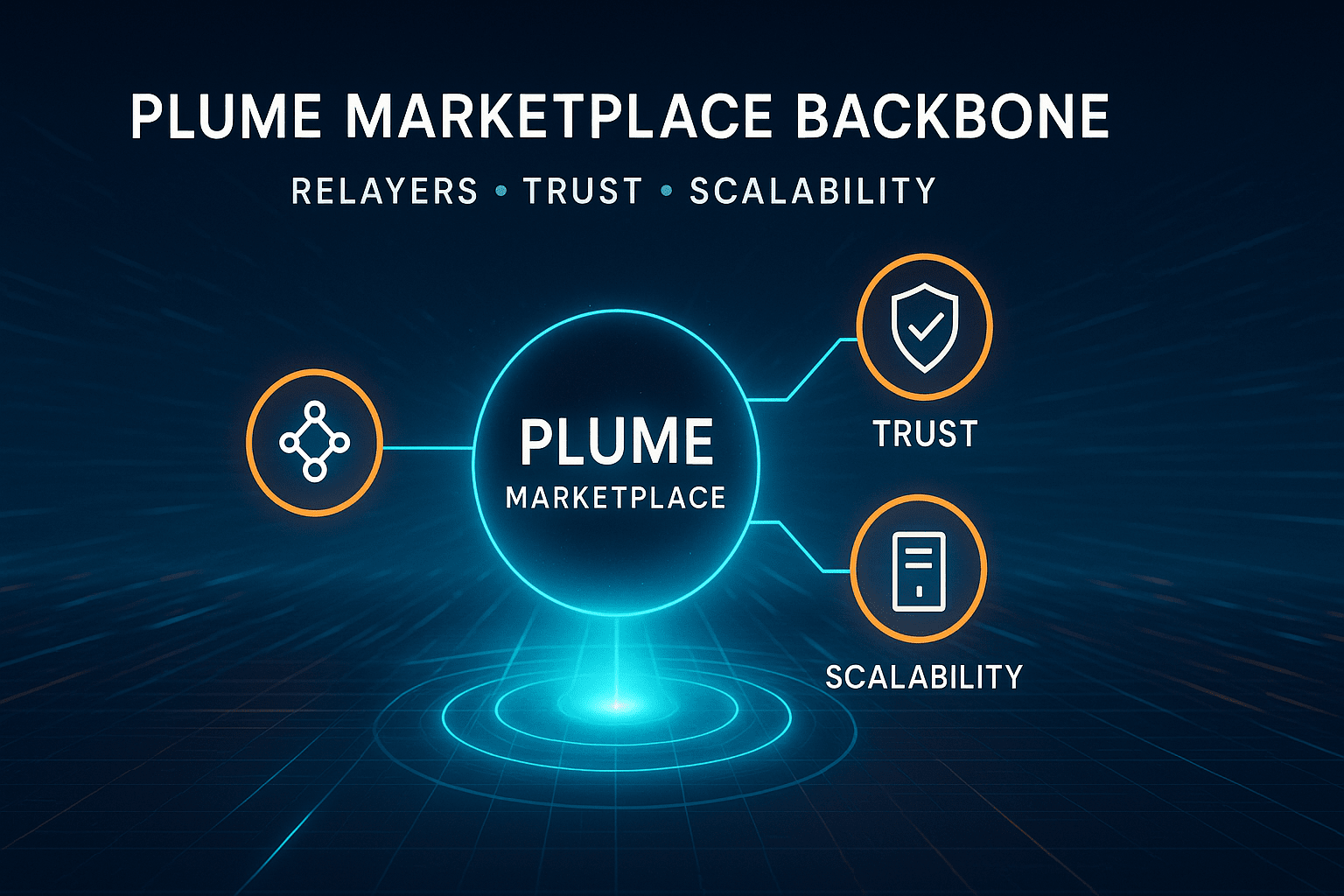
Marketplace Architecture: Modular Design, Trusted Flow
PLUME's modular architecture has the marketplace layer as a hub where asset issuers, relayers, and users connect.
It operates on modules like Arc, Passport, and Nexus that keep compliance, transaction, and data handling smooth.
Relayers act as intermediaries in this ecosystem - they check the quality of assets, perform off-chain validation, and relay trades on-chain.
The UX layer of the marketplace interacts with both relayers and chain nodes to provide users with a seamless experience.
To maintain trust, relayers must undergo staking and reputation checks. Audit logs and slashing rules prevent misconduct.
This model balances both scalability and reliability.
Relayers: The Secret Engine of Scalability
Relayers act like traffic managers for the blockchain. They handle tasks like matching, aggregation, indexing, and fee routing off-chain to reduce chain congestion.
But the real debate is - how decentralized or trusted should relayers be?
If they become too centralized, the risk of censorship or collusion increases.
If they become completely trustless, spam and low-quality listings may increase.
PLUME's model walks a middle path - the relayer reputation system, transparent logs, and failover backups are all maintained.
Some relayers will provide liquidity, some will specialize in specific asset classes, and some will handle regional compliance.
Benchmark metrics like latency, response time, failure rate, and order propagation consistency are leading towards providing enterprise-level reliability.
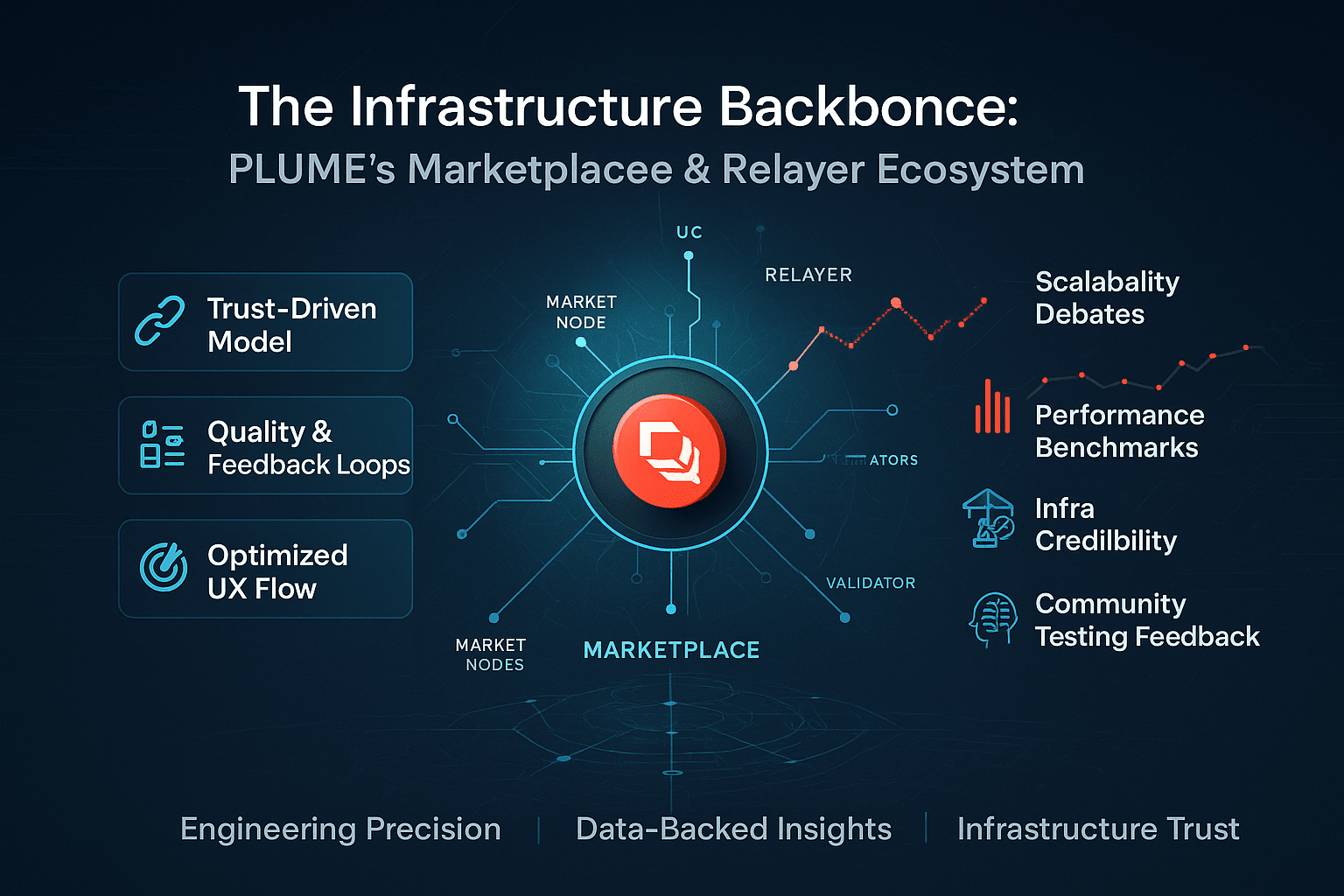
Community Feedback and Performance Insights
PLUME's architecture is divided into four layers - execution, settlement, data, and compliance. Marketplace and relayer operations operate between the execution and data layers.
The recent Nightfall L3 privacy integration has provided enterprises with private trade support, causing relayer design to evolve as some trade information is now selectively masked.
Community reactions show clear excitement:
"PLUME’s modular infrastructure gives relayers the freedom to innovate."
"Relayer latency defines UX - hope PLUME optimizes it well."
Performance benchmarks are still in the early phase, but PLUME's active presence on the deBridge interoperability layer indicates that its bridging and message-passing infrastructure is already strong.
Additionally, the SkLink integration is also linked to cross-chain yield streaming and message bridging capabilities - making the relayer architecture multi-chain.
Why It Matters (Trader, Investor, and Builder POV)
Traders / Users:
Marketplace UX, listing quality, price discovery - all these depend on relayer design. If PLUME solves latency and reliability, it can become the next-gen RWA DEX.
Investors:
A robust relayer ecosystem attracts trusted marketplace liquidity inflow. When assets are easily tradable, adoption naturally increases.
Builders / Relayers:
Developers are presented with new opportunities - such as creating custom relayers for art collectibles, healthcare, or carbon credits that incorporate compliance and analytics modules.
In short, relayers and the marketplace together are making PLUME not just an RWA chain, but a usable real asset marketplace.
Future Outlook and Use-Cases
In the coming months, the relayer ecosystem of $PLUME can expand into several verticals:
Custom Relayers:Specialized relayers for sectors like art, healthcare, carbon credits, and private equity.
Layer-2 Matching Relayers: Off-chain order matching to reduce on-chain gas costs.
Cross-Chain Relay Networks: Relayers that connect order books across different chains.
Governance Oversight: DAO model in which relayer rotation and reputation votes are determined.
Performance Optimization: Parallel relayers, fallback caching, and low-latency infrastructure.
The prediction is that in the next 12 to 18 months, PLUME will launch relayers that are sector-specialized - and their competition will focus on speed, compliance integration, and reliability.
Risks and Balanced Verdict
Potential risks:
Malicious or spammy relayers can harm marketplace trust.
Latency or reliability issues can drive traders away.
Over-centralization can undermine the principles of decentralization.
Regulatory scrutiny may increase if relayers are considered intermediaries for real assets.
Verdict:
The PLUME marketplace and relayer ecosystem are its true backbone.
If the right balance is maintained between decentralization, reputation, and performance, this infrastructure will become its moat.
Proof will only come when the relayer network scales and performance benchmarks are sustained.
Conclusion
PLUME's marketplace and relayer architecture is the next evolution of blockchain infrastructure. It is proving that RWA tokenization is not just a concept, but can become a liquid and trusted marketplace.
Do you think relayers will be able to maintain the right balance between decentralization and performance? Share your thoughts in the comments.
Stay tuned with IncomeCrypto for more information about this project.

@Plume - RWA Chain #Rwa #Web3 #PLUMEtoken #Plume #RelayerNetwork $PLUME