
I've been looking at this for the past two days$SIGN and it feels quite awkward: on the chart, it's just an ordinary K-line, with the price hovering around 0.03 USD (the range I saw on 3/31 was about 0.0317–0.0327), and its market cap is only over fifty million dollars, with a 24-hour volume in the range of twenty to thirty million dollars, it’s not too hot to explode, nor too cold to be dead. But the more I look, the more I feel that many people in the market are discussing it in the wrong direction—treating it as a story of 'who will take over the rally,' instead of recognizing its truly dangerous and potentially valuable aspects: it is more like an infrastructure that 'makes evidence verifiable and transferable across systems,' and once this thing is tied to real-world identities, compliance, capital flows, and cross-border friction, it cannot be explained simply by emotions.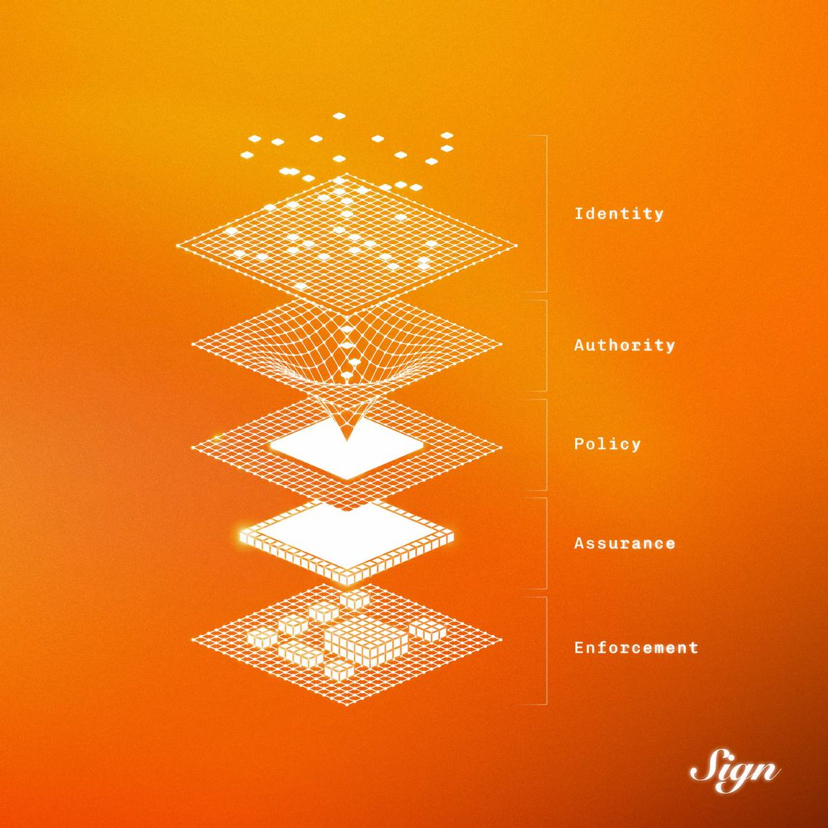
First, let's put the most glaring reality on the table: the information environment has decayed to a point where—truth and falsehood are hard to distinguish, the cost of forgery is getting lower, especially with AI-generated content making the task of "proving who you are and what you've done" increasingly feel like a joke. You will find that the more tense the geopolitical situation, the more frequent the sanctions/regulations, and the more sensitive the cross-border business, the greater the need for a verification method that "does not rely on a single platform's endorsement." The main line of Sign Protocol is actually stuck here: it develops the underlying protocol for attestations (proofs/endorsements), making "a certain subject's signed declaration of a certain fact" into a verifiable, chain-agnostic primitive, rather than locking it into a specific chain or application. In simple terms: it doesn't want you to believe that "a certain website says you passed," but rather wants the fact that "you passed" itself to become evidence that can be verified by multiple parties and transported across systems.
This leads to what I think is the most crucial and also the most "geopolitical infrastructure" point: many countries/regions fear two things when working on digital identity, regulating stablecoins, and digital capital markets—first, that data and certification systems are held hostage by external platforms; second, that a change in political direction/regulatory stance will render the original system either void or a hot potato. In Sign's official narrative, it directly positions itself as a component of "sovereignty-level digital infrastructure," stating plainly: for national-level currency, identity, and capital systems, it provides a shared evidence layer. Regardless of whether you like the term "sovereignty-level," it at least indicates one fact: what they want to build is not a DeFi toy, but an infrastructure that will be repeatedly tossed around by compliance, politics, and cross-border friction—this sector has a lot of money, long cycles, and hard risks.
But why do I say, "Danger can also be valuable"? Because once this kind of thing truly enters the real world, its opponents are not other projects but the existing certification systems of various countries, various compliance modules, and the power structure of "who will be the final arbiter." If you look at the recent discussions around the Middle East, sovereignty, and information warfare in Binance Square, they basically emphasize: the more turbulent geopolitics become, the more people want to break away from single-point dependencies and use verifiable evidence for cross-organizational collaboration. This sounds grand, but when it comes to execution, it becomes very specific: Who is the issuer? How is the legitimacy of the issuer updated? How is the revocation mechanism handled? When the "originally legitimate person" becomes illegitimate in a new political context, are historical attestations preserved, invalidated, or patched? These are not technical details; they are points of real conflict.
I use a rough but quite effective judgment method: if a protocol is merely about "making on-chain more fun," its risks mostly come from the market; but if it attempts to "make the real world more verifiable," its risks arise from real-world conflicts and power boundaries. Sign belongs to the latter. You see one point that is repeatedly mentioned: treating attestations as chain-agnostic evidence primitives, and then the upper layer can enable programmable distribution, such as TokenTable, which is a closed loop "triggering financial actions based on proofs." This is very sensitive: once funding releases are tied to evidence, any evidence dispute will directly become an economic dispute. Don't mention cross-border issues; even inconsistent statements from different departments within the same country can stir up the system.
Back to the market, today (3/31), I saw several numbers that are quite "educational": the price is around 0.032, with a 7-day drop of nearly -39%, indicating heavy short-term speculation and fragile sentiment. Under such a trend, if you only focus on "narrative heat," it's easy to get whipsawed. More importantly, a project of SIGN's size cannot escape an old problem: unlocking and supply. The Tokenomist page shows that its unlocking will continue until 2030, with the next unlocking window pointing to 2026/04/28, and the release object mentions Backers. I don't want to scare anyone here, but the matter of "incremental supply with a definite date" will inherently make funds more cautious: either they digest it in advance, or they wait to scoop it up after the drop. You might want to trade short-term, but at least you need to know what you're betting against—not against "whether the project works" but against "whether the market can absorb it when the unlocking occurs."
So how do I view SIGN's "real progress" instead of emotions? I am currently more concerned with three types of signals, and I will admit that these three types of signals are uncomfortable because they won't give you instant gratification every day. The first type is "who is using it as an evidence layer," especially related to identity, compliance, and public systems; such news is often not dense, but when it appears, it carries more weight than ten KOLs shouting. The second type is "whether the protocol layer is being treated as a public standard," such as discussions about chain-agnostic attestations serving as a more universal verification interface—once established, this will create network effects. The third type is "resilience under political context": if a deployment encounters policy changes, can it migrate smoothly and isolate layers, or does the entire proof system collapse? This type of content is rarely discussed by retail investors, but it precisely determines whether it is "geopolitical infrastructure" rather than just a "marketing slogan."
I know some people will say: you talk so much, what does it have to do with my trading? The relation lies in—when a project's value anchor shifts from "application data" to "trust structures in the real world," the market will price it in a completely different manner. You will see it suddenly being speculated during certain periods because a regulatory/cross-border friction/information security event in a region brings "verifiable evidence" to the forefront; you will also see it suddenly being crushed when everyone realizes that "this thing has a long landing cycle and uncontrollable political risks." This is not the rhythm of purely technical projects where "upgrades lead to price increases"; it resembles a long-term contract: the odds may be high, but the terms are stringent, and they can be rewritten by reality at any time.
By the way, let me complain: many people see "sovereignty-level" as a positive, but it can also be a negative. The positive lies in the high ceiling; the negative is that once you get involved with sovereignty, compliance, and identity, it means voluntarily putting yourself into the slow lane, subject to various audits, integrations, gray areas, and political uncertainties. If you want explosive points every day, you might be disappointed; but if you can tolerate it growing slowly like infrastructure, you might find it easier to see its differentiation.
Let me share a small observation: many so-called "on-chain identities," "anti-witch hunts," and "reputation systems" mostly remain in a self-congratulatory bubble; they don't work well outside that circle. Sign defines itself as a "shared evidence layer," and I understand that it aims to solve the problem of "verifiable evidence across systems" rather than "creating another points system within the circle." The difference between these two is significant: if the former succeeds, it can access a much larger market; if the latter succeeds, it typically only thrives within its own circle.
But I won't gild the lily here; rather, I think there are two points where cold water should be thrown. The first is the root issue of "issuer trust": no matter how beautiful the attestation is, it ultimately requires someone to sign. Who is signing, on what basis, how to hold them accountable for erroneous signatures, and how to update legitimacy when the political wind changes—if these issues are not resolved, no matter how strong the protocol layer is, it can only serve as a toolbox. The second is the "supply and liquidity structure": you see that the current volume isn't small, but it's not large enough to ignore the unlocking window; if the unlocking on 4/28 is viewed as a pressure test by the market, price fluctuations will be faster and fiercer than technical progress.
So my own "life-saving conclusion" is simple: if you only consider SIGN as a short-term topic, then focus on two things—whether the volume is sustained and how the market prices the unlocking window; if you see it as a long-term observation in the direction of "geopolitical infrastructure," then focus on three things—appearance of real users, whether the evidence layer is treated as a more universal standard, and the system's migratability under policy/political uncertainties. It could be a target that rewards those who can endure, or it could be a typical example of "a big story but hard reality." Anyway, I won't label it with emotions; I prefer to view it as a pipeline attempting to traverse the real world: if the pipeline can be built, value will grow naturally; if it cannot be built, no matter how much price volatility there is, it will just be noise.
@SignOfficial SIGN #Sign地缘政治基建